
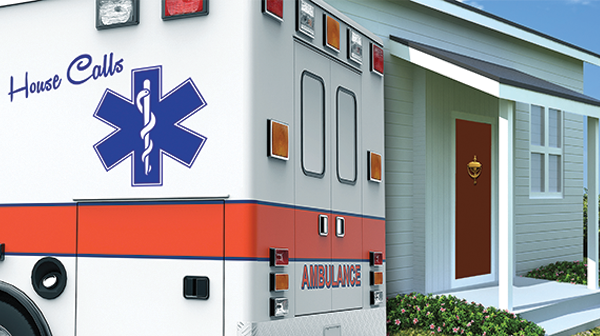
Community paramedicine (CP) supporters argue that diverting 911 patients from the emergency department decreases costs, ambulance wall time (the inability to offload patients in the ED), and ED crowding while providing more appropriate care. Unfortunately, data do not support these assertions. Prehospital diversion of 911 callers threatens patient safety, undermines the prudent layperson definition of an emergency, and erodes Emergency Medical Treatment & Active Labor Act (EMTALA) protections.
Explore This Issue
ACEP Now: Vol 34 – No 06 – June 2015CP Diversion Poses Danger to Patients
Over the past 40 to 50 years, the United States has trained people to call 911 for  perceived medical emergencies, EMTALA was enacted, and ACEP fought to establish the prudent layperson definition. Once requested via 911, an ambulance is dispatched to provide needed prehospital stabilization and transport the patient to an ED. The ED identifies emergency medical conditions and provides stabilizing care without regard for ability to pay. CP programs risk changing that paradigm. If the paramedic determines the patient to be nonurgent, then the paramedic decides, perhaps partially based on payer class, where to transport the patient or perhaps even refuses to transport. We will switch from a prudent layperson to a prudent paramedic definition of an emergency.
There are no validated protocols demonstrating that paramedics have the training, experience, and ability to determine which conditions are nonurgent and, of those nonurgent conditions, which can be safely and efficiently cared for in alternative settings. A 2014 review found that “nearly all of the studies published to date have found significant rates of under-triage by EMS personnel, ranging from a low of 3 percent to a high of 32 percent.”1 The authors opine, “If it is difficult for experienced emergency nurses to accurately identify nonurgent patients, is it reasonable to ask whether paramedics working in the field can do better?”

© SHUTTERSTOCK.COM
As part of the paramedic assessment done in an austere, prehospital environment, some CP programs require a wallet biopsy to determine if the patient has the correct health coverage. The paramedics then decide if the proposed destination has the capability and willingness to care for the patient’s presumed condition. If the patient has the wrong funding or the destination cannot provide the needed care, what will happen? Will 911 be accessed again? Will the patient receive a bill for the clinic visit and the subsequent ED visit? Or because EMTALA only applies in hospital settings, will the patient not receive needed care?
The premise that paramedics can safely and quickly determine who has an urgent medical problem discounts emergency physician expertise. Perhaps the most important service emergency physicians provide is the diagnostic acumen to rapidly determine which patient has an emergency. Do we really think that a paramedic with 10.5 additional hours of training (as under the Orange County, California, plan) can safely ascertain if an emergency exists, even for specified complaints?2 What about identifying significant hemarthrosis in a patient with seemingly minor extremity trauma who happens to have a coagulopathy? What about an apparent viral illness in an immunocompromised patient? The toothache that is a myocardial infarction? Emergency physicians complete medical school and a three- to four-year residency to master the crucial skill of considering and ruling out the worst case. If paramedics can safely identify these unusual but not infrequent problems in the field, then what is the value of an emergency medicine residency?
What about identifying significant hemarthrosis in a patient with seemingly minor extremity trauma who happens to have a coagulopathy? What about an apparent viral illness in an immunocompromised patient? The toothache that is a myocardial infarction? Emergency physicians complete medical school and a three- to four-year residency to master the crucial skill of considering and ruling out the worst case.
Paramedicine Won’t Solve ED Crowding or Cost Problems
The purported benefits of CP diversion programs are highly questionable. Although ambulance wall time is a worsening problem, it is unlikely that low-acuity patients contribute to this. Most EDs care for less-urgent patients in an efficient fast track. During busy times, ambulatory patients are triaged and moved to a waiting area, freeing the ambulance to return to service. Typically, only patients unable to ambulate or sit remain on a gurney. It is doubtful that many of these sicker patients can be safely diverted to alternative destinations.
Diverting 911 patients will not mitigate ED crowding; ED crowding is due to boarding. As emergency physicians know, the major contribution to ED boarding is the inability to disposition patients after the ED evaluation is complete. For admitted patients, it is because of bed availability. For discharged patients, delays in disposition are often due to insufficient follow-up resources. For these patients, CP programs will not improve the system; patients cannot be transported to other locations if an alternative destination does not exist or does not have the capability and willingness to evaluate and treat them. Simply changing the destination does not improve access to care; rather, it limits timely access to needed emergency care.
Lastly, when comparing the cost of care between EDs and clinics, the comparison must be apples to apples. ED costs generally are bundled per visit (facility, doctor, lab, radiology), but clinic costs usually do not include ancillary testing or consultations, nor do cost-saving estimates include the cost of the CP service or the second visit for those patients referred from alternative destinations to the ED.
Recognizing the patient risks of CP programs, the ACEP Board of Directors wisely included this final bullet in the October 2014 ACEP CP policy:
“Assurances that if a person calls 911 (or similar emergency number) for a patient’s apparent emergency medical condition or medical emergency and requests an ambulance, the patient has a right to a medical screening examination and stabilizing treatment by a qualified medical person in accordance with EMTALA. For the purposes of an EMTALA-mandated medical screening exam, paramedics and community paramedics are not believed to be qualified medical persons.”3
 Dr. Sugarman is chairman of emergency services at Sutter Delta Medical Center in Antioch, California.
References
- Morganti KC, Alpert A, Margolis G, et al. Should payment policy be changed to allow a wider range of EMS transport options? Ann Emerg Med. 2014;63:615-626.
- Office of Statewide Health Planning & Development, Community Paramedicine Pilot Project, HWPP #173, Addendum #1. Revised June 6, 2014. Accessed April 23, 2015.
- ACEP Clinical Policy. Medical direction of mobile integrated healthcare and community paramedicine programs. Accessed April 23, 2015.
Pages: 1 2 3 | Multi-Page



One Response to “Opinion: Paramedicine Diversion Programs Pose Patient–Safety Risks”
June 28, 2015
David Persse, MD FACEPTom,
Great to see you in print! I liked your article, and I agree with much of what you said. I also liked Melissa Costello’s counterpoint, and in fact think you are both correct. “Community Paramedicine” is a poorly defined term in my opinion. Its implementation is as varied as the imagination. As it turns out, here in Houston my system has recently (Dec 2014) launched a hybrid version we call Emergency TeleHealth And Navigation (aka ETHAN) for an emergency physician based EMS diversion program. Google “ETHAN EMS Houston” if you are interested. To date we have triaged over 1300 patients with 80% not being transported by ambulance to hospital. About 40% go by cab to a hospital, but the rest are mostly referred to a project member local clinic or given home health instruction.
Anyway, good to read your thoughts.
An old friend,
Dave