
The town of Paradise, California, burned to the ground on Nov. 8, 2018, in the Camp Fire. It was the most destructive and deadly wildfire ever recorded in the history of California. The risk of fire has always been there. The state is always heading into, living through, or recovering from a drought. Brush fires occur at the end of every summer. Fire has always been a part of life in California. However, large destructive fires are no longer an anomaly. The fire season has evolved into something to be feared, as each new season is worse than the last.
The Camp Fire was well underway as I walked across the parking lot of Feather River Hospital to start my ED shift. Strong winds brought in the scent of smoke and fire. Reports said the gusts were up to 60 mph. That sounds about right. Retrospectively, I can say those were the signs of a destructive wildfire closing in on our hospital, but at the time, I was completely oblivious—and so was everyone else. It was business as usual. Patients were checking into the emergency department. The operating room was running cases. Hospitalists were making rounds. The cafeteria was still serving breakfast.
Evacuation

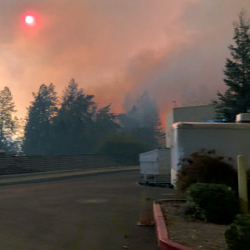
By 9:07 a.m., the sun was no longer visible
The fire started about five miles east of the hospital. It spread very fast. Within 90 minutes, embers were falling in the ambulance bay, and the order came through to evacuate. The day had barely started. There was only one intubated patient, and the rest were well enough for discharge.
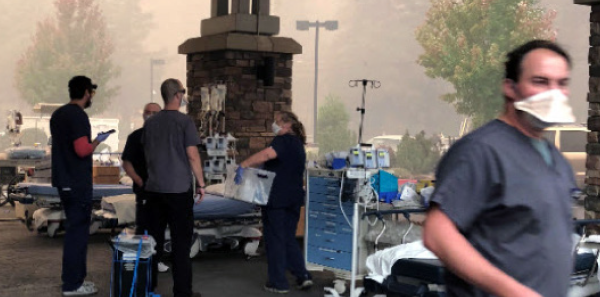
The ambulance bay was an egress point for the hospital. As staff emptied the hospital, a long line of gurneys snaked its way through the emergency department. There was no time to print off electronic health records. There were no paper charts like in days of old. All the patients had were their ID bracelets and personal effects. It would have been nice if their medical information was encoded into their ID bracelets, but we’re a long way off from that kind of technology.
There were about 60 patients and a limited number of ambulances. Critical care patients were evacuated first. When the last ambulance was gone, hospital personnel volunteered to transfer the remaining patients. They drove into the bay, and we loaded up their cars as fast as we could.
Smoke began to extinguish the sun’s light (see photos). It was obvious that the fire was getting close because the horizon was glowing. Surprisingly, there was no panic. There were no egos. People worked very well together. The hospital was empty in 45 minutes.
The only escape route was down a narrow two-lane road that was surrounded by fire. It led through miles of dried-up pines. Law enforcement directed us onto the road even though traffic was gridlocked. I learned after the fact that cars had collided with one another in the dense smoke. Burning trees had fallen across the road. Car engines had stalled from the lack of oxygen. Burning vehicles sat abandoned on the road.
The middle of a raging fire is not bright like a campfire. It’s black and red. Thick black smoke fills the air. The sun is gone. Visibility is no more than a few feet. The only source of light is a red glow from the surrounding fire. It’s a little piece of hell on Earth.
Reality sank in. Escape was impossible. Burning to death seemed to be an absolute certainty. The only unknowns were how bad it would hurt and how long it would take. They say there are no atheists in foxholes. I’d say that holds true in a raging fire.
I learned that there’s a certain peace that comes with accepting death as your fate. Ironically, in that moment, my thinking cleared and I remembered my daughter. I couldn’t leave her without a mother, so I returned to the hospital. The parking lot was made of asphalt and wouldn’t burn. For now, it was safe. My plan was to shelter in place and try to evacuate later.
Back at the Hospital
It wasn’t long before elderly couples arrived in their cars. None of them were acutely sick. They were simply there to wait out the fire. At that time, I had absolutely no idea that Cal Fire was out back trying to save the hospital; I didn’t know for hours.
Looking back, I wonder if the couples knew something I didn’t. Apparent wisdom aside, they were frail. They would need masks, food, and water. The emergency department had all three. So I loaded up a wheelchair and brought it from car to car.
Over time, people trickled in. I made periodic rounds of the parking lot to pass out supplies. On my third or fourth round, I was surprised to find a group of ED nurses sitting in an SUV. I thought they’d escaped. Their cars had caught fire as they made their way through a ravine a few miles down the road. They were forced to turn back on foot.
We set up a makeshift shelter in front of the hospital. Evacuation routes must have intermittently opened up. People stopped by for masks and water before moving on. Their cars showed signs of fire damage: ash, melted brake lights, and blistered paint.
Ambulances returned with critical care patients, and medical personnel returned with medical-surgical patients. Paramedics informed us about a woman in labor headed our way, followed by a patient with 40 percent burns. We expanded the shelter into an outdoor emergency department.
By this time, the back of the hospital was on fire, and the halls were filled with a pungent smoke. Even still, people raided the hospital to get supplies. They returned with gurneys, IV fluids, and crash carts. If it looked useful, people grabbed it. We were very well set up except for a lack of electricity. It looked a lot like a field hospital.
All the while, propane tanks exploded in the distance as the fire got closer. The wind constantly threatened to send the hospital up in flames. And there was the smoke. Always the smoke.
The fire threatened our position, so we moved to the helipad, another large piece of asphalt. Most of the surrounding fuel had burned earlier in the day, so it was relatively safe. We’d be OK if we had to spend the night.
By mid-afternoon, an evacuation route was open. It was surrounded by fire on both sides, but everyone got out.
Reflections
The city of Paradise set up a plan to evacuate its population in the event of a wildfire, but what it got was a hydrogen bomb. The evacuation plan was woefully inadequate. Roads were gridlocked. People were trapped, and some died. Catastrophes of this nature require reflection and an honest evaluation of what went wrong. No doubt, city officials have thought of this every single day since the fire.
Hospitals will continue to get caught in California’s large-scale fires. We learned the hard way that evacuation is not always possible. Plans to shelter in place need to be developed. It may not always be possible for hospital personnel to run into a burning building to gather supplies. Thus, emergency kits that are accessible and portable need to be created. The best-laid plans of mice and men often go awry, but we should prepare ourselves as best as possible.
 Dr. Peck is an emergency physician at Sutter Auburn Faith Hospital in North Auburn, California. During her military career, she practiced combat and disaster medicine in multiple austere environments.
Pages: 1 2 3 | Multi-Page



2 Responses to “Notes From Emergency Physician Working When the Camp Fire Threatened Hospital”
March 19, 2019
Marianne CannonAwful scene,and very challenging times, for you ……. and similar here in Australia during our worsening wildfire seasons.
I wonder if ACEP might take a role in advocating around the causes of worsening natural disasters , despite the root cause being made “political” by certain groups .
As a 25 year member I was delighted to see the gun vested interest groups being challenged by those of us who clean up after the shooters mess, and we are -after all – the experts in disaster and environmental medicine .
“Men argue and Nature Acts ” Voltaire (sign in San Francisco )
April 4, 2019
Abigail PolzinGreat article. Thank you for sharing. Thank you for your dedication to your patients and community too.