
Explore This Issue
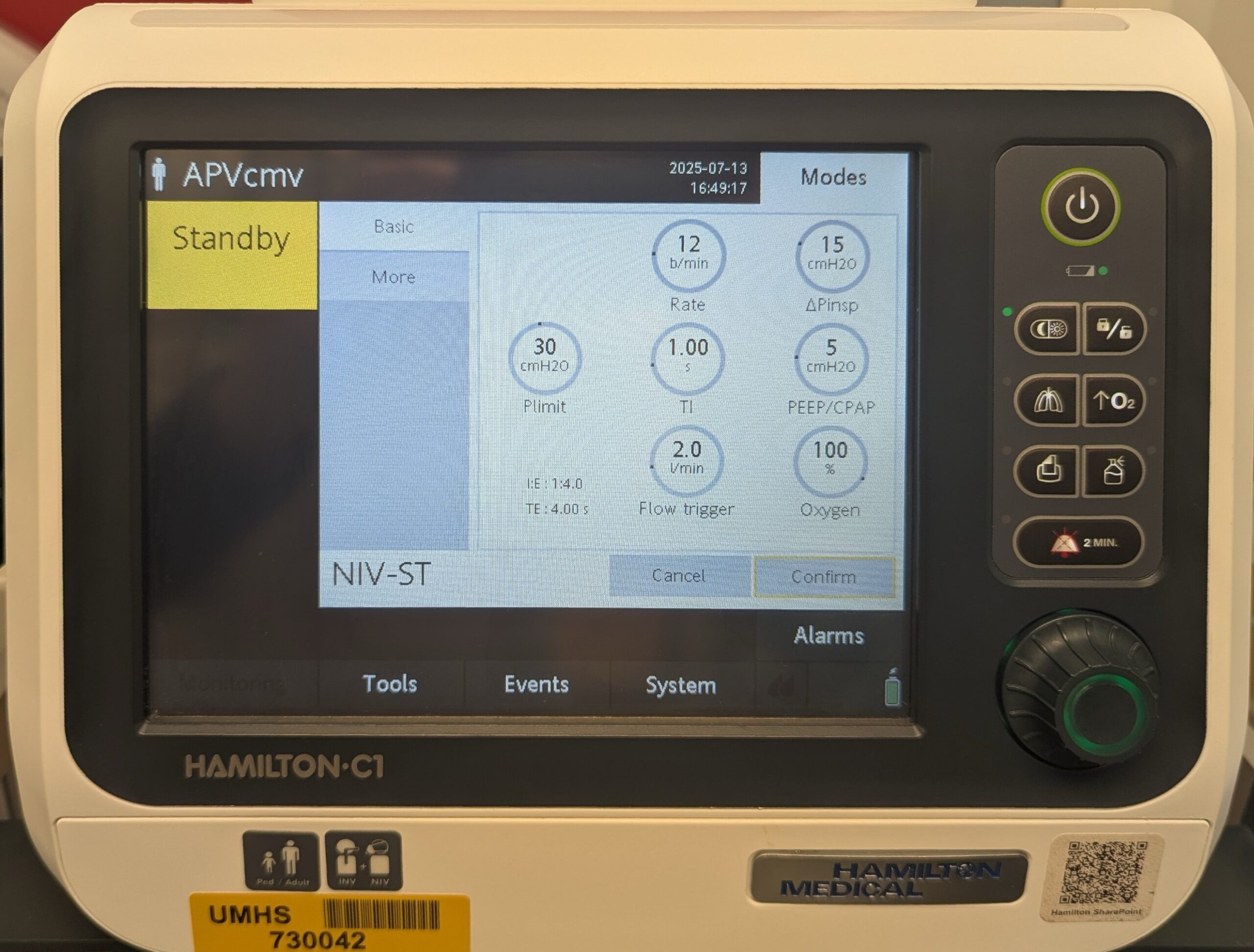
ACEP Now: October 2025 (Digital)Figure 2. This portable ventilator is programmed to use pressure support ventilation on a non-intubated patient (NIV = non-invasive ventilation) with a positive end-expiratory pressure (CPAP) of 5 cmH2O and a pressure support of 15 cmH2O (helpfully labeled here with Pinsp to indicate that it is 15 cmH2O above the positive end-expiratory pressure when the patient inspires). The backup rate is set at 12 breaths per minute and the FiO2 is 100 percent. (Click to enlarge.)
The nomenclature surrounding the inspiratory pressure is also different. The ventilator uses the terminology of pressure support, which is defined as the level of support relative to the PEEP (instead of the IPAP, which is an absolute number). Therefore, although a patient on BiPAP might be on an IPAP of 20 and an EPAP of 5 (“20 over 5”), this would translate to a pressure support of 15 and a PEEP of 5 (“15 over 5;” see Figure 2).
Although pressure support ventilation (PSV) is great for weaning ventilator support in the ICU, the major advantage for use in the ED is for simplicity.11 If you have a patient on PPV who is progressing towards intubation, a skilled respiratory therapist can transition the patient with their noninvasive mask from the NIPPV device to the ventilator even before intubation (ventilator-assisted preoxygenation), freeing up valuable space at the bedside and allowing for an easy transition to the ventilator after placement of the endotracheal tube.12,13
 Dr. Jansson is the medical director of the emergency critical care center (EC3), director of operations for the division of critical care, and an assistant professor of emergency medicine and internal medicine at the University of Michigan.
References
- Allison MG, Winters ME. Noninvasive ventilation for the emergency physician. Emerg Med Clin North Am. 2016;34(1):51-62.
- Kallet RH, Diaz J V. The physiologic effects of noninvasive ventilation. Respir Care. 2009;54(1):102–15.
- Seupaul RA. Evidence-based emergency medicine/systematic review abstract. Should I consider treating patients with acute cardiogenic pulmonary edema with noninvasive positive-pressure ventilation? Ann Emerg Med. 2010;55(3):299–300.
- Berbenetz N, Wang Y, Brown J, et al. Non-invasive positive pressure ventilation (CPAP or bilevel NPPV) for cardiogenic pulmonary oedema. Cochrane Database Syst Rev. 2019;4(4):CD005351.
- Gray A, Goodacre S, Newby DE, et al. Noninvasive ventilation in acute cardiogenic pulmonary edema. N Engl J Med. 2008;359(2):142-151.
- Rowe BH. Noninvasive positive pressure ventilation in acute chronic obstructive pulmonary disease. Ann Emerg Med. 2003;43(1):133-135.
- Osadnik CR, Tee VS, Carson-Chahhoud KV, et al. Non-invasive ventilation for the management of acute hypercapnic respiratory failure due to exacerbation of chronic obstructive pulmonary disease. Cochrane Database Syst Rev. 2017;7(7):CD004104.
- Gibbs KW, Semler MW, Driver BE, et al. Noninvasive ventilation for preoxygenation during emergency intubation. N Engl J Med. 2024;390(23):2165-2177.
- Briones Claudett KH, Briones Claudett M, Chung Sang Wong M, et al. Noninvasive mechanical ventilation with average volume assured pressure support (AVAPS) in patients with chronic obstructive pulmonary disease and hypercapnic encephalopathy. BMC Pulm Med. 2013;13(1):12.
- Storre JH, Seuthe B, Fiechter R, et al. Average volume-assured pressure support in obesity hypoventilation: a randomized crossover trial. Chest. 2006;130(3):815-821.
- Ladeira MT, Vital FMR, Andriolo RB, et al. Pressure support versus T-tube for weaning from mechanical ventilation in adults. Cochrane Database Syst Rev. 2014;2014(5):CD006056.
- Latona A, Pellatt R, Wedgwood D, et al. Ventilator-assisted preoxygenation in an aeromedical retrieval setting. Emerg Med Australas. 2024;36(4):596-603.
- Grant S, Khan F, Keijzers G, et al. Ventilator-assisted preoxygenation: protocol for combining non-invasive ventilation and apnoeic oxygenation using a portable ventilator. Emerg Med Australas. 2016;28(1):67-72.
Pages: 1 2 3 4 5 | Single Page



No Responses to “Non-Invasive Positive Pressure Ventilation in the Emergency Department”