
Logo

Log In Sign Up |  An official publication of: American College of Emergency Physicians
Navigation
  • Home
  • Multimedia
    • Podcasts
    • Videos
  • Clinical
    • Airway Managment
    • Case Reports
    • Critical Care
    • Guidelines
    • Imaging & Ultrasound
    • Pain & Palliative Care
    • Pediatrics
    • Resuscitation
    • Trauma & Injury
  • Resource Centers
    • mTBI Resource Center
  • Career
    • Practice Management
      • Benchmarking
      • Reimbursement & Coding
      • Care Team
      • Legal
      • Operations
      • Quality & Safety
    • Awards
    • Certification
    • Compensation
    • Early Career
    • Education
    • Leadership
    • Profiles
    • Retirement
    • Work-Life Balance
  • Columns
    • ACEP4U
    • Airway
    • Benchmarking
    • Brief19
    • By the Numbers
    • Coding Wizard
    • EM Cases
    • End of the Rainbow
    • Equity Equation
    • FACEPs in the Crowd
    • Forensic Facts
    • From the College
    • Images in EM
    • Kids Korner
    • Medicolegal Mind
    • Opinion
      • Break Room
      • New Spin
      • Pro-Con
    • Pearls From EM Literature
    • Policy Rx
    • Practice Changers
    • Problem Solvers
    • Residency Spotlight
    • Resident Voice
    • Skeptics’ Guide to Emergency Medicine
    • Sound Advice
    • Special OPs
    • Toxicology Q&A
    • WorldTravelERs
  • Resources
    • ACEP.org
    • ACEP Knowledge Quiz
    • Issue Archives
    • CME Now
    • Annual Scientific Assembly
      • ACEP14
      • ACEP15
      • ACEP16
      • ACEP17
      • ACEP18
      • ACEP19
    • Annals of Emergency Medicine
    • JACEP Open
    • Emergency Medicine Foundation
  • About
    • Our Mission
    • Medical Editor in Chief
    • Editorial Advisory Board
    • Awards
    • Authors
    • Article Submission
    • Contact Us
    • Advertise
    • Subscribe
    • Privacy Policy
    • Copyright Information

New “FAINT” Score May Work for Syncope Risk Stratification, but Needs Validation

By Marc A. Probst, MD, MS, FACEP; and Benjamin C. Sun, MD, MPP | on December 20, 2019 | 1 Comment
Features
  • Tweet
  • Click to email a link to a friend (Opens in new window) Email
Print-Friendly Version
New "FAINT" Score May Work for Syncope Risk Stratification, but Needs Validation
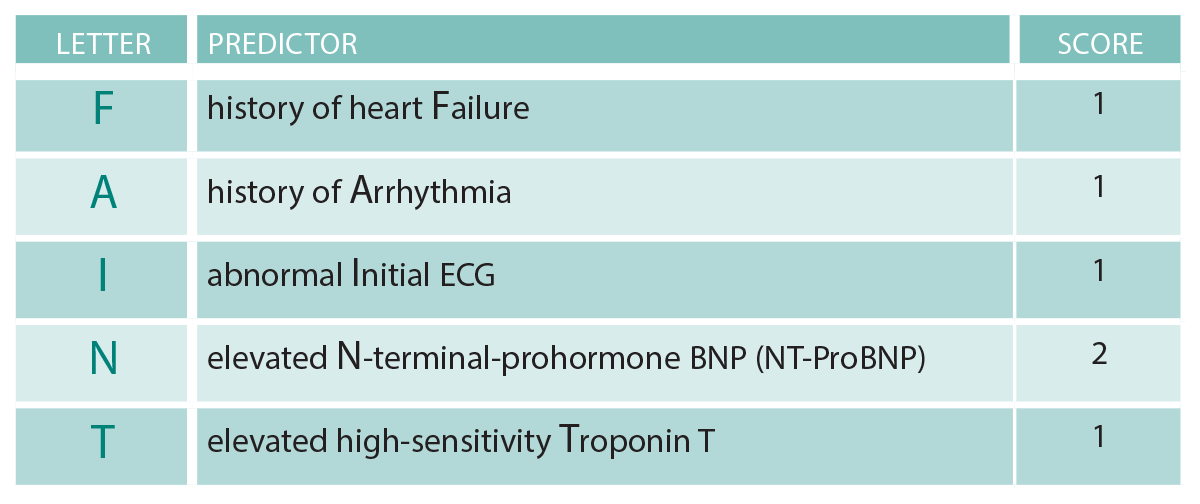
Table 1: FAINT Score1

You Might Also Like
  • New Decision Instruments That Predict Risk of Thrombolysis in Myocardial Infarction May Make TIMI Score Obsolete
  • Pulmonary Emboli May Be an Under-Recognized Cause of Syncope
  • Diagnose the Cause of Syncope—You Could Save a Life
Explore This Issue
ACEP Now: Vol 38 – No 12 – December 2019

(click for larger image) Table 1: FAINT Score1

The negative predictive value of a FAINT Score of zero was over 99 percent, a promising finding that should satisfy those clinicians who believe that 1 percent is generally an acceptable miss rate for patients presenting with cardiovascular complaints. However, this risk score has not been externally validated and thus is not ready for clinical use in isolation.

The FAINT Score now joins its Canadian cousin from Ottawa, the Canadian Syncope Risk Score. The latter has a greater number of variables (nine), some of which are subjective (ED diagnosis of cardiac syncope, for example), and is designed for use in patients ages 16 and older. Not surprisingly, both scores use the ECG and troponin as important predictive variables.
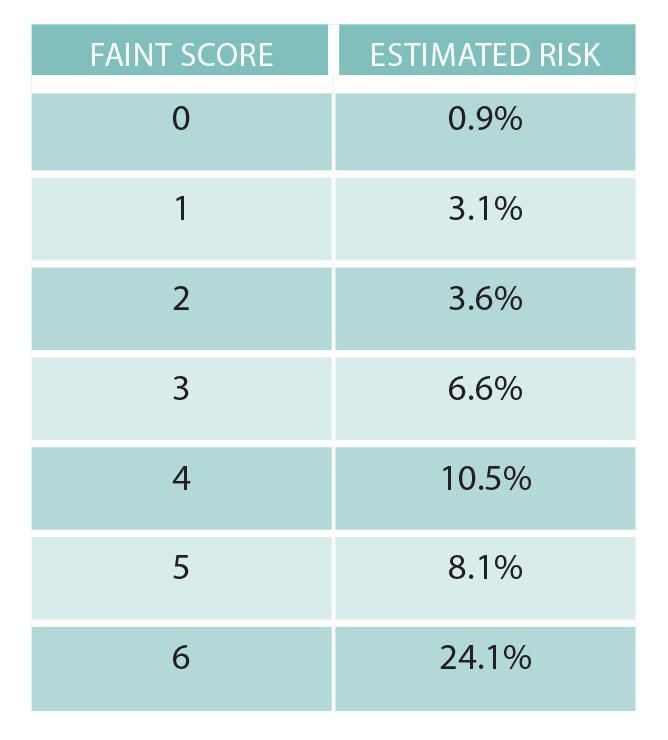
Table 2: Estimated Risk of Serious Clinical Outcome at 30 Days1

(click for larger image) Table 2: Estimated Risk of Serious Clinical Outcome at 30 Days1

What’s next? Both scores are pending external validation to confirm that their test characteristics are, in fact, consistent with those in the initial derivation studies. Meanwhile, the formal external validation of the Canadian score is expected to be published soon.

The validation of the FAINT Score is likely a few years away. Until then, we cannot formally endorse the use of it for widespread implementation. However, these scores are an exciting new development in the field of syncope risk stratification and may offer clinicians a useful tool to help determine which patients can be safely discharged directly from the emergency department. Ultimately, we believe these scores should be used in conjunction with, and not instead of, clinical gestalt, as is true for all clinical decision instruments. Consideration of other factors—such as the social circumstances, patient values, and preferences—is always warranted.

Case Resolution

Since the FAINT Score has not yet been externally validated, you cannot rely solely upon it. But its components may still be useful. You aptly order a high-sensitivity troponin and elevated N-terminal-prohormone BNP (NT-ProBNP), both of which come back normal. Calculating the patient’s FAINT Score to be zero, you believe that her risk of a serious cardiac event within 30 days is likely to be less than 1 percent. You return to the bedside and engage in shared decision-making with the patient. She understands that her risk is probably low but not zero. Although she lives alone, she agrees that discharge home with close outpatient follow-up this week is appropriate. The etiology of the syncope is never determined, but months later she is doing well, safely drinking coffee in her living room. 

Pages: 1 2 3 | Single Page

Topics: Case ReportsFAINT ScoreFaintingsyncope

Related

  • Case Report: Rare Pulmonary Embolism After Routine PIVC Insertion

    September 22, 2025 - 1 Comment
  • Annals ECG of the Month: Acute Coronary Occlusion

    August 4, 2025 - 0 Comment
  • Case Report: When Syncope Gets Hairy

    June 17, 2025 - 0 Comment

Current Issue

ACEP Now: November 2025

Download PDF

Read More

One Response to “New “FAINT” Score May Work for Syncope Risk Stratification, but Needs Validation”

  1. December 28, 2019

    Kazmi Reply

    Excellent. Thanks. -Needs more to add to,it. D/D seizure. Then this. Check orthostatic BP. The best thing is that all ER personnel should start using this and keep on adding things which are necessary to improve this. I am going to start using this and try to improve and add my own pointers.

Leave a Reply Cancel Reply

Your email address will not be published. Required fields are marked *


*
*


Wiley
  • Home
  • About Us
  • Contact Us
  • Privacy
  • Terms of Use
  • Advertise
  • Cookie Preferences
Copyright © 2025 by John Wiley & Sons, Inc. All rights reserved, including rights for text and data mining and training of artificial technologies or similar technologies. ISSN 2333-2603
