
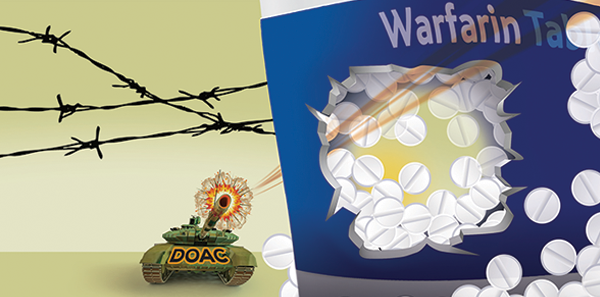
A third potential treatment for life-threatening bleeding with direct oral anticoagulants (DOACs) is aripazine/ciraparantag (PER977). Originally developed as a reversal agent for heparin and fondaparinux, this molecule also appears to have clinically relevant activity for dabigatran and the oral factor Xa inhibitors. Administration of PER977 seems to improve bleeding and measures of coagulation assays, but this appears to be related to a pro-coagulant effect rather than a specific antidote mechanism. The future of this treatment is much more uncertain.
Explore This Issue
ACEP Now: Vol 34 – No 09 – September 2015Other Concerns
At least one published meta-analysis calls into question the need for any agent-specific antidotes.5 These authors pooled bleeding events for 11 trials of the DOACs compared with warfarin and found case fatality for major bleeding events was nearly halved despite readily available reversal strategies for vitamin K antagonists. A major caveat, unfortunately, from this analysis is the data are derived solely from sponsored trials, and several authors declare conflicts of interest with pharmaceutical manufacturers.
Finally, even though the majority of our clinical concerns with the DOACs to this point have related to treating adverse effects, there is an increasing role for emergency physicians as prescribers. The most robust reporting at this point involves rivaroxaban, which is entering use at many centers as a discharge medication directly from the ED following diagnosis of deep venous thrombosis or pulmonary embolism. In small observational studies, patients discharged on rivaroxaban have been followed for recurrence and bleeding complications up to a year, and neither major bleeding nor failure of therapy has been observed.6 Apixiban can possibly be used interchangeably with rivaroxaban, but the role for edoxaban, with specific indications for use only in those with reduced renal function, is less clear.
Each manufacturer is also pursing additional clinical trials in attempts to expand indications for each anticoagulant. Trials are under way with dabigatran and the factor Xa inhibitors in the context of percutaneous coronary intervention, during catheter ablation for atrial fibrillation and expanded secondary prevention of acute ischemic stroke. The factor Xa inhibitors are being evaluated for use in heart valve replacement, prevention of cardiac events in the context of heart failure, antiphospholipid syndrome, and new venous thromboembolism treatment and prophylaxis indications. These may generate additional circumstances in which emergency physicians are called upon to initiate treatment with these medications.
The promise of a future with safer anticoagulation is near, whether through real-world data, safer use, further clinical trials, or the development of specific antidotes. Be aware of your institution’s plan for reversal of life-threatening bleeding from these anticoagulants, and just to keep it simple, point folks away from dabigatran whenever possible.
References
- Cohen D. Dabigatran: how the drug company withheld important analyses. BMJ. 2014;349:g4670.
- Connolly SJ, Ezekowitz MD, Yusuf S, et al. Dabigatran versus warfarin in patients with atrial fibrillation. N Engl J Med. 2009;361:1139-1151.
- Pollack CV, Reilly PA, Eikelboom J, et al. Idarucizumab for dabigatran reversal. N Engl J Med. 2015. [ePub before print]
- Crowther M, Crowther MA. Antidotes for novel oral anticoagulants: current status and future potential. Arterioscler Thromb Vasc Biol. 2015;35(8):1736-1745.
- Caldeira D, Rodrigues FB, Barra M, et al. Non-vitamin K antagonist oral anticoagulants and major bleeding-related fatality in patients with atrial fibrillation and venous thromboembolism: a systematic review and meta-analysis. Heart. 2015;101(15):1204-1211.
- Beam DM, Kahler ZP, Kline JA. Immediate discharge and home treatment with rivaroxaban of low-risk venous thromboembolism diagnosed in two U.S. emergency departments: a one-year preplanned analysis. Acad Emerg Med. 2015;22(7):788-795.
Pages: 1 2 3 | Single Page




No Responses to “New Developments in Direct Oral Anticoagulant Safety and Indications”