
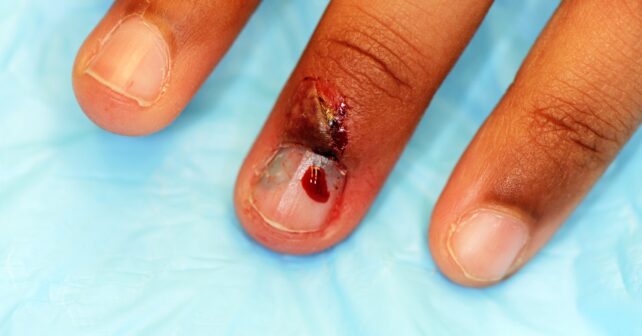
A 12-year-old boy presented after a fall from his bicycle with an injury to his right long finger. Should the nail be removed? Should the nail be replaced?
Explore This Issue
ACEP Now: August 2025 (Digital)Tailoring Treatment for Nail Bed Trauma
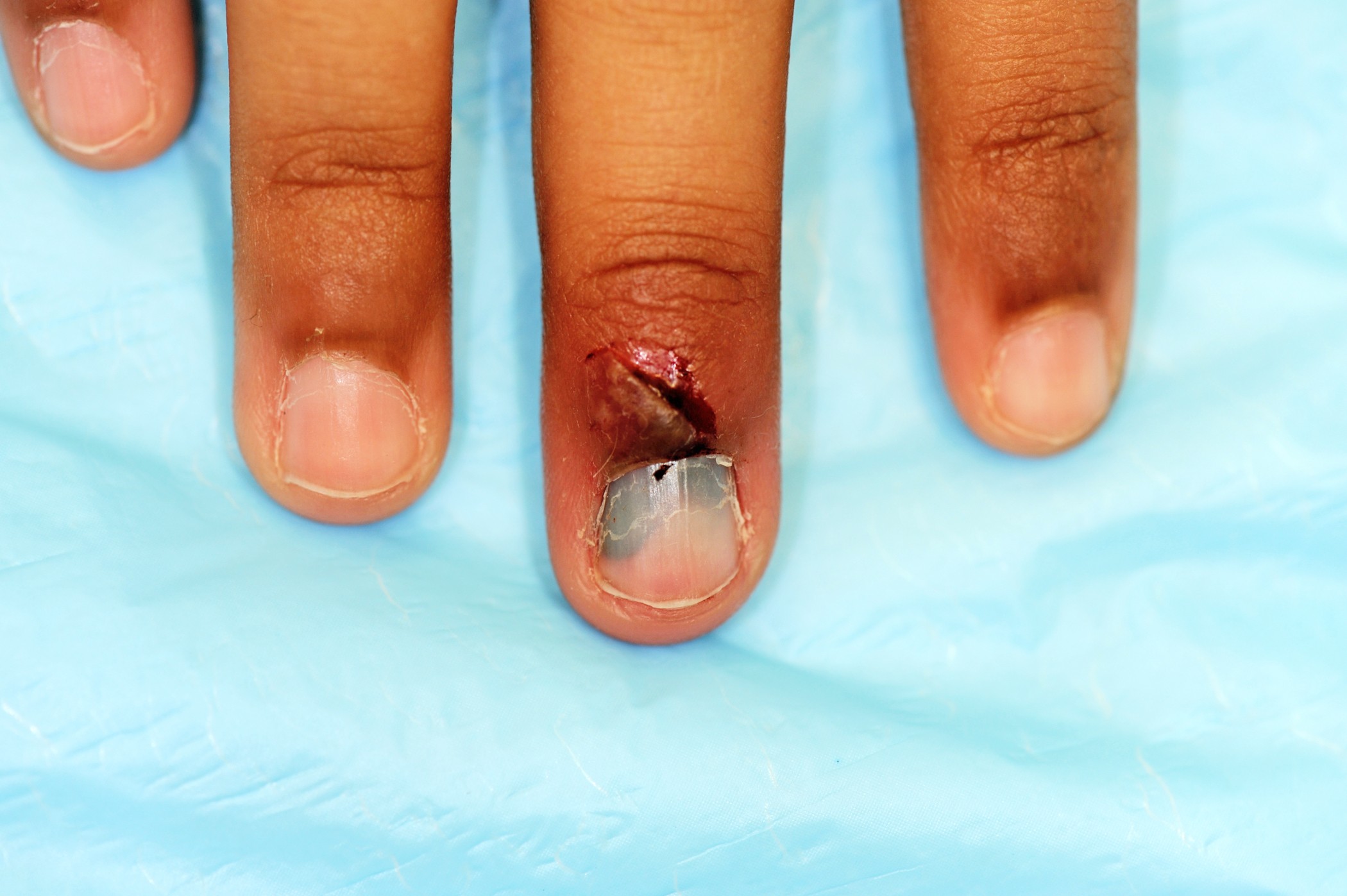
Figure 1. Crush injury to distal phalanx with laceration and subungual hematoma. Photos: David Effron, MD. (Click to enlarge.)
Nail bed injuries vary in complexity from a simple subungual hematoma to a complex open fracture with nail bed laceration. Management should be tailored to the extent of the injury and underlying fracture.
Clinical assessment will guide management. Many patients with nail bed injuries—more than 50 percent—have an associated fracture. Radiographs should be obtained to assess any bony injury.1 Outcomes are dependent on presence of fracture and degree of deformity.2 The Fingertip Injuries Outcome Assessment Score can guide prognosis after fingertip amputations (see table below). A score of 12 or less is considered excellent and a score of 13 to 18 is considered good. In pediatric patients, care should be taken to identify a Seymour fracture, a displaced distal phalangeal physeal fracture with associated nail bed injury. This fracture requires antibiotics and may require operative management, including open reduction and pinning.3
Simple subungual hematomas involving less than 50 percent of the nail area can be managed with trephination alone.4-6 Management of larger subungual hematomas is controversial. One study found that with intact nail margins, decompression alone had similar outcomes to nail removal and exploration.7
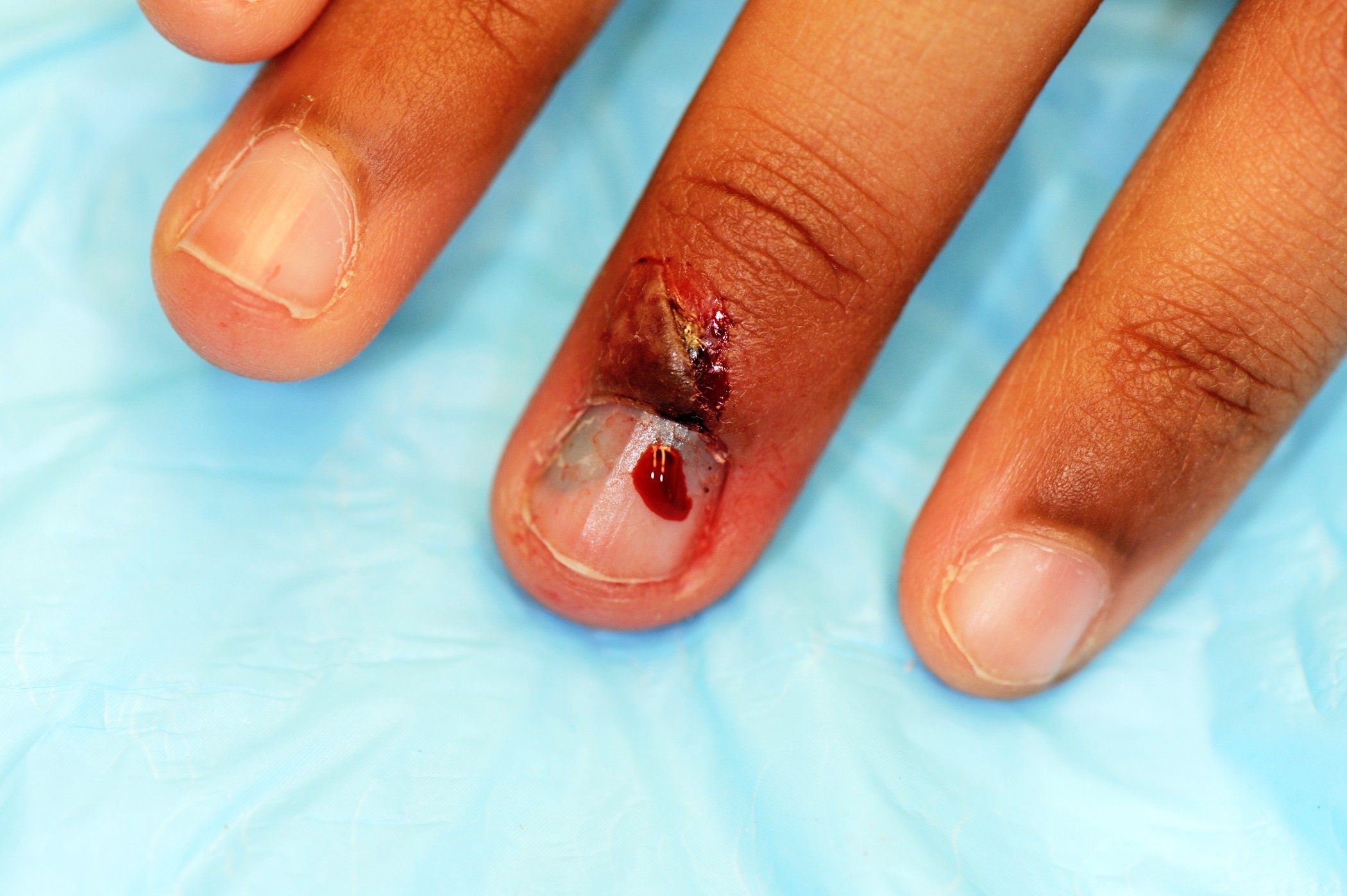
Figure 2. After trephination and laceration repair with tissue adhesive. (Click to enlarge.)
The medical literature includes conflicting recommendations regarding the management of nail bed injuries. Nail removal is generally recommended in cases involving nail margin disruption, significant swelling, or displaced fracture.8 For simple nail bed lacerations, repair with tissue adhesive has similar outcomes to suture repair.9-11 Some authors recommend nail bed repair without subsequent nail replacement.12-14 A recent study demonstrated similar outcomes with or without nail replacement after nail bed repair.15 Some authors believe that nail replacement may serve as a dressing and splint to ensure proper healing and nail growth. Replacement with the native nail is preferable to an artificial splint.16 If the nail is not available, a splint may be created using chromic suture foil, which can be inserted in the nail fold.
No single treatment strategy applies to all nail bed injuries. Repair and dressing should be tailored to the individual patient, based on assessment of hematoma, laceration, fracture, deformity, and expected prognosis. Patients should be counseled that nail deformity may be permanent or temporary; the nail may take three to 12 months to fully grow and heal.
Case Discussion
Trephination of the subungual hematoma was performed, and the laceration was repaired using tissue adhesive.
Fingertip Injuries Outcome Assessment Score
| Nail | Normal | 1 |
| Small nail | 2 | |
| Split nail or deformed nail | 3 | |
| Hook nail | 4 | |
| Absent nail | 5 | |
| Finger length | Distal third | 1 |
| Middle third | 2 | |
| Proximal third | 3 | |
| Pulp | Well padded | 1 |
| Pulp atrophy | 2 | |
| Bone | Fracture united (consolidated) or normal | 1 |
| Nonunion | 2 | |
| Bone shortening | 3 | |
| Cosmesis | Satisfactory | 1 |
| Not satisfactory (color mismatch) | 2 | |
| Sensation | <6 mm | 1 |
| 7-10 mm | 2 | |
| Cold intolerance | 3 | |
| Absent sensation/hyperalgesia | 4 | |
| Pain | No pain | 1 |
| Mild | 2 | |
| Moderate | 3 | |
| Severe | 4 | |
| Range of motion | 75%-100% | 1 |
| 50%-74% | 2 | |
| <49% | 3 | |
| Grip strength | 75%-100% | 1 |
| 50%-74% | 2 | |
| <49% | 3 | |
| Ability to work | Regular job | 1 |
| Restricted job | 2 | |
| Unable to work | 3 |
 Dr. Marco is professor of emergency medicine at Penn State Health-Milton S. Hershey Medical Center and associate editor of ACEP Now.
References
- George A, Alexander R, Manju C. Management of nail bed injuries associated with fingertip injuries. Indian J Orthop. 2017;51(6):709-713.
- James V, Heng TYJ, Yap QV, Ganapathy S. Epidemiology and outcome of nailbed injuries managed in children’s emergency department: a 10-year single-center experience. Pediatr Emerg Care. 2022;38(2):e776-e783.
- Ortega VHG, Terán AIS. Seymour fracture management and functional outcome assessment: a case report. J Surg Case Rep. 2025;2025(2):rjaf083.
- Hawken JB, Giladi AM. Primary management of nail bed and fingertip injuries in the emergency department. Hand Clin. 2021;37(1):1-10.
- Tos P, Titolo P, Chirila NL, et al. Surgical treatment of acute fingernail injuries. J Orthop Traumatol. 2012;13(2):57-62.
- De Ruiter BJ, Finnan MJ, Miller EA, Friedrich JB. fingertip injuries: a review and update on management. J Am Acad Orthop Surg. 2024. Epub ahead of print.
- Roser SE, Gellman H. Comparison of nail bed repair versus nail trephination for subungual hematomas in children. J Hand Surg Am. 1999;24(6):1166-1170.
- Venkatesh A, Khajuria A, Greig A. Management of pediatric distal fingertip injuries: a systematic literature review. Plast Reconstr Surg Glob Open. 2020;8(1):e2595.
- Edwards S, Parkinson L. Is fixing pediatric nail bed injuries with medical adhesives as effective as suturing: a review of the literature. Pediatr Emerg Care. 2019;35(1):75-77.
- Chiche L, Jeandel C, Lyps C, et al. Fingertip nail bed injuries in children: comparison of suture repair versus glue (2-octylcyanoacrylate) with 1-year follow-up. Hand Surg Rehabil. 2020;39(6):550-555.
- Strauss EJ, Weil WM, Jordan C, Paksima N. A prospective, randomized, controlled trial of 2-octylcyanoacrylate versus suture repair for nail bed injuries. J Hand Surg Am. 2008;33(2):250-253.
- Hawken JB, Giladi AM. Primary management of nail bed and fingertip injuries in the emergency department. Hand Clin. 2021;37(1):1-10.
- O’Shaughnessy M, McCann J, O’Connor TP, Condon KC. Nail re-growth in fingertip injuries. Ir Med J. 1990;83(4):136-137.
- Miranda BH, Vokshi I, Milroy CJ. Pediatric nailbed repair study: nail replacement increases morbidity. Plast Reconstr Surg. 2012;129(2):394e-396e.Erratum in: Plast Reconstr Surg. 2012;129(4):1028.
- Jain A, Greig AVH, Jones A, et al. Effectiveness of nail bed repair in children with or without replacing the fingernail: NINJA multicentre randomized clinical trial. Br J Surg. 2023;110(4):432-438.
- Navaeifar N, Kazemi-Sufi S, Afshar A, et al. Appearance outcomes of repositioned native nail plate as a free graft and artificial nail plate in the reconstruction of the fingertip injuries. J Hand Surg Glob Online. 2023;5(4):454-458.
Pages: 1 2 3 | Multi-Page



No Responses to “Nail Bed Injuries: What to Do—or Not to Do”