Logo

Log In Sign Up |  An official publication of: American College of Emergency Physicians
Navigation
  • Home
  • Multimedia
    • Podcasts
    • Videos
  • Clinical
    • Airway Managment
    • Case Reports
    • Critical Care
    • Guidelines
    • Imaging & Ultrasound
    • Pain & Palliative Care
    • Pediatrics
    • Resuscitation
    • Trauma & Injury
  • Resource Centers
    • mTBI Resource Center
  • Career
    • Practice Management
      • Benchmarking
      • Reimbursement & Coding
      • Care Team
      • Legal
      • Operations
      • Quality & Safety
    • Awards
    • Certification
    • Compensation
    • Early Career
    • Education
    • Leadership
    • Profiles
    • Retirement
    • Work-Life Balance
  • Columns
    • ACEP4U
    • Airway
    • Benchmarking
    • Brief19
    • By the Numbers
    • Coding Wizard
    • EM Cases
    • End of the Rainbow
    • Equity Equation
    • FACEPs in the Crowd
    • Forensic Facts
    • From the College
    • Images in EM
    • Kids Korner
    • Medicolegal Mind
    • Opinion
      • Break Room
      • New Spin
      • Pro-Con
    • Pearls From EM Literature
    • Policy Rx
    • Practice Changers
    • Problem Solvers
    • Residency Spotlight
    • Resident Voice
    • Skeptics’ Guide to Emergency Medicine
    • Sound Advice
    • Special OPs
    • Toxicology Q&A
    • WorldTravelERs
  • Resources
    • ACEP.org
    • ACEP Knowledge Quiz
    • Issue Archives
    • CME Now
    • Annual Scientific Assembly
      • ACEP14
      • ACEP15
      • ACEP16
      • ACEP17
      • ACEP18
      • ACEP19
    • Annals of Emergency Medicine
    • JACEP Open
    • Emergency Medicine Foundation
  • About
    • Our Mission
    • Medical Editor in Chief
    • Editorial Advisory Board
    • Awards
    • Authors
    • Article Submission
    • Contact Us
    • Advertise
    • Subscribe
    • Privacy Policy
    • Copyright Information

Nail Bed Injuries: What to Do—or Not to Do

By Catherine A. Marco, MD, FACEP | on August 18, 2025 | 0 Comment
Problem Solvers
  • Tweet
  • Click to email a link to a friend (Opens in new window) Email
Print-Friendly Version

A 12-year-old boy presented after a fall from his bicycle with an injury to his right long finger.  Should the nail be removed? Should the nail be replaced?

You Might Also Like
  • Emergency Medicine Pearls, Pitfalls for Treatment of Pediatric Distal Radius Fractures
  • Occult and Subtle Wrist and Hand Injuries You Don’t Want To Miss
  • Emergency Department Management of Extensor Tendon Lacerations
Explore This Issue
ACEP Now: August 2025 (Digital)

Tailoring Treatment for Nail Bed Trauma
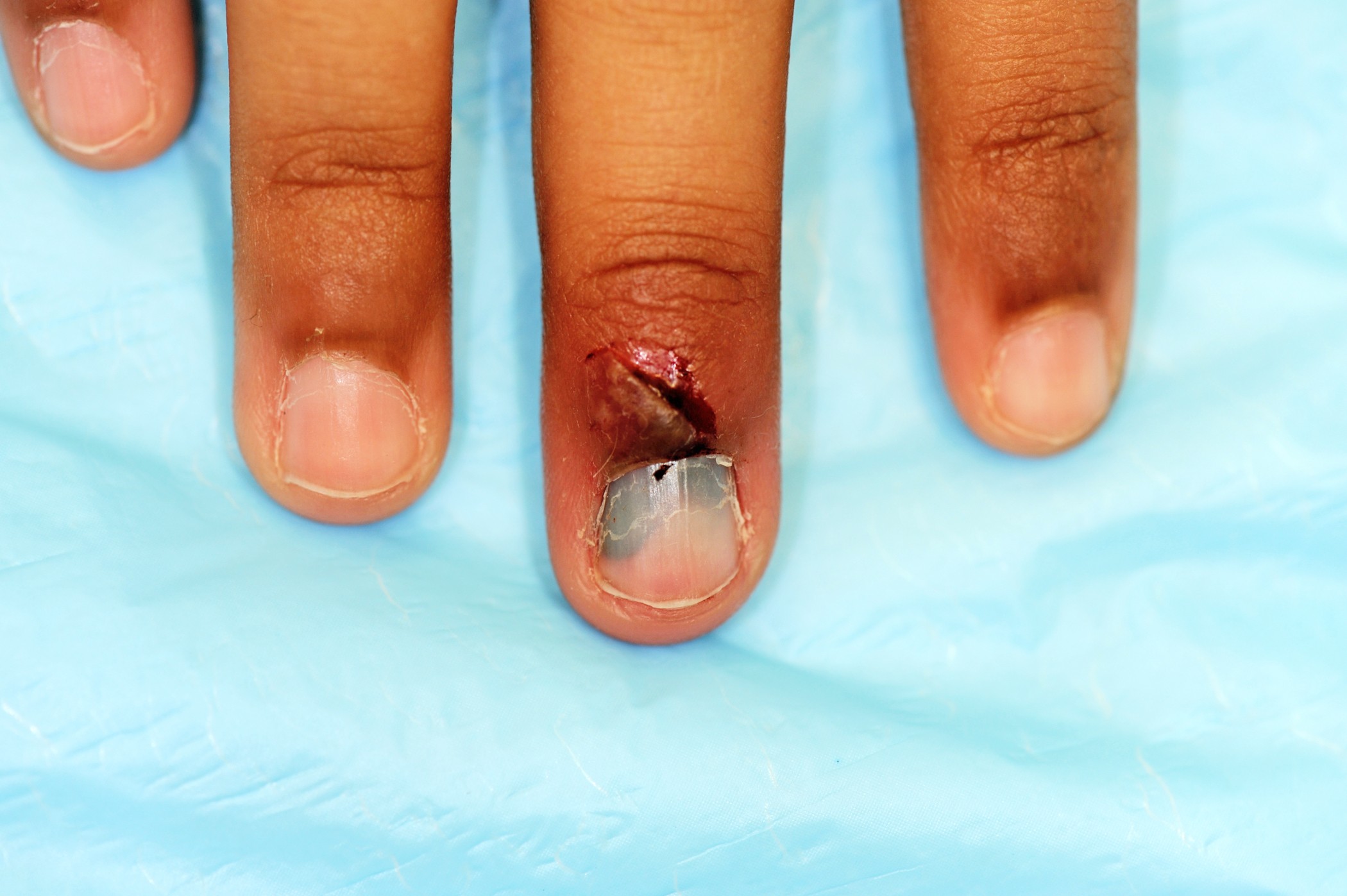
Figure 1. Crush injury to distal phalanx with laceration and subungual hematoma. Photos: David Effron, MD. (Click to enlarge.)

Nail bed injuries vary in complexity from a simple subungual hematoma to a complex open fracture with nail bed laceration. Management should be tailored to the extent of the injury and underlying fracture.

Clinical assessment will guide management. Many patients with nail bed injuries—more than 50 percent—have an associated fracture. Radiographs should be obtained to assess any bony injury.1 Outcomes are dependent on presence of fracture and degree of deformity.2 The Fingertip Injuries Outcome Assessment Score can guide prognosis after fingertip amputations (see table below). A score of 12 or less is considered excellent and a score of 13 to 18 is considered good. In pediatric patients, care should be taken to identify a Seymour fracture, a displaced distal phalangeal physeal fracture with associated nail bed injury. This fracture requires antibiotics and may require operative management, including open reduction and pinning.3

Simple subungual hematomas involving less than 50 percent of the nail area can be managed with trephination alone.4-6  Management of larger subungual hematomas is controversial. One study found that with intact nail margins, decompression alone had similar outcomes to nail removal and exploration.7
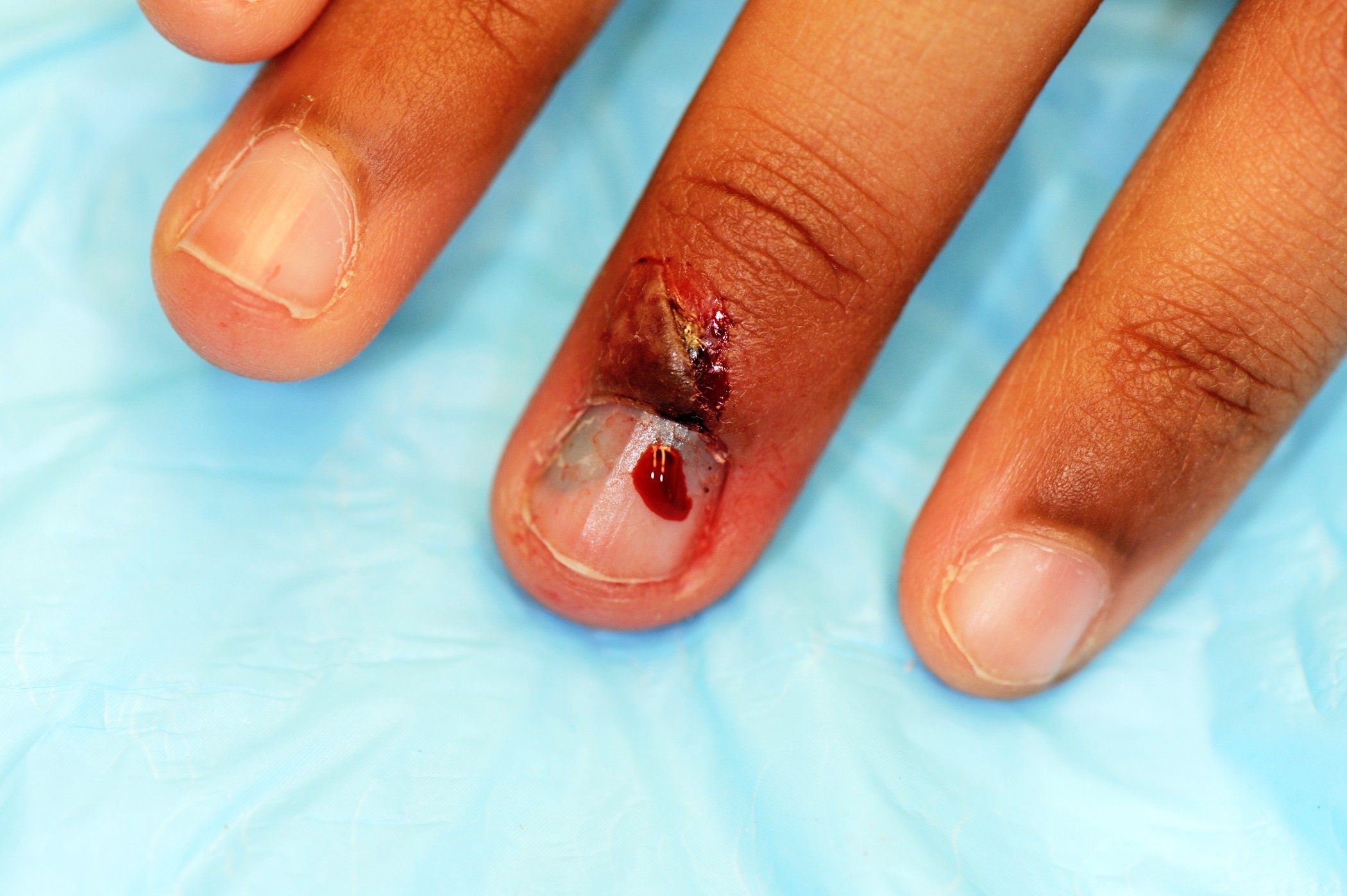
Figure 2. After trephination and laceration repair with tissue adhesive. (Click to enlarge.)

The medical literature includes conflicting recommendations regarding the management of nail bed injuries. Nail removal is generally recommended in cases involving nail margin disruption, significant swelling, or displaced fracture.8  For simple nail bed lacerations, repair with tissue adhesive has similar outcomes to suture repair.9-11  Some authors recommend nail bed repair without subsequent nail replacement.12-14  A recent study demonstrated similar outcomes with or without nail replacement after nail bed repair.15 Some authors believe that nail replacement may serve as a dressing and splint to ensure proper healing and nail growth. Replacement with the native nail is preferable to an artificial splint.16 If the nail is not available, a splint may be created using chromic suture foil, which can be inserted in the nail fold.

No single treatment strategy applies to all nail bed injuries. Repair and dressing should be tailored to the individual patient, based on assessment of hematoma, laceration, fracture, deformity, and expected prognosis. Patients should be counseled that nail deformity may be permanent or temporary; the nail may take three to 12 months to fully grow and heal.

Pages: 1 2 3 | Single Page

Topics: Fingertip InjuryfractureHand InjuryInjury & TraumaLacerationNail Bed InjuryPediatricsProcedures and SkillsSubungual HematomaTrephinationWound Care

Related

  • Patterns of Injury in Elder Abuse

    November 6, 2025 - 0 Comment
  • FACEPs in the Crowd: Dr. John Ludlow

    November 5, 2025 - 0 Comment
  • Case Report: Rare Pulmonary Embolism After Routine PIVC Insertion

    September 22, 2025 - 1 Comment

Current Issue

ACEP Now: November 2025

Download PDF

Read More

No Responses to “Nail Bed Injuries: What to Do—or Not to Do”

Leave a Reply Cancel Reply

Your email address will not be published. Required fields are marked *


*
*


Wiley
  • Home
  • About Us
  • Contact Us
  • Privacy
  • Terms of Use
  • Advertise
  • Cookie Preferences
Copyright © 2025 by John Wiley & Sons, Inc. All rights reserved, including rights for text and data mining and training of artificial technologies or similar technologies. ISSN 2333-2603
