
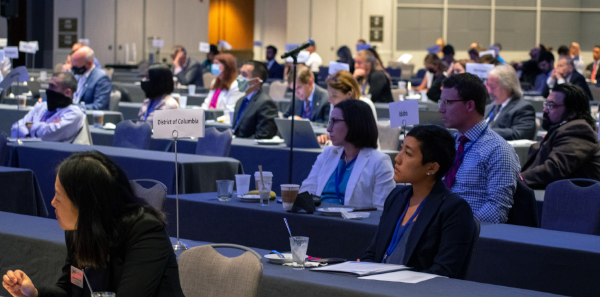
For the first time since February 2019, the ACEP community came back together for an in-person meeting. The annual Leadership & Advocacy Conference (LAC) was held July 25–28 in Washington, D.C. With extra precautions because of the specter of the Delta variant of COVID-19, 324 ACEP members from 44 states met to get the latest updates on federal and state issues, hear from members of Congress and key congressional staffers, and participate in 273 virtual Capitol Hill visits. Given the realities and challenges of holding the meeting, it was most definitely a remarkable success. Perhaps most important, the members who attended were able to personally reconnect with friends and colleagues within the ACEP family. Being together and providing one another with validation of the importance of the hard work we do was an incredibly powerful experience.
Explore This Issue
ACEP Now: Vol 40 – No 09 – September 2021Before I share more about the substance of the conference, I want to recognize the ACEP D.C. and educational meetings teams for making the conference a reality. The rapidly evolving COVID-19 situation required unique and careful planning; the conference was held with special precautions to maximize the safety of all participants.

ACEP President-Elect Gillian Schmitz, MD, FACEP (right), speaks with Rep. Gregory Murphy (NC-3).
The first day of the educational program covered many topics, including opportunities for the future of telemedicine in emergency medicine practice, the perceptions and use of social media on Capitol Hill, and an interactive session on the EM workforce issue with leaders from ACEP, the Emergency Medicine Residents’ Association (EMRA), the Council of Emergency Medicine Residency Directors, and the Accreditation Council for Graduate Medical Education. And once again, props to the ACEP Young Physicians Section and EMRA for hosting their annual pre-conference Health Policy Primer educational program.
Connecting with Congress
As with every LAC, the College developed a set of “asks” and talking points for the Capitol Hill visits. Identifying the “right” issues to focus on during the meeting requires a thoughtful and strategic approach to increase our likelihood of advocacy success. That strategy is based upon identifying issues that both are important for emergency medicine and will resonate on Capitol Hill given the political climate and priorities of the current Congress and the President’s administration. Our goal, as always, is to remind legislators that we do the work of the people every day and that we need their support to be able to continue that work. With a heavy overtone of the worsening situation created by the Delta COVID-19 variant, our issues and topics this year were:
- Support for the Dr. Lorna Breen Health Care Provider Protection Act (S 610/HR 1667) [Editor’s note: The Dr. Breen Act was passed by the Senate in early August. Thank you to everyone who advocated for it!]
- Advocating for elimination of the X-waiver registration requirement
- Preventing pending cuts to 2022 Medicare payments for emergency physicians
During the second day of the conference, we got to hear from and speak with key members of Congress including Sen. Tim Kaine (D-VA) who was a primary sponsor of the Dr. Breen Act, and the two co-chairs of the bipartisan Problem Solvers Caucus in the U.S. House, Rep. Josh Gottheimer (D-NJ-05) and Rep. Brian Fitzpatrick (R-PA-01). ACEP members shared their very real firsthand experiences of how their emergency departments, hospitals, and communities have been overwhelmed by COVID-19 with these members of Congress and key committee and congressional senior staffers.
The stories conveyed not just the clinical challenges we face but also how difficult it has been for emergency physicians to withstand the worst of COVID-19 while so many refuse to get vaccinated, wear masks, and put the public health of the nation ahead of their own beliefs.

Attendees enjoy refreshments at the conclusion of a busy day of advocacy on behalf of emergency physicians.
Although we were hopeful for a return to the traditional “on the Hill” congressional visits, the U.S. Capitol was still not completely open to the public for constituent visits. Despite that, the Virtual Hill Day was very effective and successful. Everyone on Capitol Hill is now very comfortable with virtual meetings and it has become part of the “new normal” for congressional offices. Telling our stories directly to members of Congress and staffers is invaluable in helping them understand who we are, what we do, and how important we are to protecting the health of the nation. Sharing the sobering clinical data and statistics of COVID-19 is important when talking with a member of Congress. More importantly, sharing true accounts of real people who are their constituents whose lives have been affected—or ended—by COVID-19 is critical. Telling these narratives helps legislators and staffers understand that what our work is about real people and not just politics. Inevitably, when we tell these stories, we tell them not just about our patients but also about us and how hard our work has been for now over a year and half.
A Voice for EM
Each year, while those of us who attend LAC get to tell our anecdotes, we also understand that we are representing emergency physicians across the country and telling your stories too. Although a few hundred of us can do that, there is nothing more powerful than bringing more voices to the Hill. The future of COVID-19 is still unwritten, but we certainly hope that by 2022 we can all be together again, in person, and on Capitol Hill advocating for our fellow physicians, our patients, and our specialty.
So please come next year to LAC and add your voice! In the meantime, join the 911 Grassroots Network at www.acep.org/911grassrootsnetwork to stay informed on federal and state issues. You can also support ACEP by contributing to NEMPAC, the National Emergency Medicine Political Action Committee, and help ACEP amplify your voice on the issues that matter most to emergency medicine.
Pages: 1 2 3 4 | Multi-Page


No Responses to “Live From the 2021 ACEP Leadership & Advocacy Conference”