
Logo

Log In Sign Up |  An official publication of: American College of Emergency Physicians
Navigation
  • Home
  • Multimedia
    • Podcasts
    • Videos
  • Clinical
    • Airway Managment
    • Case Reports
    • Critical Care
    • Guidelines
    • Imaging & Ultrasound
    • Pain & Palliative Care
    • Pediatrics
    • Resuscitation
    • Trauma & Injury
  • Resource Centers
    • mTBI Resource Center
  • Career
    • Practice Management
      • Benchmarking
      • Reimbursement & Coding
      • Care Team
      • Legal
      • Operations
      • Quality & Safety
    • Awards
    • Certification
    • Compensation
    • Early Career
    • Education
    • Leadership
    • Profiles
    • Retirement
    • Work-Life Balance
  • Columns
    • ACEP4U
    • Airway
    • Benchmarking
    • Brief19
    • By the Numbers
    • Coding Wizard
    • EM Cases
    • End of the Rainbow
    • Equity Equation
    • FACEPs in the Crowd
    • Forensic Facts
    • From the College
    • Images in EM
    • Kids Korner
    • Medicolegal Mind
    • Opinion
      • Break Room
      • New Spin
      • Pro-Con
    • Pearls From EM Literature
    • Policy Rx
    • Practice Changers
    • Problem Solvers
    • Residency Spotlight
    • Resident Voice
    • Skeptics’ Guide to Emergency Medicine
    • Sound Advice
    • Special OPs
    • Toxicology Q&A
    • WorldTravelERs
  • Resources
    • ACEP.org
    • ACEP Knowledge Quiz
    • Issue Archives
    • CME Now
    • Annual Scientific Assembly
      • ACEP14
      • ACEP15
      • ACEP16
      • ACEP17
      • ACEP18
      • ACEP19
    • Annals of Emergency Medicine
    • JACEP Open
    • Emergency Medicine Foundation
  • About
    • Our Mission
    • Medical Editor in Chief
    • Editorial Advisory Board
    • Awards
    • Authors
    • Article Submission
    • Contact Us
    • Advertise
    • Subscribe
    • Privacy Policy
    • Copyright Information

Let Core Values Help Guide Patient Care

By Alex Koo, MD, FACEP | on November 5, 2025 | 0 Comment
Art of Healing
  • Tweet
  • Click to email a link to a friend (Opens in new window) Email
Print-Friendly Version

We’ll discuss a blueprint on narrowing down what values are important to us through the process: Discovery → Identify → Expression → Behavior.

You Might Also Like
  • Who’s in Charge of Our Health? The Ethics of Patient Responsibility
  • ACGME/AOA Merger May Change Osteopathic Training
  • Sleep Concepts, Strategies for Shift Work in the Emergency Dept.
Explore This Issue
ACEP Now: November 2025
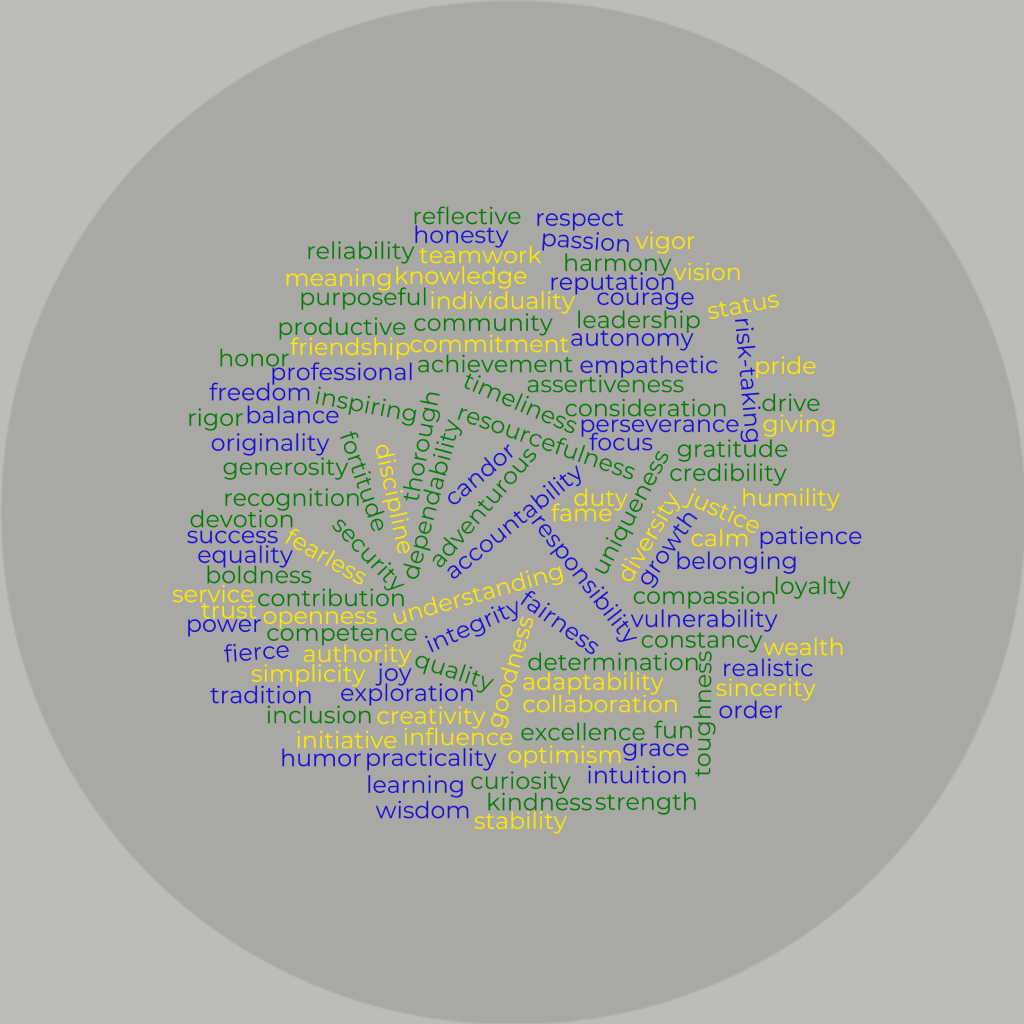
Click to enlarge.

Establish Core Values

Start by scanning the values list in our word cloud. All are admirable values, but not all can be core values.2-4 Core values are meant to be unique to you, present even when no one is watching. They’re not our organization’s values or even the values of our closest confidants. They are not the expected values of “being a physician” in the eyes of the public, our mentors, parents, friends, or partners. They are our individual beliefs of what it means to be fulfilled, to have a shift well-played, and be the best physician we strive to be.

Terms may seem synonymous but resonate differently with different people. For example, reliability and dependability overlap definitions, but someone may interpret reliability as more task-based (i.e., consistently showing up to shift early or finishing notes on time) and dependability as more emotion-based (i.e., keep the confidence of colleagues in times of crisis).

To unearth your core values, systematically reflect on three key areas: impactful moments, role models, and your desired legacy.

What makes an impactful moment? “Peak” moments encompass experiences in which you feel a sense of flow, ikigai, and meaning. “Violating” moments are those that make you feel visceral defensiveness. Analyze those moments carefully. What is it about that peak moment for the end-of-life care that you rendered? Did you find deep meaning in the competence or leadership of running the code expertly? Did you find flow in the openness of speaking honestly and compassionately with family members?

Conversely, what was it about the sign out from a well-intentioned colleague that deeply troubled you when reevaluating the patient? Was it most jarring that there may be a lack of understanding when the patient was instructed to keep his diabetic ulcers clean but had no ready access to running water, shoes, or dressing supplies? Hidden in those moments are your core values, either expressed or breached.

Consider those you admire. What behaviors do they display? Is it respect manifested as your colleague who always sits or kneels when talking to a patient, bed, or hallway? Is it adaptability when you see your charge nurse flexing to triage a patient and teaching continuous bladder irrigation to a new nurse while running the flow of incoming ambulances?

Pages: 1 2 3 4 5 | Single Page

Topics: BurnoutEthicsPatient CareWellness

Related

  • November 2025 News from the College

    November 4, 2025 - 0 Comment
  • Are Physician-Led Unions the Wave of the Future?

    September 30, 2025 - 0 Comment
  • LA County Fires Illustrate Strength of Emergency Medicine Community

    September 18, 2025 - 0 Comment

Current Issue

ACEP Now: December 2025 (Digital)

Read More

No Responses to “Let Core Values Help Guide Patient Care”

Leave a Reply Cancel Reply

Your email address will not be published. Required fields are marked *


*
*


Wiley
  • Home
  • About Us
  • Contact Us
  • Privacy
  • Terms of Use
  • Advertise
  • Cookie Preferences
Copyright © 2025 by John Wiley & Sons, Inc. All rights reserved, including rights for text and data mining and training of artificial technologies or similar technologies. ISSN 2333-2603
