Logo

Log In Sign Up |  An official publication of: American College of Emergency Physicians
Navigation
  • Home
  • Multimedia
    • Podcasts
    • Videos
  • Clinical
    • Airway Managment
    • Case Reports
    • Critical Care
    • Guidelines
    • Imaging & Ultrasound
    • Pain & Palliative Care
    • Pediatrics
    • Resuscitation
    • Trauma & Injury
  • Resource Centers
    • mTBI Resource Center
  • Career
    • Practice Management
      • Benchmarking
      • Reimbursement & Coding
      • Care Team
      • Legal
      • Operations
      • Quality & Safety
    • Awards
    • Certification
    • Compensation
    • Early Career
    • Education
    • Leadership
    • Profiles
    • Retirement
    • Work-Life Balance
  • Columns
    • ACEP4U
    • Airway
    • Benchmarking
    • Brief19
    • By the Numbers
    • Coding Wizard
    • EM Cases
    • End of the Rainbow
    • Equity Equation
    • FACEPs in the Crowd
    • Forensic Facts
    • From the College
    • Images in EM
    • Kids Korner
    • Medicolegal Mind
    • Opinion
      • Break Room
      • New Spin
      • Pro-Con
    • Pearls From EM Literature
    • Policy Rx
    • Practice Changers
    • Problem Solvers
    • Residency Spotlight
    • Resident Voice
    • Skeptics’ Guide to Emergency Medicine
    • Sound Advice
    • Special OPs
    • Toxicology Q&A
    • WorldTravelERs
  • Resources
    • ACEP.org
    • ACEP Knowledge Quiz
    • Issue Archives
    • CME Now
    • Annual Scientific Assembly
      • ACEP14
      • ACEP15
      • ACEP16
      • ACEP17
      • ACEP18
      • ACEP19
    • Annals of Emergency Medicine
    • JACEP Open
    • Emergency Medicine Foundation
  • About
    • Our Mission
    • Medical Editor in Chief
    • Editorial Advisory Board
    • Awards
    • Authors
    • Article Submission
    • Contact Us
    • Advertise
    • Subscribe
    • Privacy Policy
    • Copyright Information

Lack of Data for Evaluating Venothromboembolic Disease In Pregnant Patients Leaves Physicians Looking for Best Approach

By Joseph Harrington | on February 13, 2014 | 0 Comment
Uncategorized
  • Tweet
  • Click to email a link to a friend (Opens in new window) Email
Print-Friendly Version
Lack of Data for Evaluating Venothromboembolic Disease In Pregnant Patients Leaves Physicians Looking for Best Approach

In a more recent cross-sectional study, the incidence of VTE was quoted as 2.5 per 1,000 natural pregnancies and 4.2 per 1,000 pregnancies from in vitro fertilization.3

You Might Also Like
  • Her Chief Complaint Is … And She’s Pregnant
  • ACS In the Pregnant Patient
  • Emergency Department Usage Trend Data Can Help Physicians Prepare for Patients
Explore This Issue
ACEP Now: Vol 33 – No 02 – February 2014

CDRs will lead clinicians to one place in pregnant patients: the wrong answer. Wells is the most validated CDR for deep venous thrombosis but has not been validated in pregnancy.4 Furthermore, neither has the Wells PE rule.4 Physiologic changes that occur in pregnancy alter the physiologic parameters that are often incorporated into VTE CDRs. Edema and leg pain are common in pregnancy. In addition, dyspnea is a common complaint in pregnancy.4 Respiratory rates are also known to increase during pregnancy.

If CDRs can’t put patients in a low-risk category (low pre-test probability), then discussion about D-dimer use in pregnancy should be moot. However, in a desire to reduce radiation exposure in pregnant patients, D-dimer tests are often ordered in this population. D-dimer levels increase throughout pregnancy, beginning in the first trimester, and by 35 weeks, all will be above the cut-off level of 500mcg/L.4 This normal physiologic phenomenon has prompted some investigators to increase the cut-off level for D-dimer in pregnancy. Although false positives clearly occur in pregnancy, it seems to be a flawed strategy to increase the cut-off to avoid false positives at the risk of increasing false negatives. Such changes are under investigation and should be adopted with caution.

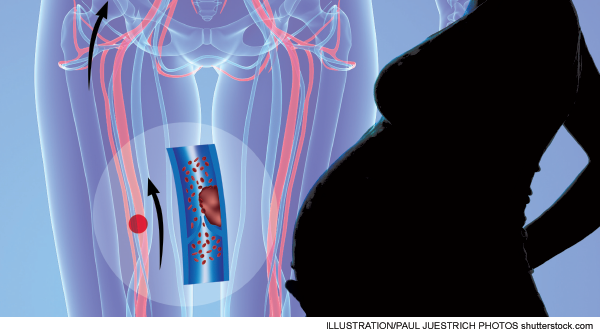
Pregnancy and Clots

If D-dimer is problematic in pregnancy, why not use the PERC rule? PERC is most likely the preferred CDR in current use. However, in the derivation study, six clinical variables were deemed “nonsignificant”: pleuritic chest pain, substernal chest pain, syncope, smoking status, malignancy, and pregnancy or immediate postpartum status.5 Kline and Slattery later reported three factors that were associated with PERC-negative PE. Interestingly, they were pleuritic chest pain, pregnancy, and postpartum status.6 Perhaps removal of these three should be called into question. If nothing else, this certainly limits the PERC rule’s application in pregnancy.

In order to reduce potential radiation exposure, many are recommending that compression ultrasonography be used first in pregnant patients as opposed to computed tomography pulmonary angiogram.4 This approach certainly has merit, particularly in pregnant patients with leg complaints. However, it also has some drawbacks. Venous flow velocity reduces approximately 50 percent in the legs by weeks 25–29 of pregnancy, possibly impacting image interpretation, and isolated iliac vein thrombosis is more common in pregnancy and is difficult to diagnose.1

Pages: 1 2 3 | Single Page

Topics: Clinical GuidelineEmergency MedicineEmergency PhysicianOB/GYNPractice ManagementPregnancyProcedures and SkillsPulmonaryResearchUltrasound

Related

  • Florida Emergency Department Adds Medication-Dispensing Kiosk

    November 7, 2025 - 1 Comment
  • Q&A with ACEP President L. Anthony Cirillo

    November 5, 2025 - 0 Comment
  • November 2025 News from the College

    November 4, 2025 - 0 Comment

Current Issue

ACEP Now: November 2025

Download PDF

Read More

About the Author

Joseph Harrington

View this author's posts »

No Responses to “Lack of Data for Evaluating Venothromboembolic Disease In Pregnant Patients Leaves Physicians Looking for Best Approach”

Leave a Reply Cancel Reply

Your email address will not be published. Required fields are marked *


*
*


Wiley
  • Home
  • About Us
  • Contact Us
  • Privacy
  • Terms of Use
  • Advertise
  • Cookie Preferences
Copyright © 2025 by John Wiley & Sons, Inc. All rights reserved, including rights for text and data mining and training of artificial technologies or similar technologies. ISSN 2333-2603
