
Being a physician can make relationships challenging—long hours, high stress, and the danger of burnout can tax even a strong marriage. But what happens when both spouses are physicians?
Explore This Issue
ACEP Now: Vol 37 – No 09 – September 2018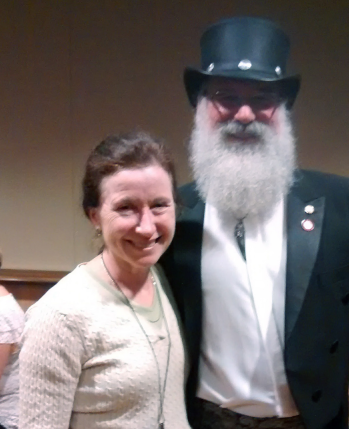
Dr. O’Shea (left) with Reid Blackwelder, MD, at a recent conference.
PHOTOS: Thomas Benzoni & Noreen O’Shea
According to Noreen O’Shea, DO, FAAFP, and Thomas Benzoni, DO, FACEP, the challenges of their demanding careers are balanced by the understanding and support of being married to someone who knows exactly what it’s like to provide care in the emergency department. The couple met as undergraduates and got married shortly before Dr. Benzoni started medical school. About 40 years later, they both teach part-time at Des Moines University in Des Moines, Iowa, where Dr. O’Shea also practices at a federally qualified health center and Dr. Benzoni practices at local emergency departments, Level 1 to Level 4.
The couple recently sat down with ACEP Now Medical Editor in Chief Kevin Klauer, DO, EJD, FACEP, to discuss their experiences of being in a two-physician marriage.
KK: How long have you two been together?
NO: According to him, 50-plus years. We will be married 39 years in August.
KK: How did you two meet? Were you medical students?
TB: This goes back to Creighton University in a class on world hunger.
NO: We met when I was sophomore at Creighton. Everybody had to take a philosophy class, and so we were in a philosophy class on world hunger together.
TB: After our honeymoon, we could survive anything.
NO: We had a difficult honeymoon. We were camping on the Current River in southern Missouri and were attacked by horseflies and had a bout of Montezuma’s revenge.
TB: Yeah. Don’t give your wife salmonella poisoning on your honeymoon. That’s the only advice I’ll give you.
NO: We got married three weeks before he started medical school. And then I didn’t start medical school until a year after him.
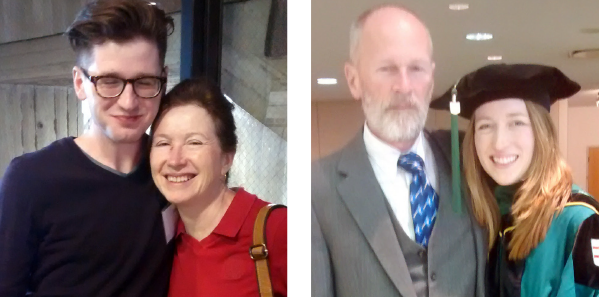
Dr. O’Shea (LEFT) and Dr. Benzoni (RIGHT) with two of their children.
KK: Have you both always practiced emergency medicine?
TB: That’s the only thing I know how to do. The chapter after Creighton is even more formative. Noreen was assigned with the Public Health Service to the Appalachian Mountains. We spent four years in Appalachia and built a hospital where there hadn’t been one.
NO: I’ve been practicing family medicine, but I have done, in order to keep my skills up, one or two days a month in the emergency department.
KK: Tell us about the dynamic and intricacies of a two-physician marriage.
TB: To me, the big advantage is that Noreen understands that I’m in a 24-7-365 business and that sometimes when I come home, I’m a grumpy old bastard, and sometimes when I come home, it’s been a really good day. Most of the days are in between.
KK: It has to be very helpful for somebody to have a fundamental understanding of what the environment is like and what the practice is like.
NO: It also started while we were in medical school. He understood when I felt like I had to study. And he could understand the stresses but also share in the joys.
KK: What are some of the challenges or obstacles of being together as a two-physician team?
TB: A challenge is the opposite side of an opportunity. Just going along chronologically, our oldest [our daughter] was born while we were in Michigan. Having children created some scheduling challenges. The department would have these Saturday morning meetings. Well, we both had to be there, so we’d bring her along. People looked at us funny because you didn’t do that in those days. But we hadn’t seen her all week, so she’s coming with us anyway.
A lot of things just happened to work out if you were willing to get a little bit of grace back and forth. I still send Noreen my proposed schedule, and she gets to veto anything that she wants.
We tried for a while for each of us maintain our own calendars, and you can guess how that worked out. So she’s in charge of the calendar.
NO: And sometimes if I didn’t write it down or I made a mistake on the calendar, we would get a call an hour or half hour after the shift was supposed to have started, “Tom, where are ya?”
TB: In 35 years of doing that, that’s only happened twice.
KK: Noreen, tell us about some challenges from your perspective.
NO: I don’t type that well, so when I can’t dictate because of the structure of the electronic medical record [EMR], I spend a lot more time doing pajama time at home, charting on my patients. He doesn’t have that luxury [to delay charting] in the ED the same way I do. Sometimes, he’s aggravated about it, but he’s more often my champion. We share frustrations about EMRs.
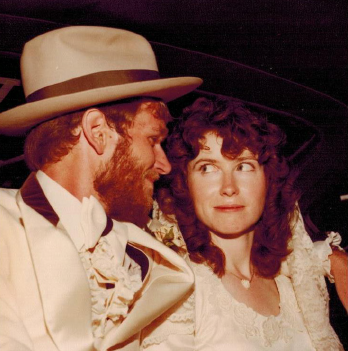
Dr. O’Shea and Dr. Benzoni at their wedding.
KK: It’s difficult enough for someone to be with one physician, but both of you together as physicians in a relationship has to be very complicated. Did you ever get to the point where you thought it was just going to be too hard?
TB: I’ve always been a bit of a realist about it. I know I’m really hard to get along with, so I just figure, with a lot of forgiveness, it goes the other way, too.
NO: We did have a time that was really difficult. There was a lot of pressure externally when he was part of an independent group about 10 years ago. They got down to staffing a very busy Level 2 emergency department with four guys. That was really hard because he and all the rest of them were working so, so hard. That’s a reason, among others, we moved to Des Moines to be out of that hot pressure-cooker situation where he was taking on so much responsibility and so many shifts.
KK: It sounds like that was a turning point for you, too, that if it continued, it could have put your relationship in jeopardy?
TB: By then, the kids were gone. They were all out of the house, and I didn’t see any reason to keep working that hard either. Maintaining the relationship is so important. I often tell people—they think I’m being snarky about it, and it’s only partly true—39 years of marriage and not having to pay a divorce lawyer really gives us a lot of freedom.
NO: I feel like, as a family physician, I can defend emergency physicians and how difficult their work is because not only do I live with one and see that, but I also have worked in the emergency department. Part of my role as a physician’s spouse is to represent my spouse’s specialty in a positive manner. He has also done the same thing.
KK: Can you offer a couple of thoughts for people who may be earlier in their relationships? If you’re going be with a physician or if you’re going to be in a two-physician relationship, how can you make that work?
TB: For me, it’s really easy. Bring in the same attitude you do to work. You have to learn to live, and you have to learn to give some and deemphasize yourself. If you’re fighting, you’re probably not fighting for anything important anyway.
NO: We would make sure we’d get to the kids’ games or whatever was happening at school. He was able in his group to arrange the schedules so that any of his partners or he could make it at the beginning or the end of the school play. Making time for each other and family is really important.
We also find great joy in being part of local medical societies and supporting other physician couples or even couples that are one physician and a non-physician spouse. That has been really helpful.
KK: How many kids do you have?
TB: Want some? Four of them.
KK: I’m sure you wouldn’t give any of them up. How old are they?
NO: One is 33. She’ll be 34 in September. The rest are 30, 28, and 25. Our 28-year-old is in her EM residency.
KK: I’ve learned from listening to you two that despite the fact that it can be challenging in any relationship, you have to find ways to make it work, to find the positives, and to overcome the negatives. You two have been very successful in doing that. Thank you very much for your time and congratulations on all of your successes.
Pages: 1 2 3 4 | Multi-Page




No Responses to “Is a Two-Physician Marriage Double the Challenge or Double the Fun?”