
Explore This Issue
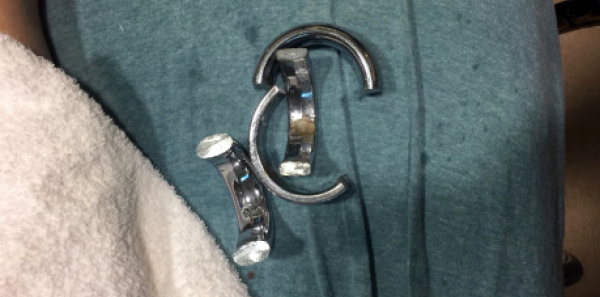
ACEP Now: Vol 40 – No 10 – October 2021Figure 1: Example of multiple rings removed from a single patient that were too hard and thick for normal ring removal devices.
Photos: Matthias Barden
The location of our emergency department in the greater Palm Springs, California, area has likely contributed to significant departmental experience with the removal of constrictive metallic penile hardware. This presentation can be quite anxiety-provoking, both for the patient and the clinicians involved. Removing penile hardware is a time-sensitive, appendage-threatening procedure for which the emergency physician may have limited specialist backup.
Standard tools used for digital jewelry removal in the emergency department have often proven insufficient to deal with this particular type of ring (see Figure 1), and more powerful equipment may not be readily available.
An option described previously has been to rely on EMS for additional tools and assistance, such as use of pneumatic saws or grinding tools.1 However, our experience has been that requesting EMS come into the hospital to assist with a procedure has created liability and scope-of-practice concerns.
A better option is making sure the necessary equipment is ready and available for the emergency department to handle this presentation internally. There have been published case reports describing the use of a widely commercially available electric rotary grinding tool (e.g., a Dremel) for similar situations.2 As described, using a power tool in such proximity to an already vascularly compromised penis poses multiple risks and concerns. Here, we describe our tips and tricks based on our multiple experiences with successfully managing these cases in our department.
Suggested Equipment and Process
You will need a rotary grinding tool such as a Dremel, saline drip set for irrigation, face shield to avoid spark injury to the physician, metallic guard such as a foam aluminum splint or forceps split in half, and towels to avoid spark injury to the patient (see Figure 2).
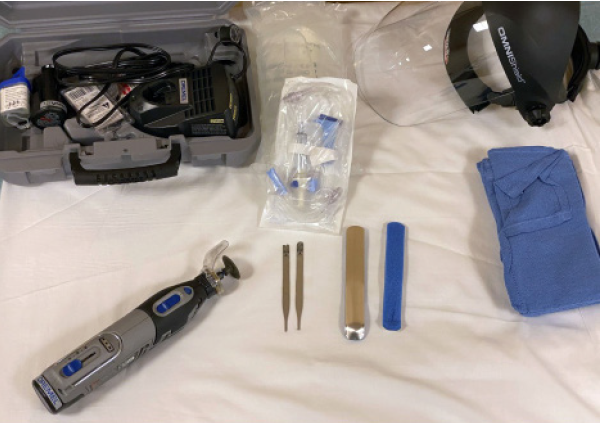
Figure 2: This removal technique requires a rotary grinding tool such as a Dremel, saline drip set for irrigation, face shield to avoid spark injury to the physician, metallic guard such as a foam aluminum splint or forceps split in half, and towels to avoid spark injury to the patient.
The patient should be advised of the risks, benefits, and alternatives for the procedure. We have occasionally utilized moderate sedation with patients who are extremely apprehensive or anxious, but in general, it is helpful to have the patient awake so that they may provide feedback on any discomfort that develops during the procedure. Three major risks that must be mitigated include direct injury if the grinder contacts the skin, injury caused by sparks, and burns from heat generated from the grinding that can be conducted through metal rings.
To avoid direct injury, a metal guard should be inserted between the ring and the patient’s skin. A foam aluminum finger splint can be used. If the available foam aluminum splints are too wide or thick to get into this tight space, we have also had success using a standard set of forceps, which can be manually split into two parts, with one half being used as the guard.
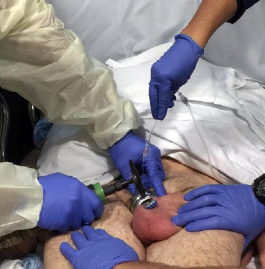
Figure 3: IV drip set irrigation is being used to dissipate heat, the patient and clinicians are shielded from sparks, and a foam aluminum splint is used to protect the skin beneath the device. (In this case, a pneumatic grinding device supplied by EMS was used.)
The patient should be draped with towels with consideration of the path sparks will take during the procedure. Face masks or other eye protection are advised for all clinicians working near the site of spark generation.
Continuous fluid irrigation directly onto the site of cutting is advised, as a considerable amount of heat is produced by the grinding device (see Figure 3). The patient should be advised of this expectation and be asked to give feedback if they feel heat developing so that additional time can be allowed for heat dissipation. Once a cut has been made through the entirety of the ring, some relatively malleable metals can be spread apart wide enough to allow for removal from the genitals. More rigid materials may require the clinician to rotate the ring approximately 180° to make a second full thickness cut.
With these practices, we have had success managing this presentation in our department, but practice patterns may vary depending on the setting of practice. Urology involvement may be beneficial, if available, and there are additional techniques described by urological specialists that could be employed in particularly difficult cases.3
 Dr. Barden is emergency medicine residency associate program director.
 Dr. Rasheed is an emergency medicine resident at Eisenhower Health System in Rancho Mirage, California.
References
- Santucci RA, Deng D, Carney, J. Removal of metal penile foreign body with a widely available emergency-medical-services-provided air-driven grinder. Urology. 2004;63(6): 1183-1184.
- Lamba S, Patel NN, Scott SR. Penile incarceration secondary to an S-shaped lead pipe: removal with Dremel moto-tool. J Emerg Med. 2012;42(6):659-661.
- Detweiler MB. Penile incarceration with metal objects—a review of procedure choice based on penile trauma grade. Scand J Urol Nephrol. 2001;35(3):212-217.
Pages: 1 2 3 | Multi-Page



One Response to “How To Remove Incarcerating Metallic Penile Hardware”
October 31, 2021
Sam GradyMost people don’t necessarily have access to all those supplies. Instead, use a cast cutter and have cold saline to reduce excessive heating from the cutter.