Logo

Log In Sign Up |  An official publication of: American College of Emergency Physicians
Navigation
  • Home
  • Multimedia
    • Podcasts
    • Videos
  • Clinical
    • Airway Managment
    • Case Reports
    • Critical Care
    • Guidelines
    • Imaging & Ultrasound
    • Pain & Palliative Care
    • Pediatrics
    • Resuscitation
    • Trauma & Injury
  • Resource Centers
    • mTBI Resource Center
  • Career
    • Practice Management
      • Benchmarking
      • Reimbursement & Coding
      • Care Team
      • Legal
      • Operations
      • Quality & Safety
    • Awards
    • Certification
    • Compensation
    • Early Career
    • Education
    • Leadership
    • Profiles
    • Retirement
    • Work-Life Balance
  • Columns
    • ACEP4U
    • Airway
    • Benchmarking
    • Brief19
    • By the Numbers
    • Coding Wizard
    • EM Cases
    • End of the Rainbow
    • Equity Equation
    • FACEPs in the Crowd
    • Forensic Facts
    • From the College
    • Images in EM
    • Kids Korner
    • Medicolegal Mind
    • Opinion
      • Break Room
      • New Spin
      • Pro-Con
    • Pearls From EM Literature
    • Policy Rx
    • Practice Changers
    • Problem Solvers
    • Residency Spotlight
    • Resident Voice
    • Skeptics’ Guide to Emergency Medicine
    • Sound Advice
    • Special OPs
    • Toxicology Q&A
    • WorldTravelERs
  • Resources
    • ACEP.org
    • ACEP Knowledge Quiz
    • Issue Archives
    • CME Now
    • Annual Scientific Assembly
      • ACEP14
      • ACEP15
      • ACEP16
      • ACEP17
      • ACEP18
      • ACEP19
    • Annals of Emergency Medicine
    • JACEP Open
    • Emergency Medicine Foundation
  • About
    • Our Mission
    • Medical Editor in Chief
    • Editorial Advisory Board
    • Awards
    • Authors
    • Article Submission
    • Contact Us
    • Advertise
    • Subscribe
    • Privacy Policy
    • Copyright Information

How To Manage Tracheo-Innominate Fistula

By Jonathan Glauser, MD, FACEP, MBA; David Effron, MD, FACEP | on March 14, 2024 | 0 Comment
Airway
  • Tweet
  • Click to email a link to a friend (Opens in new window) Email
Print-Friendly Version

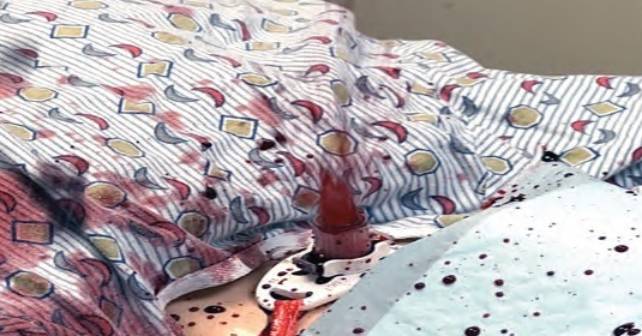
A 24-year-old male with history of quadriplegia and traumatic brain injury presents to the emergency department with hemorrhage in his oral cavity and blood from his tracheostomy tube. He has had a tracheostomy for approximately 15 months since his injury. Blood is spurting from the orifice of the tube.

You Might Also Like
  • Quick Tips for ENT Emergencies
  • How to Manage Fluids in Emergency Airway Procedures
  • Early Tracheostomy May Be Beneficial in Ventilated COVID-19 Patients
Explore This Issue
ACEP Now: Vol 43 – No 03 – March 2024

Tracheo-innominate fistula (TIF) is an unusual and frequently lethal complication of such definitive airway placement. First reported in 1879 in the case of diphtheria in a pediatric patient, TIF is fatal without surgical treatment due to hemorrhage and failure of airway security. It occurs after an estimated 0.1-1 percent of tracheostomies.1,2,3 Unlike most lethal entities, TIF does not predominantly affect the elderly. In one case series of seven patients, the average patient age was 15.7 years, all of whom had prior severe neurological deficits such as cerebral palsy, agenesis of the corpus callosum, or muscular dystrophy.4

Sentinel bleeding may occur in more than 50 percent of patients, with peak incidence of three days to six weeks following tracheostomy. It is reported that massive hemorrhage occurring three days to six weeks after tracheostomy is TIF until proven otherwise. Vascular erosion from a tracheostomy tube requires at least 48 hours to develop.5

Diagnosis and Pertinent Anatomy
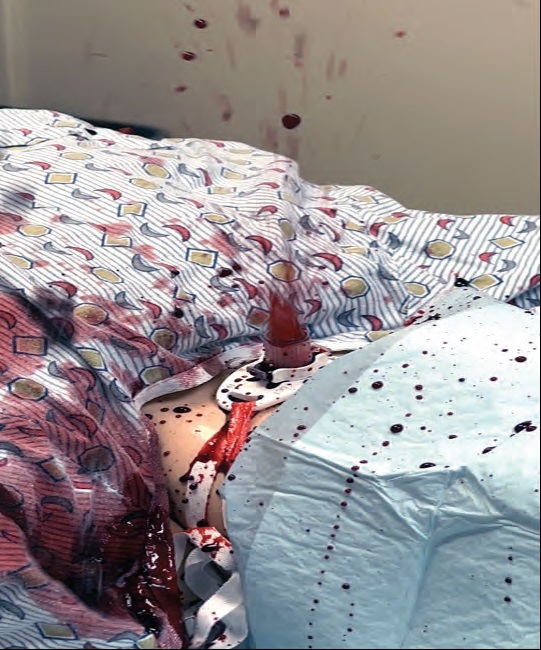
Tracheo-Innominate fistula, a lethal complication of intubation/tracheostomy. (Click to enlarge.)

The innominate artery is the first branch off of the aortic arch. It divides into the right common carotid artery and the right subclavian artery behind the right sternoclavicular joint. The innominate artery runs anterior to the trachea, at approximately the 6th-10th rings, and usually traverses the trachea at the 9th ring.6 A high-lying innominate artery may therefore be a risk factor in formation of TIF. This is also a consideration in controlling bleeding around a tracheostomy site with direct compression.

The condition develops as a connection between the posterior wall of the brachiocephalic trunk and the anterior aspect of the adjacent trachea. On angiography of the brachiocephalic trunk, there may be a small dot of contrast medium accumulation, or no detectable leakage. Bronchoscopy may show no sign of TIF.7,8 The significance of this is clear: bronchoscopy or angiography may not suffice to make the diagnosis in the emergency setting.

Diagnosis of TIF may have to be made on clinical grounds—sudden arterial bleeding from a tracheotomy or ET tube—perhaps with radiographic finding of innominate artery compression by the trachea and/or computed tomography (CT) angiography of the neck and chest. CTA may show no active bleeding source, but may demonstrate that the tip of the tracheal tube is flush with the innominate artery.9 There may be no time in which to perform a CT scan, and as noted above, CTA and laryngoscopy may show no remarkable findings of fistula.10

Pages: 1 2 3 4 5 | Single Page

Topics: Airway ManagementClinicalfistulaIntubationTracheostomy

Related

  • Why the Nonrebreather Should be Abandoned

    December 3, 2025 - 0 Comment
  • Non-Invasive Positive Pressure Ventilation in the Emergency Department

    October 1, 2025 - 0 Comment
  • Emergency Department Management of Prehospital Tourniquets

    October 1, 2025 - 0 Comment

Current Issue

ACEP Now: November 2025

Download PDF

Read More

No Responses to “How To Manage Tracheo-Innominate Fistula”

Leave a Reply Cancel Reply

Your email address will not be published. Required fields are marked *


*
*


Wiley
  • Home
  • About Us
  • Contact Us
  • Privacy
  • Terms of Use
  • Advertise
  • Cookie Preferences
Copyright © 2025 by John Wiley & Sons, Inc. All rights reserved, including rights for text and data mining and training of artificial technologies or similar technologies. ISSN 2333-2603
