
Last year, you added to your busy schedule the role of your hospital’s Sexual Assault Nurse Examiner (SANE) Program medical director. As your hospital also has recently become a trauma center, your department now treats many patients who are victims of violence. The department has a very active Sexual Assault Nurse Examiner (SANE) program. The emergency department (ED) nurse manager comes to you one day and asks for your help in converting the SANE program into a forensic care program. How should you proceed? What is your answer?
Explore This Issue
ACEP Now: March 2026Discussion: SANE programs in the United States were first established in the mid- to late 1970s, to address inadequate or unprofessional treatment of sexual assault victims in EDs and to improve the collection of forensic evidence.1 Since then, more than 1,000 programs have been established across the country to provide this vital service.2 Over the past one to two decades, many hospitals have transitioned these programs into comprehensive forensic programs. These programs use SANE nurses as forensic nurse examiners to provide comprehensive care for all victims of violence. Typical victims treated include adult/adolescent sexual assault, domestic violence, pediatric sexual assault, child abuse and neglect, elder/vulnerable adult abuse and neglect, strangulation, assault, firearms injury, stabbings, and other violent crimes.
The backbone of these programs is SANE training. Another important part of the program is providing survivor-centered, trauma-informed care. These services complement the emergency/trauma care already provided by the hospital and provide a crucial link to the criminal justice response for victims of violence. Studies have shown the importance of a criminal justice response for victims.3 Historically, studies have found improper injury identification, gunshot wound identification, and forensic evidence handling in the ED.4-6
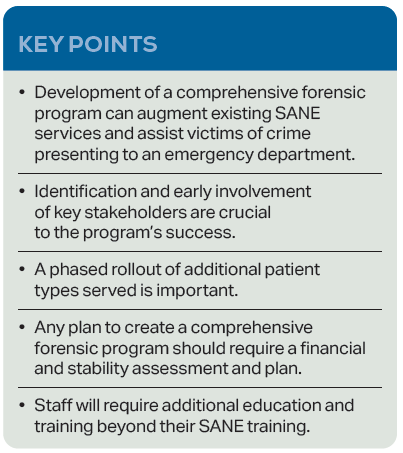
Several recommended steps can guide the expansion from a SANE program to a comprehensive forensic program.
Step 1: Define the Expanded Scope
This answer will help guide you along the rest of the process. Which of the previously mentioned patient types will be included in your scope of services? Once determined, you will need to create scope statements for the patient populations, examination types, and on-call/on-shift coverage expectations.
Step 2: Update Clinical Protocols and Policies.
Your SANE policies will not be enough on their own. You will need to expand examination policies and procedures beyond sexual assault and create a policy for each category of patient. You will also need a non-sexual assault evidence collection policy and procedure. You should also create strangulation and physical assault documentation standards if those are not already a part of your forensic documentation. Consent forms will need to be updated highlighting the uniqueness of different exams and potentially different evidence pathways. You will also need to address how to manage patients who decline law enforcement involvement. Other key policies that will require development and/or revision include:
- Evidence handling and chain of custody;
- Photography standards;
- Mandatory reporting (especially for pediatric, vulnerable adult, and violent crime patients);
- Safety planning and advocacy referrals; and
- Subpoena and testimony response.
It is best practice to involve advocacy centers and crime victim centers early in the development of your center. They can provide valuable information, insight, and training of your staff, but also may provide an advocate response to the hospital when a patient presents.
Step 3: Expand Staff Education and Certification
SANE training alone does not equal Comprehensive Forensic Examiner readiness. Nurses should maintain their SANE-A/SANE-P credentials and certifications. Additional courses required can include:
- Strangulation assessment training;
- Injury interpretation and documentation;
- Advanced forensic photography;
- Intimate partner violence (IPV) and trafficking identification;
- Pediatric-focused training;
- Elder and vulnerable adult-focused training;
- Firearms injury identification training; and
- Court testimony.
Create a list of all available courses and training required and how the nurses can complete them. Online and local/ regional courses provide the most cost-effective options. Seek grants and charitable contributions to help pay for registration and attendance fees. Most programs will cross-train experienced SANEs first.
Additionally, program leadership should create tiered competency levels and minimal educational standards for the examiners. This often includes requiring proctored exams by experienced SANEs when new populations are added.
Step 4: Strengthen Medical–Legal Partnerships.
A comprehensive forensic program lives or dies by its relationships with community entities. Formal memoranda of understanding should be developed with law enforcement agencies, prosecutors’ offices, child protective and adult protective services, advocacy organizations, crime labs, and violence intervention programs. This can become a daunting task when you provide services to multiple police jurisdictions and counties. You may want to focus on the largest and busiest ones first. Consider having a representative from each agency serve on your multidisciplinary team to meet regularly to discuss successes, challenges, and barriers. Important concepts include provision of medical-forensic examinations without police presence and management of evidence collected.
Step 5: Upgrade Equipment and Infrastructure.
Beyond your standard SANE kits, you will need dedicated forensic cameras and secure image storage (which require their own policies and procedures), alternate evidence collection kits and supplies (clothing, swabs, weapons, projectiles, etc.), strangulation documentation tools, body maps and injury measurement tools, and secure evidence storage and handling/transfer. Supplies should be pediatric appropriate, centrally located, and mobile to go to wherever the patient is in your ED.
Step 6: Revise Documentation and Electronic Medical Record (EMR) Workflows.
Comprehensive programs require different documentation than sexual assault medical forensic exam documentation. Many of the principles are the same and can be incorporated into the new forms. New EMR templates for different exam types will need to be created and should include photo upload integration. There should also be clear separation of medical versus forensic documentation.
Step 7: Address Funding and Stability.
SANE funding is often restricted to sexual assault. A small number of states provide reimbursement for other specific examinations. How your program will be funded and sustained is key to its success. Often, blended funding streams are required (hospital support, victims of crime assistance, federal and state grants, foundation grants, and philanthrophic donations). It will need to be determined whether the center should be its own cost center or rolled up into the ED/trauma center cost center. Will the staff be dedicated to the program or share work responsibilities in the ED? Keeping statistics on the patient types seen and outcomes can help when seeking outside funding. You can show your return on investment by reduced ED lengths of stay, improved prosecution outcomes, trauma-informed care metrics, and links to crucial services.
Step 8: Change the Program Identity.
This is a crucial step. You may need to rename the program to adequately describe the work being done. You will need to reeducate the ED and trauma staff on when to call the team. Call schedules, policies, and marketing strategies will need to be updated. Finally, you will need to manage the expectations of your partners and the community.
Step 9: Plan Your Rollout.
Successful programs rarely flip a switch. A carefully planned phased approach is essential. Many programs first add strangulation and physical assault, then IPV and trafficking, and finally, pediatric and elder/ vulnerable adult services. Each phase will require training, protocol development and updates, partner notification, and go-live evaluation.
Step 10: Quality Assurance and Outcomes Tracking.
Program scrutiny is important and can be a key to its success. Data on case types and volumes, evidence acceptance rates and outcomes, and legal outcomes should be tracked. Response metrics and patient data should be tracked as well.
 Additionally, the comprehensive forensic program should build upon the existing peer review and continuous quality improvement (CQI) frameworks. Peer review and CQI standards should be created for each patient type.
In summary, a SANE program focuses on one crime while a comprehensive forensic program focuses on forensic excellence across many trauma types. It can be a valuable service the hospital provides to patients and the community but must be well planned and involve key stakeholders.
Conclusion
You and your nurse manager embarked on the journey and followed the steps outlined here and consulted other programs in the country. A phased program outline was developed, and within six months, the program expanded to care for strangulation survivors, with a plan to expand to all crime victims over the next year.
 Dr. Rozzi is an emergency physician, medical director of the Forensic Examiner Team at WellSpan York Hospital in York, Pennsylvania, and secretary of ACEP’s Forensic Section.
 Dr. Riviello is chair of emergency medicine at Crozer-Keystone Health System and medical director of the Philadelphia Sexual Assault Response Center.
References
- Office for Victims of Crime. SANE program development and operation guide. Washington, DC, 2015 (rev, 2025). Available at: https://www.ovcttac.gov/downloads/saneguide/sane-guide-revised-2025-formatted-508-12092025_JA.pdf
- International Association of Forensic Nurses. SANE program listings. Available at: https://myonline.forensicnurses.org/rolodex/searchOrganizationDirectory
- Campbell R, Patterson D, Bybee D. Prosecution of adult sexual assault cases: a longitudinal analysis of the impact of a Sexual Assault Nurse Examiner Program. Violence Against Women. 2012;18:223-234.
- Batts JJ, Sanger RM. Collecting forensic evidence in the emergency department: a guide for lawyers, investigators, and experts. American Journal of Trial Advocacy. 2020;42(2):331-384.
- Carmona R, Prince K. Trauma and forensic medicine. J Trauma. 1989;29:1222-1225.
- Apfelbaum JD, Shockley LW, Wahe JW, Moore EE. Entrance and exit gunshot wounds: incorrect terms in the emergency department? J Emerg Med. 1998;16(5):741-745. https://doi.org/10.1016/S0736-4679(98)00075-4.



No Responses to “How To Develop a Comprehensive Forensic Care Program beyond SANE”