

As part of the Career Fulfillment pillar of ACEP’s new strategic plan, the College is committed to aggressively solving challenges and supporting well workplaces for all emergency physicians using evidence-driven tactics. There are many factors that contribute toward a “well workplace,” but one of the most important is that emergency physicians need to be protected from violence in the emergency department (ED).
Explore This Issue
ACEP Now: Vol 41 – No 07 – July 2022When it comes to the increase in ED and hospital violence, there is no one-size-fits-all solution. ACEP has been using a multipronged approach to combat this issue through federal advocacy, regulatory changes, and public awareness campaigns. The College believes employers and hospitals should develop workplace-violence prevention and response procedures that address the needs of their particular facilities, staff, contractors, and communities, as those needs and resources may vary significantly. ACEP is currently lobbying hard in Congress for two important workplace-violence bills, but let’s go back to a few years ago when ACEP started collecting the evidence needed to confirm the problem.
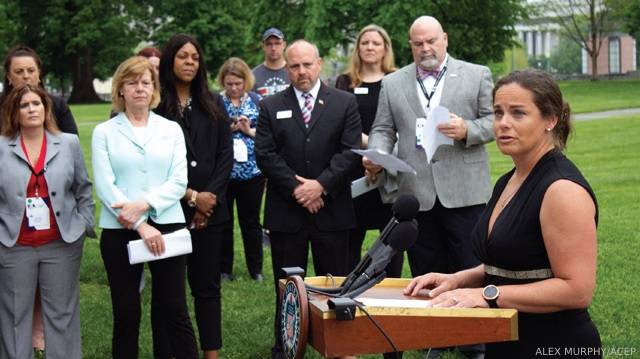
Jennifer Casaletto, MD, FACEP, spoke during ACEP’s and ENA’s May 4 press event at Capitol Hill to raise public awareness and push the Senate to move forward with the Workplace Violence Prevention for Health Care and Social Service Workers Act.
Collecting Evidence
In September 2018, ACEP conducted a poll of its members to illustrate the breadth and impact of workplace violence in the ED. The findings were powerful: Almost 50 percent of emergency physicians had been physically assaulted at work and more than 60 percent of those incidents had occurred in the year before the survey. Nearly seven out of 10 respondents said their hospitals reported the incidents, but only three percent pressed charges. And violence isn’t limited to the clinicians either; more than 50 percent said that patients had been physically harmed during an incident.
Since the poll’s release in October 2018, our data has been mentioned nearly 700 times across a broad variety of media outlets, including CNN, The Washington Post, USA Today, Huffington Post, U.S. News & World Report, and Kaiser Health News. The poll was also directly cited in the “Findings” section of the ACEP-supported Workplace Violence Prevention for Health Care and Social Service Workers Act (H.R. 1195), federal legislation introduced by Representative Joe Courtney (D-CT) to require the Occupational Safety and Health Administration (OSHA) to issue an enforceable workplace violence prevention standard for health care and social service employers.
Joining Forces
After the poll results were in, ACEP joined forces with the Emergency Nurses Association (ENA) to launch “No Silence on ED Violence,” a campaign aiming to support, empower and protect ED personnel by raising awareness of the serious dangers health workers face every day, and by generating action among stakeholders and policymakers to ensure a violence-free workplace for emergency nurses and physicians. This partnership kicked off in October 2018 and is still going (stopEDviolence.org).
At the close of ACEP’s 2022 Leadership & Advocacy Conference (LAC22) in early May, ACEP and ENA cohosted a press conference on Capitol Hill during which emergency physicians and nurses shared their personal experiences to raise awareness about the frequency of attacks within the emergency department and to push the Senate to move forward with the Workplace Violence Prevention for Health Care and Social Service Workers Act.
“The pandemic continues to show everyone how vital emergency care can be, but it has only exacerbated many of the factors that contribute to violence in the emergency department,” said ACEP President Gillian Schmitz, MD, FACEP. “The health care professionals in our nation’s emergency departments are fully dedicated to caring for patients and saving lives. Now Congress has a critical opportunity to pass legislation to protect each of them from violent attacks on the job.”
Identifying Challenges
In 2020, ACEP was part of an action team sponsored by the National Quality Forum that included 27 experts and recognized leaders from the private and public sector committed to improving the safety of the health care workforce. The team developed an issue brief that includes specific set of priority challenges for policymakers and other stakeholders to address. See sidebar for the full list.
Reform Through Regulation
On Jan. 1, 2022, The Joint Commission (TJC) started enforcing new workplace violence prevention requirements to guide hospitals in developing strong workplace-violence prevention programs. ACEP helped develop these new requirements by participating in an expert workgroup and supplying comments. Here’s an overview of the new standards:
- Workplace Assessment: Hospitals must conduct an annual worksite analysis related to their workplace violence prevention program, and based upon findings, leadership must take action to mitigate or resolve the workplace violence safety and security risks.
- Monitoring: Hospitals must establish processes for continually monitoring, internally reporting, and investigating workplace hazards, such as safety and security incidents involving patients, staff, or others within its facilities, including those related to workplace violence.
- Education and Training: Hospitals must provide training, education, and resources to leadership, staff, and licensed practitioners to address prevention, recognition, response, and reporting of workplace violence, including training in de-escalation, nonphysical intervention skills, physical intervention techniques, and response to emergency incidents.
- Response Plans: Hospital response plans will specify policies and procedures to prevent and respond to workplace violence, processes to report incidents to analyze incidents and trends, and processes for follow-up and support to affected victims and witnesses.
ACEP is also working with the U.S. Occupational Safety and Health Administration (OSHA) to seek input from emergency physicians to create federal workplace standards and protections for health care workers. However, OSHA’s regulatory process has been put on hold during the COVID-19 public health emergency.
Lobbying for Legislation
Protecting emergency physicians from ED violence has been a core component of ACEP’s federal advocacy efforts for years and was a priority issue during LAC22 in early May. Hundreds of emergency physicians shared their stories about encountering ED violence with their legislators and asked them to establish important, common sense procedures to protect emergency physicians, health care workers, and patients from violence in the health care workplace.
ACEP is lobbying for two bills on the table right now that seek to prevent workplace violence, working closely with the sponsors throughout:
H.R. 1195/S. 4182: Workplace Violence Prevention for Health Care and Social Service Workers Act
Senate version introduced by Sen. Tammy Baldwin (D-WI) on May 11, 2022, 27 cosponsors as of June 17, 2022.
This bipartisan effort takes critical steps to address ED violence by requiring OSHA to issue enforceable standards to ensure health care and social services workplaces implement violence prevention, tracking, and response systems.
The House of Representatives version (H.R.1195), which ACEP played a critical role in shaping so that its protections extended to emergency physicians who are in a group rather than directly employed by the hospital, passed in a bipartisan 254-166 vote in the House on April 16, 2021. The Senate version of the bill (S. 4182) was introduced just after LAC22 and has 27 cosponsors. ACEP is urging the Senate to follow the House and swiftly consider and pass this important legislation.
H.R. 7961: Safety from Violence for Healthcare Employees (SAVE) Act
Introduced by Reps. Madeleine Dean (D-PA) and Larry Bucshon, MD (R-IN) on June 7, 2022, four additional cosponsors as of June 17, 2022.
This new, bipartisan legislation takes critical steps to address emergency department violence by establishing legal penalties for individuals who knowingly and intentionally assault or intimidate health care workers, and creates grants to help hospitals and medical facilities establish and improve workplace safety, security, and violence prevention efforts.
This legislation is modeled after protections that currently exist for aircraft and airport workers, such as flight crews and attendants, whose exposure to violence and assault from unruly passengers has been extensively and publicly documented in recent years.
Your Voice Matters
Want to push these workplace-violence bills forward? Urge your legislators to cosponsor these bills and thank them for their support. Use ACEP’s Advocacy Action Center for a simple way to contact your legislators and ask for their support of these critical bills. You can also call their offices and share your personal stories from the ED. Your firsthand experience with workplace violence is especially compelling and helps legislators put a face to the concern.
Jordan Grantham is senior content manager at ACEP.



No Responses to “How ACEP Is Pushing for a Safer Workplace”