
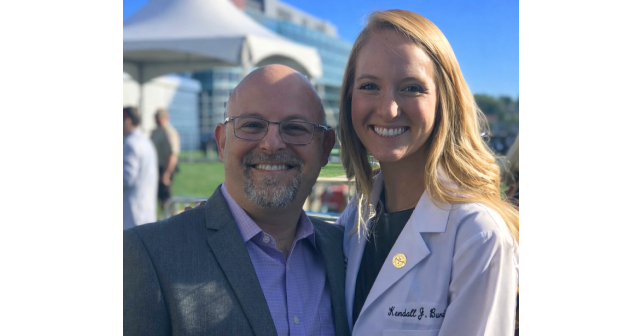
When Kendall Donohue, MD, matched into a pediatric emergency medicine fellowship, she was embarking on a path shaped over more than a decade and guided in part by Eric Fleegler, MD, MPH, a mentor who had known her family since before she was born.
Explore This Issue
ACEP Now: February 2026 (Digital)Dr. Fleegler’s connection to Dr. Donohue’s family dates to his days as a medical student at the University of Pennsylvania. His parents lived in Ambler, Pennsylvania, where they became close friends with their next-door neighbors, Dr. Donohue’s parents. After Dr. Donohue was born, she and her two brothers became regular visitors — practically family — at Dr. Fleegler’s family home.
“Kids from the neighborhood would come over to my mom’s house a lot. She was kind of in this grandmother role,” recalled Dr. Fleegler. “She had chests of toys for them, and she would make them Jell-O in the shape of race cars. Kendall and these neighborhood kids became ‘the Jell-O kids’ to us.”
Years later, while in high school, Dr. Donohue began thinking seriously about becoming a physician. She returned to her family friend Dr. Fleegler, describing her interests in medicine and science and seeking advice on what she could do next.
“He said, ‘I’m doing this research project on social medicine, and I think that would be a great opportunity for you to learn and get some experience,’” she recalled.
At the time, Dr. Fleegler was a pediatric emergency physician in Boston with a research focus on social determinants of health. That summer, Dr. Donohue joined his team working on software for longitudinal tracking of chronic disease symptoms. What began as a summer research project evolved into a long-term collaboration. Over the next decade, Dr. Fleegler and Dr. Donohue worked together as mentor and mentee, supervisor and trainee, attending and resident, and eventually research collaborators and colleagues.
“We first started working together about 12 years ago, and we’ve never actually had any period of time where we stopped working together on something,” said Dr. Fleegler.
Their story is one shaped by geography. Dr. Fleegler met Dr. Donohue because their families happened to live next door to one another. In a bit of poetic symmetry, years later, they collaborated on research using geographic information systems (GIS) to map how location shapes access to emergency care. They have now co-authored five papers together, exploring geographic inequities along with other topics including social needs screening in the emergency department, access to pediatric trauma care, and associations between historic redlining (the federal policy restricting housing and credit services by geographic area) and firearm violence.
One of Dr. Fleegler’s projects aimed to create a system connecting families seen in the emergency department and other locations with community-based resources. The project, which launched in 2003 under the name, The Online Advocate, became known as HelpSteps in 2014 when it served as the main referral system for the Boston Public Health Commission. It was adopted in 2017 by the United Way/Mass2-1-1 and is used by more than 500,000 people annually across the state of Massachusetts.
Early in her career, Dr. Donohue helped build the project’s database, and Dr. Fleegler recalled her work as meticulous and essential. “It is an arduous, somewhat thankless, task. It is hard. Kendall turned out to be a master,” he said.
Dr. Fleegler continued to guide Dr. Donohue as she progressed in her career. He encouraged her to seek out grants, tasked her with learning new tools, and supported her taking ownership of projects. He was a sounding board for her career decisions, from residency applications to research directions.
For Dr. Donohue, one of the most influential aspects of Dr. Fleegler’s mentorship is his approach to teaching, even in clinical practice. She recalled an early ED shift when a young child presented with croup. Rather than offering a quick explanation in a busy emergency department, Dr. Fleegler sat down with the family, drew diagrams, and carefully walked them through what they could expect.
“He’s the best teacher. He will give the best education to a friend, a neighbor, a patient, and a research mentee. It’s something that I have been lucky to see in all those different spaces,” Dr. Donohue said.
Dr. Donohue described Dr. Fleegler as someone who treats nearly every question as an opportunity to help, whether the topic is research topics, career planning, or even daily life outside of medicine.
“If I ask him, ‘Should I be investing in my retirement fund?’ I will get a thoughtful 10 minutes on the pros and cons, what he did, what he didn’t do, what he thinks I should do,” she said.
This year’s fellowship match brought their shared history full circle. Dr. Donohue matched into pediatric emergency medicine at Boston Children’s Hospital — the same fellowship Dr. Fleegler completed earlier in his career.
“It feels like a perfect finish to a story and start of a career. I feel like I already have so much backing to support me,” Dr. Donohue said.
Both consider their relationship to be an example of what mentorship in emergency medicine, at its best, can be: enduring, flexible, and centered on mutual growth.
“Having a mentor like Eric, they aren’t putting their interests first, they are truly mentoring and shaping the person that the mentee wants to be,” said Dr. Donohue.
“Mentorship relationships should really be two ways. We learn from each other. I may bring greater depth of experience and history of doing stuff, but we work together, we learn together, we develop questions together, and truly, that’s when it really becomes fun,” added Dr. Fleegler.
When asked about Dr. Donohue’s future, Dr. Fleegler is certain: “One day she’ll be my boss. Kendall is going to have an amazing career ahead of her.”
Ms. Enser is ACEP’s Public Relations Manager.



No Responses to “Full Circle: The Power of Long-Term Mentorship in Emergency Medicine”