
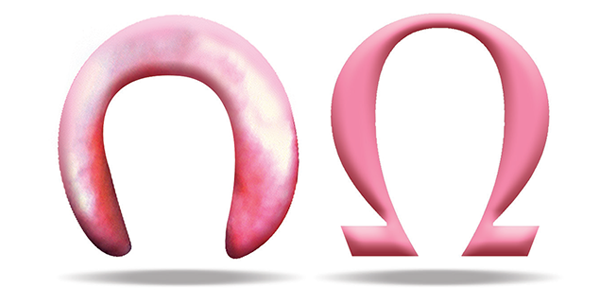
Curved blade laryngoscopy, whether with a conventional direct blade or video laryngoscope (with a Macintosh design or hyperangulated shape), depends on indirect elevation of the epiglottis. The tip of the blade sits in the vallecula, with the epiglottis lifted upward by pressure on the underlying hyoepiglottic ligament. The epiglottis is positioned between the line of sight (video or direct) and the glottic opening.
Explore This Issue
ACEP Now: Vol 35 – No 06 – June 2016In my cadaver lab in Baltimore, as well as in emergency airways, I am increasingly encountering the “omega-shaped epiglottis.” A long, curvilinear epiglottis with an omega shape has commonly been reported in children, but I have noticed it is quite common in obese adult patients as well.
An omega-shaped epiglottis creates multiple challenges for intubation. The epiglottis may be difficult to elevate, precluding any sighting of the glottis. Passing a tube or bougie through a long omega-shaped epiglottis is akin to passing a thread through a needle. The operator cannot see if the tip of a tube or bougie is actually going into the glottis.
Difficulties of tube delivery and laryngeal exposure are especially problematic in obese patients. Many of these patients require continuous positive airway pressure before and during induction to maintain oxygenation, and they require a “one and done” approach to intubation to avoid desaturation. They have short safe apnea times and are often difficult to mask ventilate.
Emergency airway providers should anticipate this problem, especially in obese patients, and have a clear plan for tackling the challenge.
Techniques for handling the omega-shaped epiglottis include:
1 Using bimanual laryngoscopy. This changes how the tip of the blade interacts with the hyoepiglottic ligament. This is best done by operators applying their right hand to the neck during direct or video laryngoscopy. Occasionally, assistants are needed to maintain pressure at the proper location because the view can deteriorate when pressure is released.
2 Using a bougie to “thread the needle” (see Figure 1). This also allows confirmation of placement within the trachea as the bougie interacts with the tracheal rings.
3 Lifting the epiglottis directly with the tip of the curved blade, thereby providing direct exposure to the larynx (see Figure 2). This is best accomplished with a standard geometry Macintosh blade, whether direct or video (eg, GlideScope Titanium Macintosh, McGrath Mac, or Storz C-Mac), as opposed to a hyperangulated video laryngoscope. Hyperangulated blades (standard GlideScope, Storz D blade, McGrath X-blade, and other hyperangulated devices such as King Vision) may not be long enough to reach down and elevate the epiglottis directly.
4 Using a straight blade direct laryngoscope. Find the epiglottis, then position the blade in the right side of the mouth, pivot the tip of the blade under the epiglottis, and advance slightly and then lift. Keep the proximal end of the blade in the extreme corner of the mouth (right paraglossal positioning). The small flange of the Miller design does not permit sweeping of the tongue. Moreover, the straight design does not allow pivoting back toward the center. Because of the shape of the dental arch, the straight blade (handle) can only pivot backwards if positioned all the way rightward (right on the right nostril).

(click for larger image)
Figure 1. Omega-shaped epiglottis visualized with GlideScope Titanium Macintosh #4 blade. The intubation is accomplished using a styletted tube (straight-to-cuff shape, 35 degrees) and “threading the needle” by carefully passing it through the omega-shaped epiglottis into the glottis. In bottom left image, the cuff is obscuring visualization of the target. In bottom right image, the tube can be seen passing over the posterior cartilages.

(click for larger image)
Figure 2. Omega-shaped epiglottis lifted directly by tip of Storz C-Mac blade. An advantage of the Storz C-Mac, GlideScope Titanium Mac, or McGrath Mac blades is that they can be used to lift the epiglottis directly if necessary (ie, using a curved blade like a straight blade). Size #4 Mac blades of these products work best and are recommended for all adult patients. The flange heights of all three of these products are the same in Mac #3 and Mac #4 sizes, and sometimes the extra blade length is necessary. Using a Mac #4 blade on all patients prevents having to switch to a larger size. Always start laryngoscopy holding the blade very lightly (two-finger grip with thumb) and follow down the tongue until the epiglottis is identified. For many patients, you will not need full insertion of the Mac #4, but having it readily available is very helpful.
Pages: 1 2 | Multi-Page



One Response to “Four Techniques for Handling the Omega-Shaped Epiglottis”
August 16, 2021
Marcelo S RamosThere are two epiglotiis variants that pose a challenge for intubation the omega shaped described in this issue and what I usually call “Elephant ear epiglottis”, a large floppy epiglottis that is exptremally soft and falls over the glottic openning when you perform DL/VL. For both I adopt the solution of using the blade as if it were a straight Miller blade.