
The emergency department at Texas Health Harris Methodist Hospital in Fort Worth is a different breed of emergency department. This can be felt upon entering the beautiful facility through the patient entrance. The greeter area is a stunning architectural space that is quiet, uncluttered, and welcoming. Filled with art and natural light (with attractive furniture on gleaming granite floors), the space is calming and invites patients to be seen. This waiting room serves more as a lobby and is meant for families, not patients. The fact that it was nearly empty every time we passed through it was testimony to the efficient operations within.
Explore This Issue
ACEP Now: Vol 35 – No 04 – April 2016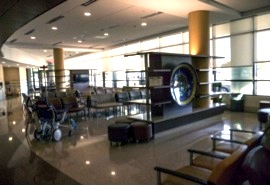
The patient entrance/waiting room at Texas Health Harris Methodist Hospital.
Texas Health Fort Worth by the Numbers
- Annual census: 123,000
- Beds: 100
- Admission rate: 24 percent
- Ambulance arrivals: 30 percent
An “all hands on deck/patients first” imperative is imbedded into the culture and is almost palpable. The Texas Health Fort Worth ED has a long legacy of excellent teamwork, communication, cooperation, and overall effectiveness. The department is almost continuously trialing improvements, and this continuous “change culture” has bred amazing innovation. It has a systematic process for the rollout and trial of changes in the department that heavily involves the input of frontline physicians and staff. The ED gives almost every initiative a six-week opportunity to succeed, and as a result, they are enjoying a decades’ worth of improvement. Patient flow and workflow processes are not static. The department is always trying to improve. Some initiatives have not worked, but many have, and these changes added to the already-efficient operations in the Texas Health Fort Worth ED.
The ED boasts unrivaled performance in both clinical and operational metrics. Most of their Core Measures metrics (pneumonia, stroke, ST elevation myocardial infarction, sepsis) had performance at above 95 percent, with many at 100 percent. Further, its operational performance is unheard of in EDs seeing more than 100,000 patients a year.
Texas Health Fort Worth Performance Metrics
- Door to doc: 20 minutes
- Overall length of stay: 185 minutes
- Length of stay for admitted patients: 291 minutes
- Left without being seen: 1.4 percent
What are some of its strategies for such outstanding workflow, patient flow, and clinical quality? It begins with a very efficient intake process using traditional nurse triage. This process is abbreviated and takes fewer than five minutes with rapid bed placement. There is capacity for the triage of 10 patients at once, and though I like physician triage preferentially, if traditional nurse triage is abbreviated, resourced, and staffed properly, it can be a very effective intake model. It clearly is effective as it has been implemented at Texas Health Fort Worth.
The physicians are obsessive about monitoring the tracking system for new patients being placed in rooms. Patients not yet seen by a qualified medical professional appear with a red cue on the tracker, and it is unusual to see more than a few red cues on the tracking board even on a busy afternoon. It is also unusual to see a patient who has been waiting to see a physician for more than 20 minutes. Because the department is so wildly efficient, it has bed capacity most times of the day, but unlike many EDs of this size, it also has clearly articulated processes and flow changes that occur when there is a surge. The hospital was recently at capacity for 24 hours, and the ED boarded 55 admissions. It turned on its surge plan, which included the following changes:
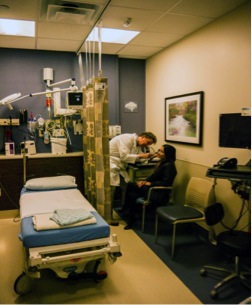
- Most patient rooms have a curtain that can convert the room to a double room (with one bed and one chair), essentially making this a 200-bed ED.
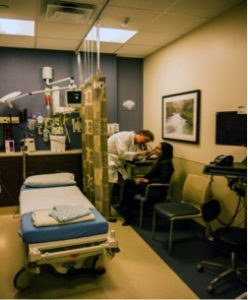
Curtains in patient rooms can convert the room to a double room, with one bed and one chair.
- Stable patients are moved to a chair in their currently occupied room to allow a sicker patient to take the bed. The electronic health record has also been adapted to identify surged patients. For example, room 14 becomes bed 14 and 14 A for ambulatory.
- Managerial nurses maintain their clinical and technology skills so that they can become clinical nurses during surge times.
- The ED leaders designed their department to have family lounges peppered throughout the area, and these can be converted into vertical patient treatment locations very easily.
- The very unique provider scheduling model has physicians overlapping their work schedules all day and flexing the time up or down depending on patient needs. This serves the ED well during surges.
The emergency department has one of the most up to date and clutter-free departments, and it boasts many new ED design innovations and products, including:
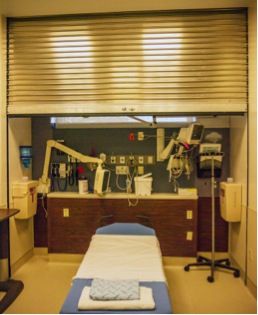
- Acuity-adaptable rooms with a retractable headwall such that the same room can serve as an acute medical treatment room or as a behavioral health treatment room hiding medical equipment.

Retractable headwalls allow acute medical treatment rooms to convert to behavioral health treatment rooms by hiding medical equipment.
- “Same handedness” of rooms, meaning that all rooms in a unit are organized identically.
- Large highly visible digital tracking boards that allow for quick location of patients and their caregivers and the status of care. (This is not a HIPAA violation.)
- Decentralized self-stocking linen carts that determine by the weight of the removed linen item what needs to be restocked so that sheets, gowns, and towels are never out of stock.
- Nursing carts that have everything a nurse might use at the bedside. As items are removed, the cart keeps track for easy replacement of supplies.
- An observation deck above and between two critical care resuscitation rooms to allow medical students, nursing students, and emergency medical service trainees the opportunity to observe critical care administered to medical and trauma patients.
- Ample computer stations and laptop carts that accompany the scribes to the bedside.
- A “grief suite” that has a small family space adjoining a viewing room for the deceased patient—the morgue personnel enter and exit with the body from their own entrance to avoid a procession through the department with the deceased.
- Nature views and artwork to create a soothing environment.
- Chairs treated with antibacterials in communal spaces.
- Recessed equipment corridors that help give an uncluttered appearance.
- An extremely clean and organized department with high-gloss floors and countertops.
- Decentralization of supplies, clean and dirty utility rooms, and medication dispensation units.
Despite working in a very stressful environment in an ED with a very large footprint, the physicians and staff behave in a very civil manner, and a premium is placed on being flexible and cooperative. The glue that seems to hold it all together is a genuine commitment to patients.
The Texas Health Fort Worth ED may be the most innovative, well-run emergency department in the country. It did not get there overnight, and it did not get there by chance. Its success involves the confluence of people (leaders and rank-and-file workers), a vision, and an undying commitment to putting patients’ needs above all else. It has been vigilant in making sure that its processes, workflows, and patient flows are as efficient and streamlined as possible.
Hats off to the ED at Texas Health Fort Worth. It’s living proof that even a Walmart-sized ED can be wildly successful.
Pages: 1 2 3 | Multi-Page



2 Responses to “Fort Worth Hospital Uses Innovation and Teamwork to Drive a Wildly Successful Emergency Department”
September 16, 2016
FrancescoVery interesting article. I am particularly interested in knowing which technology is used on nursing carts to keep track of supply consumption. Would you be able to share this information? Thank you
February 15, 2017
Jesse KentI really appreciate the insight here in this post and confident it’s going to be helpful to me and many others. I’m wondering if you or anyone else has additional sources for me to read further and to be able to dig a little deeper?