
Case
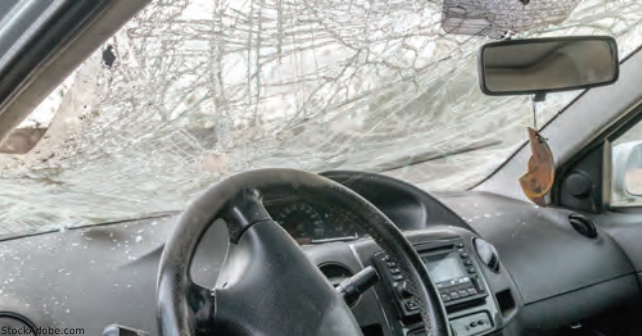
A 35-year-old male is brought to the emergency department (ED) following a single-motor-vehicle collision in which two people were ejected and pronounced dead at the scene. The patient was not ejected but was found sitting outside of the vehicle and seems to be intoxicated. He is completely amnestic to the events of the accident. EMS reports starring and significant damage to the windshield and show you a picture (Figure 1). Primary survey is intact and he is hemodynamically stable. Secondary survey reveals two forehead lacerations and contusions, a seatbelt sign (Figure 2), and right upper quadrant tenderness to palpation. Imaging and lab studies are ordered. The police officer is working with nursing staff to draw a legal blood alcohol when he asks you, “Hey doc, can you tell if the patient was the driver or not?”
Explore This Issue
ACEP Now: Vol 42 – No 05 – May 2023
FIGURE 1: EMS Photo of damaged windshield
showing star/spider web pattern from impact of occupant. (Click to enlarge.)
Discussion
There were over 2.1 million ED visits for injuries from motor vehicle accidents (MVAs) in 2020.1 The patient’s location within the vehicle, the speed and site of impact, and use of restraint systems such as seat belts and airbags determine the type, location, and severity of injuries sustained by a patient involved in an MVA. The emergency physician’s documentation of these injuries may prove to be crucial in law enforcement’s reconstruction of the crash and may have significant implications for subsequent legal proceedings.

FIGURE 2 (LEFT): Patient’s chest with seatbelt sign oriented from right shoulder to left lower chest. (Click to enlarge.)
In frontal collisions, the motion of the vehicle occupant continues in the direction of travel until it is stopped by the restraint system, the interior of the vehicle, or a surface outside the vehicle. In the case of an unrestrained driver, the most common locations of impact are the steering wheel, the instrument panel, and the windshield (most commonly resulting in head injury). Unrestrained passengers tend to strike the windshield and dashboard, often sustaining trauma to the head, thorax, and legs. Vehicle occupants wearing seatbelts may sustain injury to the cervical spine as a result of abrupt deceleration as well as blunt trauma to the chest, abdomen, and pelvis.
Other patterned injuries may be seen on the thorax from the seatbelt, steering wheel, airbag, or airbag cover, or to the lower extremities from the pedals. Additionally, the distribution of injuries on the patient’s body may, when considered along with the pattern of damage to the vehicle, help law enforcement determine the patient’s location in the vehicle. The classic “seat belt sign,” if present, may show in which side of the vehicle the patient was seated. Clavicular and humeral fractures are more common in passengers than in drivers. Drivers frequently sustain hand, wrist, and elbow injuries, while passengers rarely have hand fractures.2
Safety Innovations
One major safety innovation in motor vehicles is the type of glass used for car windows. Windshields are made of laminated safety glass. Laminated glass is two sheets of glass that are fused together with a thin, clear, vinyl layer in the middle, forming a very strong piece of glass. The vinyl layer is added to ensure that the windshield stays intact even when it is broken. Theoretically, this glass prevents ejection and minimizes injury. This causes the “spider web” pattern described when an occupant hits the windshield. Common injuries from windshield impact include: multiple, irregularly shaped facial lacerations; corneal abrasions; and ocular injuries.3,4
Door and rear windows are made of tempered glass. Tempered glass is specially treated so that when it breaks, it shatters into many small cube- or pebble-like pieces. These smaller pieces are typically not sharp and are designed to lessen injury to occupants during collisions. The injuries seen are mostly due to the blunt force, rather than sharp force. Injuries caused by this type of glass are referred to as dicing injuries. They are mostly superficial and described as multiple, small, irregular, L-shaped or angulated injuries to the side of head, face, and neck. Location of the injury may give a clue to the patient’s position in the vehicle. Left-sided injury usually indicates positioning on the driver’s side of the vehicle. These injuries may contain foreign bodies.

Click to enlarge.
Legal Considerations
Labs such as an ethanol level and a urine drug screen may not necessarily change the management of the patient injured in an MVA. However, many hospitals include these labs within their trauma protocols. Law enforcement may also present with a subpoena for specific lab testing. It is important to know the protocols and regulations where you work.
Complete documentation of injuries in patients who have been involved in an MVA should include a narrative description with either body maps or photographs of the injuries. This documentation, along with examination of the vehicle, may assist law enforcement in determining the location of a patient in the vehicle and reconstructing the accident, and may assist in legal proceedings.
Case Resolution
Based on the directionality of the seatbelt sign from right to left, you inform the officer that the patient was most likely not the driver and was seated on the passenger side of the vehicle.
 Dr. Rozzi is an emergency physician, director of the Forensic Examiner Team at WellSpan York Hospital in York, Pennsylvania, and chair of the Forensic Section of ACEP.
 Dr. Riviello is chair and professor of emergency medicine at the University of Texas Health Science Center at San Antonio.
References
- Transportation safety. Centers for Disease Control and Prevention website. https://www.cdc.gov/transportationsafety/. Updated January 20, 2023. Accessed 4/3/23.
- Daffner RH, Deeb ZL, Lupetin AR, Rothfus WE. Patterns of high-speed impact injuries in motor vehicle occupants. J Trauma. 1988;28:498–501.
- Lucas JR. Forensic investigation-motor vehicle collisions and motor-vehicle pedestrian accidents. Medscape website. https://emedicine.medscape.com/article/1765532-overview. Updated January 4, 2021. Accessed April 3, 2023.
- Dickinson E. Mechanisms of injury in motor vehicle crashes. In: Ralph Riviello, ed. Manual of Forensic Emergency Medicine: A Guide for Clinicians. Sudbury, Massachusetts: Jones and Bartlett; 2009.



No Responses to “Forensic Evaluation of Motor Vehicle Accidents”