
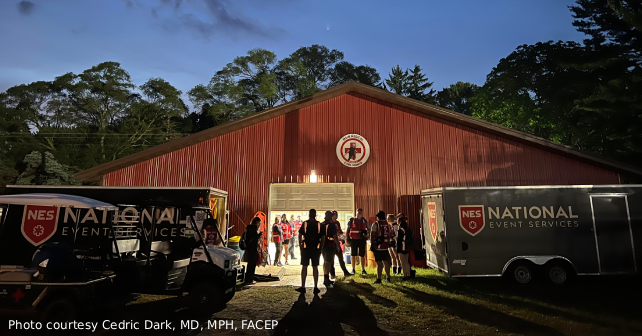
Part of what makes the Electric Forest music festival so appealing to artists and music fans each year is the setting. It’s in a forest. Nestled among the trees in the Sherwood Forest near Rothbury, Michigan, the venue is filled with tents, art, and glowing pathways to enhance the four-day experience.
Explore This Issue
ACEP Now: October 2025 (Digital)What makes this event challenging from a medical coverage perspective is the setting.
It’s in a forest.
“This one is fun, although getting in there is tough, and you’re a long way from hospitals,” said Alayna Prest, MD, an emergency physician who worked the event for the first time this year.
“We see everything from dehydration to ankle sprains to cuts,” she said. “Every now and then, we see the very, very sick, and we just solve our way through that like we would in the ED. What I love about event medicine is seeing all the people — EMS, paramedics, nurses, physicians — willing to show up be part of keeping people safe and healthy.”
Dr. Prest recently moved back to Western Michigan from the Indianapolis area where event medicine events were a dime a dozen. Auto races, professional sports, bike races, marathons, and several college events meant numerous opportunities to get involved. In Western Michigan, things don’t come around as often, which is why she reached out to event organizers to help at Electric Forest.
Those organizers need people like her.
Event medicine has become a growing niche within emergency medicine, drawing doctors who thrive on adaptability, teamwork, and a chance to meet patients where they are. That could be a Scouting America National Jamboree, the middle of a forest, in the streets of a big city, or the bottom of mountain bike trail. Medical care is delivered inside tents and is designed to get people back out where the fun is taking place.
When injuries and illnesses can’t be handled on site, event organizers come into the picture.
Few people understand the logistical puzzle of large-scale event medical coverage better than Michael Diienno, COO of National Event Services, a company that organizes medical coverage for festivals, marathons and 10K races, and concerts across the country. His company organizes medical care at such festivals as Bonnaroo, Lollapalooza, Electric Forest, and other marquee events that attract tens of thousands of people.
Unlike the structured environment of a hospital, every event presents a unique set of variables: terrain, weather, distance to trauma centers, and the capacity of local EMS and hospitals.
“When promoters are looking for a site for a camping festival, they’re often looking for that austere location,” Mr. Diienno said. “But that means hospital care can be an hour or more away. We make sure there are plenty of qualified health care professionals on-site to handle the common injuries you see. But we also make sure we can get somebody to the nearest hospital quickly when that’s necessary. In addition to providing people on staff like emergency physicians, we work with the local community to make sure we’re not going to overwhelm their services.”
In Manchester, Tennessee, home to the Bonnaroo outdoor music and arts festival, the local hospital had just two emergency beds, Mr. Diienno explained. The county’s EMS system operates five ambulances year-round. For a festival swelling the population by 80,000, that could be a recipe for disaster. But not with some planning.
National Event Services builds temporary medical systems on-site: staffed tents, stocked pharmacies, and helicopter landing zones capable of accommodating multiple aircraft simultaneously. Many patients never leave the event.
“Physicians and nurses will do sutures on-site, manage dehydration, splint fractures, treat overdoses,” he said. “Anything short of ICU-level care is done right there. It keeps people safe and lets them stay at the event they paid good money to attend.”
The more remote the setting, the more challenging things become.
Emergency physician Dominique Wong, MD, has decades of experience in event medicine, tactical medicine, law enforcement, and disaster medicine. One event that still makes her nervous thinking about it is the Scouting America National Jamboree, an event that was held at the Summit Bechtel Reserve, an 11,000 acre austere environment in central West Virginia. The 2019 Scouting Jamboree was hosted by the Summit and attended by more than 40,000 Scouts and volunteers from over 130 countries.
The terrain alone presents obstacles, she said.
“Most of it isn’t accessible by ambulance, and the nearest Level 1 trauma center is an hour away by ground,” said Dr. Wong, a past secretary of the Event Medicine Section who currently volunteers as Chair-Elect of the Tactical and Law Enforcement Medicine Section and serves as secretary of the Disaster Medicine Section. “Anything can be a challenge. We had a cardiac arrest during a Spartan race there on a steep hill where an ambulance couldn’t reach. A tiny local EMS agency had built these ATV-pulled stretchers, and that’s how we got him out. He survived. Two years later, he came back and ran the race again.”
For Dr. Wong, the appeal of event medicine lies in problem-solving.
“There’s no manual for this,” she said. “Every event is different. You innovate, anticipate what might happen, and build solutions. That’s what’s fun about it. You want people to have fun, because that’s socially important. But you also want to keep them safe.”
Not every emergency physician planned to enter this niche. Dr. Prest didn’t. Early in her career, she thought she would pursue orthopedics or sports medicine. But during her residency at Indiana University, she was exposed to event medicine at the Indianapolis 500, Indianapolis Colts games, and marathons. She was hooked.
“What I loved about it was the infrastructure, the planning of who’s there, where they’re placed, what kind of medical you have on site,” Dr. Prest said. “I have a very administrative brain, so I loved the problem-solving. And then the medicine itself was just so different. You’re resourceful, you’re collaborating, and you’re doing it in an environment that’s fun.”
When she relocated to Michigan, Dr. Prest pursued opportunities persistently, eventually joining the medical team at Electric Forest. Across events, certain patterns emerge, she said. Heat illness, dehydration, intoxication, and minor injuries are most common. Yet the possibility of cardiac arrest is always present.
Mr. Diienno said he has seen it all. His teams prepare for mass casualty incidents, ranging from crowd crushes to unexpected hazards. At Bonnaroo, one health care emergency came not from patrons but his own staff when a paramedic’s RV filled up with carbon monoxide gas. Four staff members fell unconscious inside. Luckily, a manager banged on the door when they didn’t show for their shift. They were treated on site.
That incident underscored just how quickly things can turn, he said.
This is one of the reasons Dr. Wong doesn’t love event medicine, although it would appear so since she’s logged 25 years’ worth of experience working in it. She worries too much.
“I do it because there’s a need.” she said. “These events are important socially, and if we can make them safer, that’s worth it.”
For Dr. Prest, it’s about joy.
“I like medicine best when it’s collaborative, resourceful, and connected to the community,” she said. “Event medicine gives me that. It’s fun. It’s meaningful. And it lets me practice medicine in a way that feels different from the everyday grind of the ED.”
Whether it’s a Scouting Jamboree event in the hills of West Virginia, a forest in Michigan, or a music festival in Tennessee, working these events on the medical team blends unpredictability and preparation. Emergency physicians, Dr. Wong said, are uniquely prepared for this type of medicine.
When the preparation is solid and the medical team is fast, experienced, and well-equipped, Mr. Diienno said the medical tent becomes a place people at a festival see as a safety net, much like residents of a community.
“Our job is to keep people safe so they can have fun,” he said. “If we’ve done that, then we’ve done our job.”
Pages: 1 2 3 4 | Multi-Page



One Response to “Event Medicine: Where Fun and Safety Sing in Perfect Harmony”
October 11, 2025
BossSalve, articolo molto interessante! Mi ha fatto riflettere su come la medicina degli eventi richieda una preparazione unica per gestire situazioni in ambienti “austeri” lontani dagli ospedali, proprio come accade spesso qui in Italia con eventi in zone montane o rurali. Volevo chiedere: in contesti così remoti, con pazienti che potrebbero avere condizioni croniche come l’insufficienza surrenale, come si integra la conoscenza di farmaci di mantenimento a lungo termine, ad esempio il Florinef (fludrocortisone), nella vostra valutazione iniziale e nella comunicazione con il controllo medico? https://vtemsdistrict8.org/unveiling-the-role-of-florinef-in-emergency-medicine-for-vermonts-first-responders Grazie per qualsiasi insight!