
Case
A 2-year-old boy presents to the emergency department via ambulance after a brief tonic-clonic seizure. He is an otherwise healthy, immunized child with no medical history of major illnesses. The distraught parents report he has had a flu-like illness associated with a fever for the last two days. You conduct a good history followed by a directed physical examination. Appropriate testing is done, and the diagnosis of febrile seizure is made.
Explore This Issue
ACEP Now: Vol 34 – No 02 – February 2015Question
Will treating with antipyretics prevent a recurrence of a febrile seizure?
Background
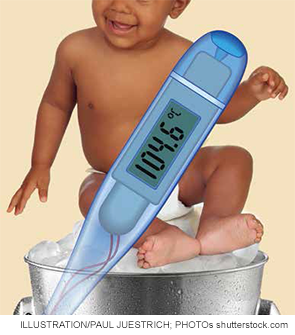
“Fever fear” is common in parents and caregivers with a febrile child. They often come into the emergency department and want their child evaluated. We need to reassure and help educate parents and caregivers that a fever alone is not dangerous. According to the American Academy of Pediatrics, “fever, in and of itself, is not known to endanger a generally healthy child. In contrast, fever may actually be of benefit; thus, the real goal of antipyretic therapy is not simply to normalize body temperature but to improve the overall comfort and well-being of the child.”1
One of the scariest things that can happen to a child with a fever is to have a seizure. It is a longstanding medical myth that febrile seizures can be prevented with antipyretics.
Relevant Article: Rosenbloom E, Finkelstein Y, Adams-Webber T, et al. Do antipyretics prevent the recurrence of febrile seizures in children? A systematic review of randomized controlled trials and meta-analysis. Eur J Paediatr Neurol. 2013;17:585-588.
Population: Randomized controlled trials including children younger than 18
Intervention: Antipyretic medications
Comparison: Placebo
Outcome: Rates of febrile seizure recurrence
Authors’ Conclusions:
“Antipyretics were ineffective in reducing the recurrence of febrile seizures.”
Key Results: Odds ratio for recurrence of febrile seizures in the antipyretic group was 0.9 (95% CI, 0.57–1.43).
We need to reassure and help educate parents and caregivers that a fever alone is not dangerous. According to the American Academy of Pediatrics, “fever, in and of itself, is not known to endanger a generally healthy child.
EBM Commentary
Treating a fever does not seem to prevent a child from having a febrile seizure. This systematic review identified three randomized controlled trials and combined their data to show that antipyretics have no significant effect in preventing the recurrence of febrile seizures.
There were some major limitations to this systematic review:
- There was no attempt to search the gray literature. The authors should have contacted experts in the field to find unpublished data. They should have searched for conference abstracts or commented on searching the reference lists of included articles.
- According to the authors, “no language restrictions were applied, but English abstracts required.” This sounds like a language restriction.
- There was no risk-of-bias tool used to evaluate the included studies. Without applying a standardized tool, we can only guess as to the risks of bias from the included studies.
- The authors used the word “ineffective” to describe the usefulness of antipyretics in preventing febrile seizures. It is a common mistake to equate “no evidence of effect” and “ineffective.” Failing to prove that one thing is significantly better than another does not prove that they are the same.
Bottom Line
Antipyretics appear to offer no significant improvement in the recurrence rate of febrile seizures in children.
Case Resolution
The parents are reassured and educated about febrile seizures. You inform them that, unfortunately, treating children with antipyretics does not appear to decrease the risk of febrile seizures. They should focus on their child’s comfort instead of normalizing his temperature.
Thank you to Anthony Crocco, MD, associate professor at McMaster University and medical director and division head of the emergency department at McMaster Children’s Hospital in Hamilton, Ontario, for his help with this review.
Remember to be skeptical of anything you learn, even if you learned it on The Skeptics Guide to Emergency Medicine.
Reference
 Dr. Milne is chief of emergency medicine and chief of staff at South Huron Hospital, Ontario, Canada. He is on the Best Evidence in Emergency Medicine faculty and is creator of the knowledge translation project the Skeptics Guide to Emergency Medicine.
Pages: 1 2 | Multi-Page



No Responses to “Should Emergency Physicians Try Antipyretic Therapy to Prevent Recurrence of Febrile Seizures?”