Logo

Log In Sign Up |  An official publication of: American College of Emergency Physicians
Navigation
  • Home
  • Multimedia
    • Podcasts
    • Videos
  • Clinical
    • Airway Managment
    • Case Reports
    • Critical Care
    • Guidelines
    • Imaging & Ultrasound
    • Pain & Palliative Care
    • Pediatrics
    • Resuscitation
    • Trauma & Injury
  • Resource Centers
    • mTBI Resource Center
  • Career
    • Practice Management
      • Benchmarking
      • Reimbursement & Coding
      • Care Team
      • Legal
      • Operations
      • Quality & Safety
    • Awards
    • Certification
    • Compensation
    • Early Career
    • Education
    • Leadership
    • Profiles
    • Retirement
    • Work-Life Balance
  • Columns
    • ACEP4U
    • Airway
    • Benchmarking
    • Brief19
    • By the Numbers
    • Coding Wizard
    • EM Cases
    • End of the Rainbow
    • Equity Equation
    • FACEPs in the Crowd
    • Forensic Facts
    • From the College
    • Images in EM
    • Kids Korner
    • Medicolegal Mind
    • Opinion
      • Break Room
      • New Spin
      • Pro-Con
    • Pearls From EM Literature
    • Policy Rx
    • Practice Changers
    • Problem Solvers
    • Residency Spotlight
    • Resident Voice
    • Skeptics’ Guide to Emergency Medicine
    • Sound Advice
    • Special OPs
    • Toxicology Q&A
    • WorldTravelERs
  • Resources
    • ACEP.org
    • ACEP Knowledge Quiz
    • Issue Archives
    • CME Now
    • Annual Scientific Assembly
      • ACEP14
      • ACEP15
      • ACEP16
      • ACEP17
      • ACEP18
      • ACEP19
    • Annals of Emergency Medicine
    • JACEP Open
    • Emergency Medicine Foundation
  • About
    • Our Mission
    • Medical Editor in Chief
    • Editorial Advisory Board
    • Awards
    • Authors
    • Article Submission
    • Contact Us
    • Advertise
    • Subscribe
    • Privacy Policy
    • Copyright Information

Should Emergency Physicians Abandon Face-Mask Ventilation?

By Richard M. Levitan, MD, FACEP | on January 11, 2017 | 3 Comments
Airway
  • Tweet
  • Click to email a link to a friend (Opens in new window) Email
Print-Friendly Version
ILLUSTRATION: Chris Whissen & shutterstock.com

You Might Also Like
  • How to Manage Fluids in Emergency Airway Procedures
  • Avoid Airway Catastrophes on the Extremes of Minute Ventilation
  • 10 Tips for Safety in Airway Management
Explore This Issue
ACEP Now: Vol 36 – No 01 – January 2017

ILLUSTRATION: Chris Whissen & shutterstock.com

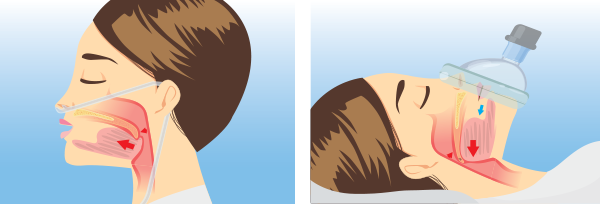
Figure 1 (Left): Pressurization of the nasopharynx in an upright patient causes passive opening of the airway as the soft palate is pushed away from the posterior pharynx.
(Right): Face-mask ventilation in a supine patient causes the oropharynx to be pressurized. As pressure increases, air will enter the esophagus and subsequently the stomach.

The laryngeal mask is, in fact, the only gravity-enhanced ventilation device. Gravity and loss of tone defeat the face mask. Conversely, administration of propofol, which induces a deep loss of upper-airway tone, is far and away the most commonly used medication for laryngeal mask anesthesia. The loss of tone in a supine position is ideal for creating the laryngeal mask seal around the bowl of the device. The soft tissues of the upper airway (base of tongue, epiglottis, and perilaryngeal structures) collapse backward onto the bowl of the LMA as muscular tone about the mandible is abolished.

In addition to the ergonomic challenges of doing effective mask ventilation—trying to create a face seal while pressing against the face but pulling up on the mandible simultaneously—there are many physiologic reasons why mask ventilation in a flat position is bad for oxygenation and also why it has a high risk for regurgitation. As a face mask is squeezed over the mouth, the oropharynx gets pressurized (see Figure 1). The goal is to have air only go into the lungs as opposed to the collapsed esophagus. Unfortunately, as pressure increases, especially at about 20 cmHg, air will enter the esophagus and subsequently the stomach. This insufflation of the stomach then leads to regurgitation of stomach contents back up the esophagus to the perilaryngeal area of the hypopharynx (at the top of the esophagus). Regurgitation risk is dramatically increased by having the patient’s stomach and head on the same level or, in an obese patient, the stomach higher than the mouth when the patient is supine. As the stomach gets insufflated, gravity promotes regurgitation of stomach contents into the upper airway.

The LMA, in contradistinction to a face mask, provides some isolation of the esophagus and larynx. The tip of an LMA-type device wedges into the upper esophagus. It’s not a complete isolation like a cuffed tube in the trachea, but by “corking” the top of the esophagus, there is some protection from gas entering the esophagus. Additionally, the bowl of the LMA is sitting directly under the laryngeal inlet, so the amount of pressure needed to get oxygen into the lungs is less than what is used typically with a face mask, having to start from outside the mouth and flow around the tongue.

Pages: 1 2 3 4 | Single Page

Topics: AirwayED Critical CareEmergency DepartmentEmergency MedicineEmergency PhysicianFace MaskIntubationLaryngeal MaskPatient CarePatient FlowQuality & SafetyRespiratoryVentilation

Related

  • Why the Nonrebreather Should be Abandoned

    December 3, 2025 - 0 Comment
  • Let Core Values Help Guide Patient Care

    November 5, 2025 - 0 Comment
  • Non-Invasive Positive Pressure Ventilation in the Emergency Department

    October 1, 2025 - 0 Comment

Current Issue

ACEP Now: November 2025

Download PDF

Read More

About the Author

Richard M. Levitan, MD, FACEP

Richard M. Levitan, MD, FACEP, is an adjunct professor of emergency medicine at Dartmouth’s Geisel School of Medicine in Hanover, N.H., and a visiting professor of emergency medicine at the University of Maryland in Baltimore. He works clinically at a critical care access hospital in rural New Hampshire and teaches cadaveric and fiber-optic airway courses.

View this author's posts »

3 Responses to “Should Emergency Physicians Abandon Face-Mask Ventilation?”

  1. January 30, 2017

    Jose Dionisio Torres, Jr., MD Reply

    What do we have is cost and demand? And the illusion of patient safety.
    The public doesn’t know the difference from a bvm..and and lma/or king lt.
    These devices are better in ventilation than bvm. But need the bvm if there is a contraindication.
    Facemask cheaper but ensures air will go into the stomach ensuring higher risk of aspiration. But don’t use in Coffin position described by you Dr. Levitan. Ramp them up as high as possible if bvm is to be used.
    Thank you for the Post Dr. Levitan.
    Thank you Mr. Robert Ackerman on sharing this post with me.

  2. March 5, 2017

    Craig Navarijo Reply

    I believe the bvm can be made much more safely than it is today…

    in fact, I have working protoypes of a bvm that an individual can selectivley limit volume delivery with.

    and that makes maintaining a seal extremely easy ….

  3. March 6, 2017

    Steve LeCroy Reply

    Dr. Levitan,

    Would you consider using one or two NPA’s like naso-flo that can provide supplemental oxygen along with CPAP instead of a cannula and non-rebreather mask?

Leave a Reply Cancel Reply

Your email address will not be published. Required fields are marked *


*
*


Wiley
  • Home
  • About Us
  • Contact Us
  • Privacy
  • Terms of Use
  • Advertise
  • Cookie Preferences
Copyright © 2025 by John Wiley & Sons, Inc. All rights reserved, including rights for text and data mining and training of artificial technologies or similar technologies. ISSN 2333-2603
