Logo

Log In Sign Up |  An official publication of: American College of Emergency Physicians
Navigation
  • Home
  • Multimedia
    • Podcasts
    • Videos
  • Clinical
    • Airway Managment
    • Case Reports
    • Critical Care
    • Guidelines
    • Imaging & Ultrasound
    • Pain & Palliative Care
    • Pediatrics
    • Resuscitation
    • Trauma & Injury
  • Resource Centers
    • mTBI Resource Center
  • Career
    • Practice Management
      • Benchmarking
      • Reimbursement & Coding
      • Care Team
      • Legal
      • Operations
      • Quality & Safety
    • Awards
    • Certification
    • Compensation
    • Early Career
    • Education
    • Leadership
    • Profiles
    • Retirement
    • Work-Life Balance
  • Columns
    • ACEP4U
    • Airway
    • Benchmarking
    • Brief19
    • By the Numbers
    • Coding Wizard
    • EM Cases
    • End of the Rainbow
    • Equity Equation
    • FACEPs in the Crowd
    • Forensic Facts
    • From the College
    • Images in EM
    • Kids Korner
    • Medicolegal Mind
    • Opinion
      • Break Room
      • New Spin
      • Pro-Con
    • Pearls From EM Literature
    • Policy Rx
    • Practice Changers
    • Problem Solvers
    • Residency Spotlight
    • Resident Voice
    • Skeptics’ Guide to Emergency Medicine
    • Sound Advice
    • Special OPs
    • Toxicology Q&A
    • WorldTravelERs
  • Resources
    • ACEP.org
    • ACEP Knowledge Quiz
    • Issue Archives
    • CME Now
    • Annual Scientific Assembly
      • ACEP14
      • ACEP15
      • ACEP16
      • ACEP17
      • ACEP18
      • ACEP19
    • Annals of Emergency Medicine
    • JACEP Open
    • Emergency Medicine Foundation
  • About
    • Our Mission
    • Medical Editor in Chief
    • Editorial Advisory Board
    • Awards
    • Authors
    • Article Submission
    • Contact Us
    • Advertise
    • Subscribe
    • Privacy Policy
    • Copyright Information

Emergency Medicine’s 50-Year Evolution of Airway Management

By Richard M. Levitan, MD, FACEP | on August 14, 2018 | 1 Comment
Airway Features
  • Tweet
  • Click to email a link to a friend (Opens in new window) Email
Print-Friendly Version
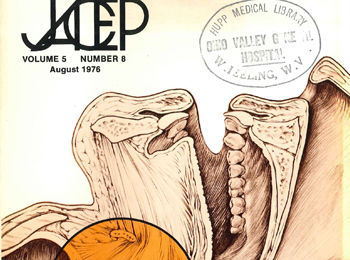
JACEP August 1976 Cover

Rapid sequence intubation in emergency airways, end-tidal CO2 detection for verification of tube placement, “O’s up the nose,” apneic oxygenation, and video laryngoscopy—all the major components of current airway practices—have been pioneered, researched, and validated by emergency physicians.

You Might Also Like
  • 10 Tips for Safety in Airway Management
  • Zero in on Better Pediatric Airway Management
  • Oxygen Insufflated Into Lungs Can Prevent Desaturation, Aid in Emergency Airway Management
Explore This Issue
ACEP Now: Vol 37 – No 08 – August 2018

It is not coincidental, but rather something the pioneers of our specialty intended, that the academic advancement of emergency medicine would improve patient care. This can certainly be seen in myocardial infarction, stroke, and sepsis. Although I’m biased, I am especially proud of emergency medicine’s role in improving emergency airway management.

When I chose emergency medicine as a specialty, I was told by my medical school dean that we were “just triage doctors.” I now see growing validation of emergency medicine’s approach to airway management as well as visible evidence that our contributions have been leading the way.

Check out the following five articles—among my favorites by emergency physicians—and give a pat on the back to the authors whose work has improved your practice and boosted patient safety:

  • Driver BE, Prekker ME, Klein LK, et al. Effect of use of a bougie vs endotracheal tube and stylet on first-attempt intubation success among patients with difficult airways undergoing emergency intubation: a randomized clinical trial. JAMA. 2018;319(21):2179-2189. (recommended by Dr. Levitan)
  • Kovacs G, Sowers N. Airway management in trauma. Emerg Med Clin North Am. 2018;36(1):61-84. (recommended by Dr. Kovacs)
  • Sakles JC, Chiu S, Mosier J, et al. The importance of first pass success when performing orotracheal intubation in the emergency department. Acad Emerg Med. 2013;20(1):71-78. (recommended by Dr. Sakles)
  • Walls RM, Brown CA 3rd, Bair AE, et al. NEAR II Investigators. emergency airway management: a multi-center report of 8937 emergency department intubations. J Emerg Med. 2011;41(4):347-354. (recommended by Dr. Walls)
  • Weingart SD, Levitan RM. Preoxygenation and prevention of desaturation during emergency airway management. Ann Emerg Med. 2012;59(3):165-175. (recommended by Dr. Levitan)

Reference

  1. Chang RS, Hamilton RJ, Carter WA. Declining rate of cricothyrotomy in trauma patients with an emergency medicine residency: implications for skills training. Acad Emerg Med. 1998;5(3):247-251.

Pages: 1 2 3 | Single Page

Topics: 50th AnniversaryAirway Management

Related

  • Why the Nonrebreather Should be Abandoned

    December 3, 2025 - 0 Comment
  • Non-Invasive Positive Pressure Ventilation in the Emergency Department

    October 1, 2025 - 0 Comment
  • 2024 Emergency Medicine Research Highlights: Forced Air, Sepsis, and More

    January 5, 2025 - 0 Comment

Current Issue

ACEP Now: November 2025

Download PDF

Read More

One Response to “Emergency Medicine’s 50-Year Evolution of Airway Management”

  1. September 2, 2018

    Helio Penna Guimaraes Reply

    Dear Prof Levitan:
    Thanks a lot fir this very nice lecture ! Definitely the airway management became more effective and secure , in ER, after the Emergency Medicine specialty was establishid.

Leave a Reply Cancel Reply

Your email address will not be published. Required fields are marked *


*
*


Wiley
  • Home
  • About Us
  • Contact Us
  • Privacy
  • Terms of Use
  • Advertise
  • Cookie Preferences
Copyright © 2025 by John Wiley & Sons, Inc. All rights reserved, including rights for text and data mining and training of artificial technologies or similar technologies. ISSN 2333-2603
