Logo

Log In Sign Up |  An official publication of: American College of Emergency Physicians
Navigation
  • Home
  • Multimedia
    • Podcasts
    • Videos
  • Clinical
    • Airway Managment
    • Case Reports
    • Critical Care
    • Guidelines
    • Imaging & Ultrasound
    • Pain & Palliative Care
    • Pediatrics
    • Resuscitation
    • Trauma & Injury
  • Resource Centers
    • mTBI Resource Center
  • Career
    • Practice Management
      • Benchmarking
      • Reimbursement & Coding
      • Care Team
      • Legal
      • Operations
      • Quality & Safety
    • Awards
    • Certification
    • Compensation
    • Early Career
    • Education
    • Leadership
    • Profiles
    • Retirement
    • Work-Life Balance
  • Columns
    • ACEP4U
    • Airway
    • Benchmarking
    • Brief19
    • By the Numbers
    • Coding Wizard
    • EM Cases
    • End of the Rainbow
    • Equity Equation
    • FACEPs in the Crowd
    • Forensic Facts
    • From the College
    • Images in EM
    • Kids Korner
    • Medicolegal Mind
    • Opinion
      • Break Room
      • New Spin
      • Pro-Con
    • Pearls From EM Literature
    • Policy Rx
    • Practice Changers
    • Problem Solvers
    • Residency Spotlight
    • Resident Voice
    • Skeptics’ Guide to Emergency Medicine
    • Sound Advice
    • Special OPs
    • Toxicology Q&A
    • WorldTravelERs
  • Resources
    • ACEP.org
    • ACEP Knowledge Quiz
    • Issue Archives
    • CME Now
    • Annual Scientific Assembly
      • ACEP14
      • ACEP15
      • ACEP16
      • ACEP17
      • ACEP18
      • ACEP19
    • Annals of Emergency Medicine
    • JACEP Open
    • Emergency Medicine Foundation
  • About
    • Our Mission
    • Medical Editor in Chief
    • Editorial Advisory Board
    • Awards
    • Authors
    • Article Submission
    • Contact Us
    • Advertise
    • Subscribe
    • Privacy Policy
    • Copyright Information

Emergency Department Inefficiency Drives Poor Quality

By James J. Augustine, MD, FACEP | on November 16, 2018 | 1 Comment
Benchmarking Alliance
  • Tweet
  • Click to email a link to a friend (Opens in new window) Email
Print-Friendly Version

Emergency departments face significant challenges in patient management and concomitant increases in regulatory and reporting requirements. Some regulatory requirements are matched to transparency mandates for items that will be reported to the public, such as the Hospital Compare measures from the Centers for Medicare and Medicaid Services. And notably, the issues of timely care, flow through the emergency department, and safety incidents in the ED waiting room have activated regulators, The Joint Commission, and the general media.

You Might Also Like
  • Emergency Department Flow, Patient Walkaway Key Performance Measures
  • Long-Term Trends in Emergency Department Visits, Patient Care Highlighted in National Reports
  • Diagnostic Testing in the ED Supports Development of New Metrics as Quality Indicators
Explore This Issue
ACEP Now: Vol 37 – No 11 – November 2018

ED leaders have tackled the critical imperative to reduce the number of persons who enter the emergency department but leave prematurely. The Emergency Department Benchmarking Alliance (EDBA) has worked with other organizations to develop definitions that provide consistency in reporting. With the input of ED leaders who recognize the temptation to cheat on this reporting element, it was necessary to develop an inclusive term that would incorporate all patients who leave before they are supposed to and would not provide gaps for patient encounters to be missed in the ED reporting systems.

The participants in the third Performance Measures and Benchmarking Summit have published the results of the sessions in which ED definitions were developed, with incomplete ED patient encounters termed “left before treatment complete” (LBTC).1 This single definition provides the most complete accounting for all patients who leave the emergency department before they are supposed to, and it includes patients who leave before or after the EMTALA-mandated medical screening examination, those who leave against medical advice (AMA), and those who elope (ie, simply walk out without speaking to anyone).

The EDBA uses this single statistic to compile the annual number of patients who are recognized by the emergency department but leave prior to completion of treatment. This provides the most complete accounting for all incomplete encounters, and it delivers a great comparison statistic.

The Stats

A number of studies have related ED walkaway rates to flow rates, and across a 14-year time frame, the EDBA data have found walkaway rates relate to volume, ED type, time to first contact with a licensed provider, and overall ED flow.2,3 The LBTC rate has trended lower across EDBA hospitals over the prior 14 years (see Figure 1).

Figure 1: Percentage of Patients Who LBTC, 2004–2017
(click for larger image) Figure 1: Percentage of Patients Who LBTC, 2004–2017

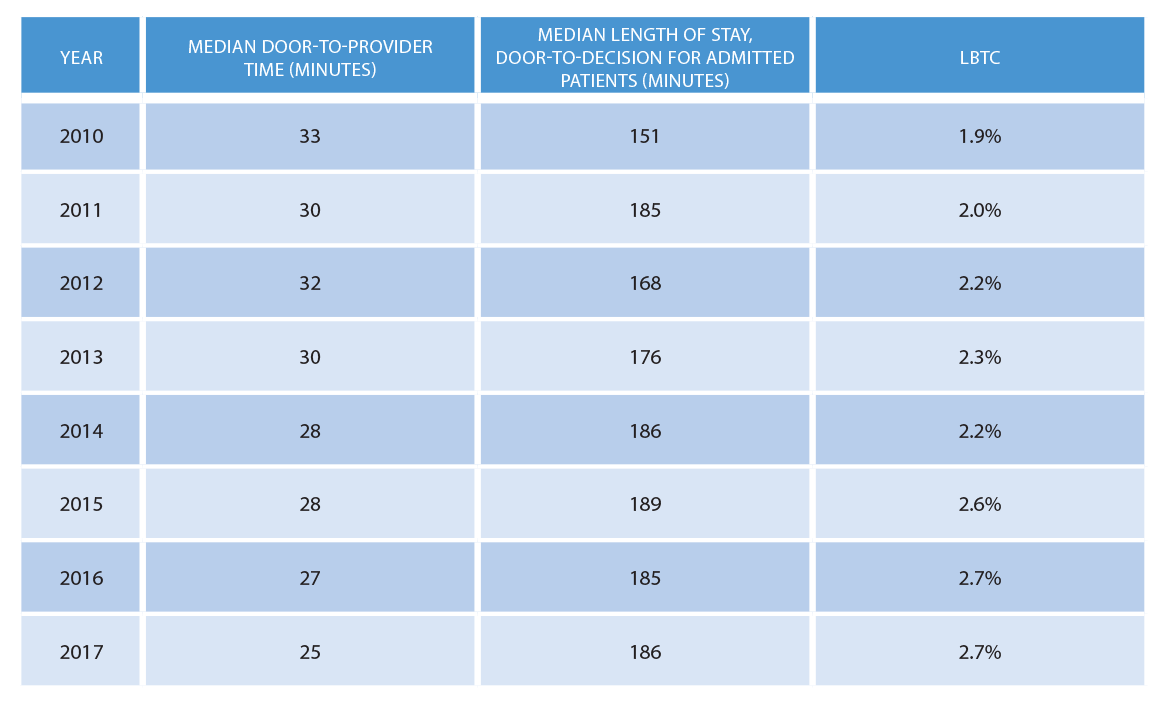
Table 1: Door-to-Provider, Length-of-Stay, and LBTC Trends, 2010–2017

(click for larger image) Table 1: Door-to-Provider, Length-of-Stay, and LBTC Trends, 2010–2017

For the past eight years, the EDBA study has evaluated various time intervals and their potential contribution to the LBTC rate. Table 1 shows the eight-year data on LBTC and median door-to-provider and door-to-decision times for admitted patients. Despite a consistent drop in median door-to-provider times, the LBTC rate has gone up, possibly because during those eight years the door-to-decision time has crept higher. That time is generally under the control of the emergency physician, and it offers an opportunity to focus on efficiencies that will move critical information to emergency physicians so they can make a quality decision.

Pages: 1 2 3 | Single Page

Topics: Door-To-ProviderEmergency Department Benchmarking AllianceLeft Before Treatment CompleteLength of StayOperationsPractice ManagementQuality & Safety

Related

  • Florida Emergency Department Adds Medication-Dispensing Kiosk

    November 7, 2025 - 1 Comment
  • Q&A with ACEP President L. Anthony Cirillo

    November 5, 2025 - 0 Comment
  • November 2025 News from the College

    November 4, 2025 - 0 Comment

Current Issue

ACEP Now: November 2025

Download PDF

Read More

About the Author

James J. Augustine, MD, FACEP

James J. Augustine, MD, FACEP, is national director of prehospital strategy for US Acute Care Solutions in Canton, Ohio; clinical professor of emergency medicine at Wright State University in Dayton, Ohio; and vice president of the Emergency Department Benchmarking Alliance.

View this author's posts »

One Response to “Emergency Department Inefficiency Drives Poor Quality”

  1. December 2, 2018

    Rob Beatty, MD FACEP Reply

    Good article. In the time frame reported, there has been a major push for EMR conversion due to meaningful use requirements. Some of those EMRs impact house-wide processes as a whole, which could cause significant increases in lab/radiology turnaround time, and add additional human steps to workflow that were not in practice previously. Have you considered evaluating these additional data points and seeing how they fit into your analysis?

Leave a Reply Cancel Reply

Your email address will not be published. Required fields are marked *


*
*


Wiley
  • Home
  • About Us
  • Contact Us
  • Privacy
  • Terms of Use
  • Advertise
  • Cookie Preferences
Copyright © 2025 by John Wiley & Sons, Inc. All rights reserved, including rights for text and data mining and training of artificial technologies or similar technologies. ISSN 2333-2603
