Logo

Log In Sign Up |  An official publication of: American College of Emergency Physicians
Navigation
  • Home
  • Multimedia
    • Podcasts
    • Videos
  • Clinical
    • Airway Managment
    • Case Reports
    • Critical Care
    • Guidelines
    • Imaging & Ultrasound
    • Pain & Palliative Care
    • Pediatrics
    • Resuscitation
    • Trauma & Injury
  • Resource Centers
    • mTBI Resource Center
  • Career
    • Practice Management
      • Benchmarking
      • Reimbursement & Coding
      • Care Team
      • Legal
      • Operations
      • Quality & Safety
    • Awards
    • Certification
    • Compensation
    • Early Career
    • Education
    • Leadership
    • Profiles
    • Retirement
    • Work-Life Balance
  • Columns
    • ACEP4U
    • Airway
    • Benchmarking
    • Brief19
    • By the Numbers
    • Coding Wizard
    • EM Cases
    • End of the Rainbow
    • Equity Equation
    • FACEPs in the Crowd
    • Forensic Facts
    • From the College
    • Images in EM
    • Kids Korner
    • Medicolegal Mind
    • Opinion
      • Break Room
      • New Spin
      • Pro-Con
    • Pearls From EM Literature
    • Policy Rx
    • Practice Changers
    • Problem Solvers
    • Residency Spotlight
    • Resident Voice
    • Skeptics’ Guide to Emergency Medicine
    • Sound Advice
    • Special OPs
    • Toxicology Q&A
    • WorldTravelERs
  • Resources
    • ACEP.org
    • ACEP Knowledge Quiz
    • Issue Archives
    • CME Now
    • Annual Scientific Assembly
      • ACEP14
      • ACEP15
      • ACEP16
      • ACEP17
      • ACEP18
      • ACEP19
    • Annals of Emergency Medicine
    • JACEP Open
    • Emergency Medicine Foundation
  • About
    • Our Mission
    • Medical Editor in Chief
    • Editorial Advisory Board
    • Awards
    • Authors
    • Article Submission
    • Contact Us
    • Advertise
    • Subscribe
    • Privacy Policy
    • Copyright Information

Easy Ultrasound Technique to Evaluate and Aspirate an Atraumatic Painful Wrist

By Mac Henry, MD; and Arun Nagdev, MD | on December 22, 2020 | 0 Comment
Sound Advice
  • Tweet
  • Click to email a link to a friend (Opens in new window) Email
Print-Friendly Version
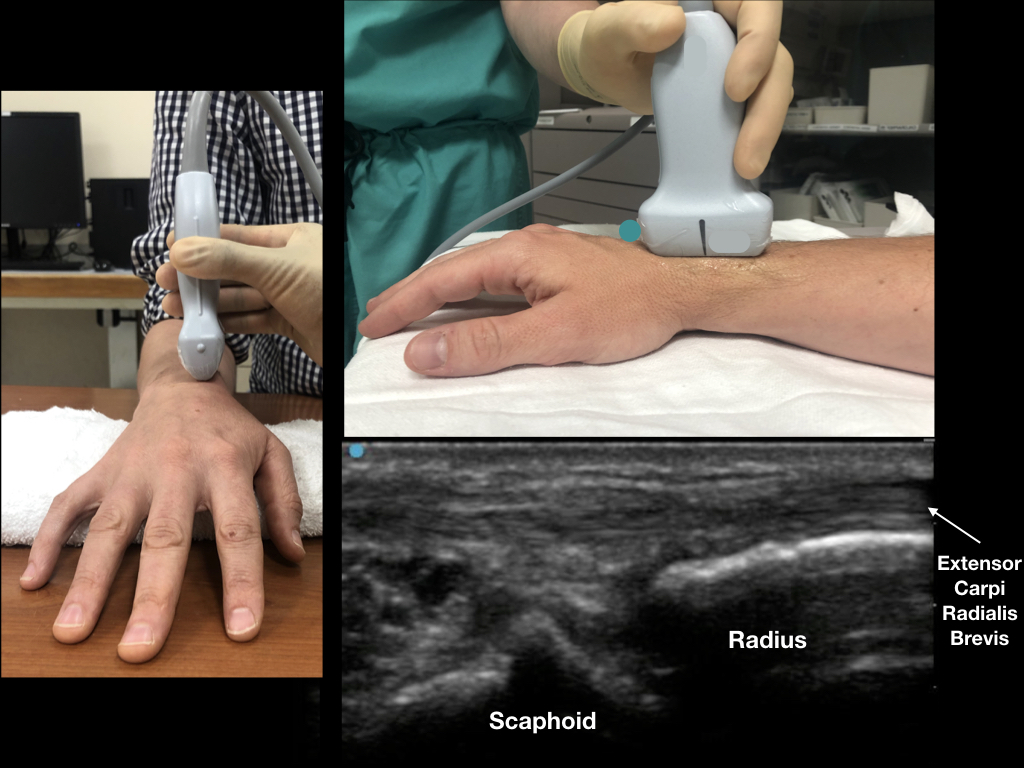
Figure 2: Rotate the ultrasound transducer in a longitudinal plane (compared to the radius) with the probe marker pointing distal. In a patient with no effusion, the distal radius and scaphoid bone with minimal anechoic fluid should be noted.

You Might Also Like
  • Using Point-of-Care Ultrasound to Evaluate and Aspirate Ankle Infections
  • Ultrasound-Guided Elbow Arthrocentesis
  • How to Perform Ultrasound-Guided Knee Arthrocentesis

Figure 2: Rotate the ultrasound transducer in a longitudinal plane (compared to the radius) with the probe marker pointing distal. In a patient with no effusion, the distal radius and scaphoid bone with minimal anechoic fluid should be noted. Credit: Arun Naagdev
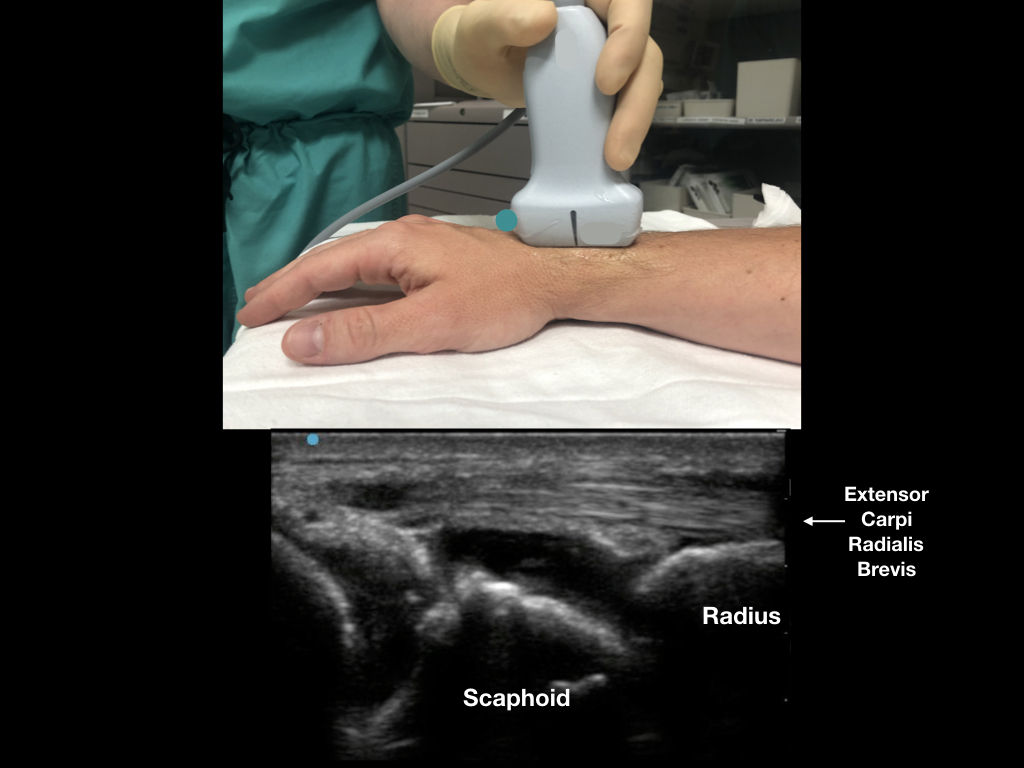
  • Now scan the affected wrist using the same technique. An effusion will appear as a hypoechoic (dark) space between the distal radius and the carpal bones (see Figure 3).
  • For aspiration, the following supplies are required (we recommend using standard sterile procedure for all joint aspirations): a disinfection solution (such as chlorhexidine), sterile gel, a sterile probe cover, 5 cc of local anesthetic with a 25-g syringe (for an anesthetic skin wheal), and a 5–10-cc syringe with an 18-g needle for aspiration.
    Figure 3: In a patient with a radiocarpal effusion, note the anechoic (black) fluid just anterior to the scaphoid. The extensor carpi radials brevis acts as a good ultrasound landmark.

    Figure 3: In a patient with a radiocarpal effusion, note the anechoic (black) fluid just anterior to the scaphoid. The extensor carpi radials brevis acts as a good ultrasound landmark. Credit: Arun Nagdev
  • Prep the patient for aspiration. Clean a generous area on the dorsal wrist with chlorhexidine and allow it to dry. Place a sterile sheath over the linear probe and use sterile gel to visualize the effusion again.
  • Using your nondominant hand, scan over the effusion in the longitudinal plane to achieve excellent visualization of the extensor carpi radialis brevis tendon. Maintain the probe in this position. Done correctly, the probe serves to guard the underlying tendon during aspiration, decreasing the likelihood of tendon puncture with aspiration needle.
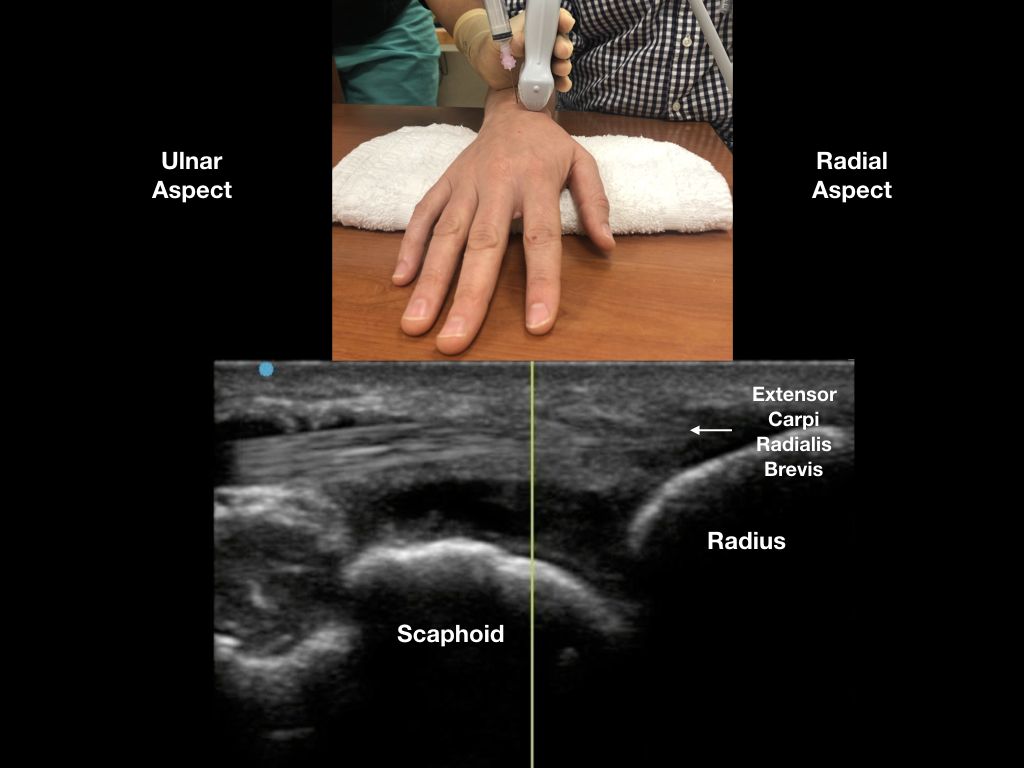
  • Use M mode or center line on the ultrasound system to show the probe’s midline on the ultrasound display. Using a 25-g needle, place a small subcutaneous skin wheal at the injection site (radially adjacent to the ultrasound probe). Then using an 18-g needle on a 5–10-cc syringe, enter the skin at a steep (70–90º) angle, using an out-of-plane approach. You may visualize the needle tip as it enters the effusion. Gently aspirate as you enter and obtain as much fluid as possible (see Figure 4).
    Figure 4: With the ultrasound probe covering the extensor carpi radials brevis, enter the swollen joint capsule with an out-of-plane technique. We recommend a steep needle angle of entry between Lister’s tubercle and the extensor carpi radials brevis. The procedure should be performed with sterile precautions (like any other joint aspiration).

    Figure 4: With the ultrasound probe covering the extensor carpi radials brevis, enter the swollen joint capsule with an out-of-plane technique. We recommend a steep needle angle of entry between Lister’s tubercle and the extensor carpi radials brevis. The procedure should be performed with sterile precautions (like any other joint aspiration). Credit: Arun Nagdev

  • Conclusion

    The simplified technique described here gives clinicians inexperienced with wrist aspirations a reliable method to easily detect the presence of a joint effusion and, as needed, to enter the joint capsule with reduced risk of injury to tendons and vasculature. In our experience, this technique has been invaluable in the evaluation of patients with a painful and swollen distal forearm or wrist in our emergency department. In most cases, the clinician uses their physical exam in conjunction with ultrasound of the radiocarpal joint to determine the need for aspiration. In cases with a clear radiocarpal joint effusion, our novel, easy technique ensures successful joint fluid aspiration.

    Pages: 1 2 3 | Single Page

    Topics: AspirationImaging & UltrasoundWrist

    Related

    • ACEP’s October 2025 Poll: How Often Do You Read Your Own X-Rays?

      September 30, 2025 - 0 Comment
    • Case Report: Rapid Diagnosis of Acute Aortic Dissection with POCUS

      June 11, 2025 - 1 Comment
    • How Well Does Ultrasound Detect Volvulus in Infants?

      September 5, 2024 - 0 Comment

    Current Issue

    ACEP Now: November 2025

    Download PDF

    Read More

    No Responses to “Easy Ultrasound Technique to Evaluate and Aspirate an Atraumatic Painful Wrist”

    Leave a Reply Cancel Reply

    Your email address will not be published. Required fields are marked *


    *
    *


    Wiley
    • Home
    • About Us
    • Contact Us
    • Privacy
    • Terms of Use
    • Advertise
    • Cookie Preferences
    Copyright © 2025 by John Wiley & Sons, Inc. All rights reserved, including rights for text and data mining and training of artificial technologies or similar technologies. ISSN 2333-2603
