
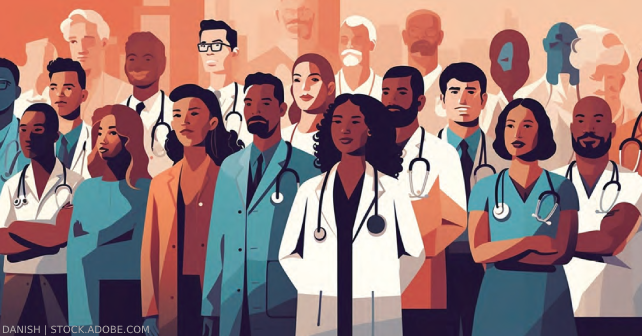
The United States is a country of rich ethnic and cultural diversity, which, although a strength in many regards, makes health disparities readily apparent. According to the 2020 Census data, the population of the United States is 75.8 percent white, 18.9 percent Hispanic, and 13.6 percent Black/African American.1 However, when comparing the current physician workforce, the 2022 Physician Specialty Data Report recorded nearly 64 percent of physicians as white, 20.6 percent Asian, only 6.9 percent Hispanic/Latino and only 5.7 percent Black/African American.2 It is a growing belief, backed by evidence, that patients have better health outcomes when the physician workforce reflects the complexity and diversity of the patient population.3 One recent study to assess the association between mortality rates in the U.S. and Black representation among primary care physicians found that greater Black workforce representation was associated with higher life expectancy and was inversely associated with all-cause Black mortality.3 Therefore, to better serve our diverse patient population, the field of medicine has been taking innovative and comprehensive steps on improving physician diversity, including pipeline programs, community outreach, and efforts to retain and advance faculty from underrepresented minorities.
Explore This Issue
ACEP Now: Vol 42 – No 07 – July 2023Despite these efforts, medical students and residents from underrepresented minorities still face myriad obstacles when navigating their training, from macroaggressions such as overt racism to more subtle microaggressions such as being mistaken by a patient or colleague for a nurse or service worker. These types of encounters increase burnout and compassion fatigue and contribute to minority physicians leaving medicine altogether.4-6 Experiencing mistreatment and discrimination by patients, families, and visitors has significant occupational and personal implications. Discrimination negatively impacts career satisfaction, career advancement, and job turnover.4-6 Studies have showed that up to 62 percent of minority medical students note that microaggressions encountered at work lead to feelings of burnout while 40 percent of physicians who have experienced discrimination considered changing careers.4,5 Hence, acknowledging and discussing implicit bias, structural racism, and discrimination within the house of medicine is crucial.7
Addressing such a vast issue is multifaceted
One proposed solution is incorporating diversity, equity, and inclusion (DEI) education into residency training—and faculty training. DEI encompasses everything from fostering and recruiting medical students from diverse backgrounds, to learning about how implicit biases and research biases affect patient care, to teaching physicians how to recognize and address macro- and microaggressions in the workplace. For example, why are myocardial infarctions in women often underdiagnosed? The answer includes the fact that many studies regarding cardiovascular disease and myocardial infarctions primarily recruited men as subjects, creating an unintentional bias.8 Biases like this have been enshrined in medical textbooks for decades—fighting to change such truisms can be challenging.
Pages: 1 2 3 | Single Page



No Responses to “Diversity, Equity, and Inclusion in Resident Education”