Logo

Log In Sign Up |  An official publication of: American College of Emergency Physicians
Navigation
  • Home
  • Multimedia
    • Podcasts
    • Videos
  • Clinical
    • Airway Managment
    • Case Reports
    • Critical Care
    • Guidelines
    • Imaging & Ultrasound
    • Pain & Palliative Care
    • Pediatrics
    • Resuscitation
    • Trauma & Injury
  • Resource Centers
    • mTBI Resource Center
  • Career
    • Practice Management
      • Benchmarking
      • Reimbursement & Coding
      • Care Team
      • Legal
      • Operations
      • Quality & Safety
    • Awards
    • Certification
    • Compensation
    • Early Career
    • Education
    • Leadership
    • Profiles
    • Retirement
    • Work-Life Balance
  • Columns
    • ACEP4U
    • Airway
    • Benchmarking
    • Brief19
    • By the Numbers
    • Coding Wizard
    • EM Cases
    • End of the Rainbow
    • Equity Equation
    • FACEPs in the Crowd
    • Forensic Facts
    • From the College
    • Images in EM
    • Kids Korner
    • Medicolegal Mind
    • Opinion
      • Break Room
      • New Spin
      • Pro-Con
    • Pearls From EM Literature
    • Policy Rx
    • Practice Changers
    • Problem Solvers
    • Residency Spotlight
    • Resident Voice
    • Skeptics’ Guide to Emergency Medicine
    • Sound Advice
    • Special OPs
    • Toxicology Q&A
    • WorldTravelERs
  • Resources
    • ACEP.org
    • ACEP Knowledge Quiz
    • Issue Archives
    • CME Now
    • Annual Scientific Assembly
      • ACEP14
      • ACEP15
      • ACEP16
      • ACEP17
      • ACEP18
      • ACEP19
    • Annals of Emergency Medicine
    • JACEP Open
    • Emergency Medicine Foundation
  • About
    • Our Mission
    • Medical Editor in Chief
    • Editorial Advisory Board
    • Awards
    • Authors
    • Article Submission
    • Contact Us
    • Advertise
    • Subscribe
    • Privacy Policy
    • Copyright Information

Designer Drug 25B-NBOMe Use Likely to Land Overdose Cases in Your Emergency Department

By Henry K. Su, BA, Mark Baker, MD, and Larry J. Baraff, MD | on November 19, 2014 | 1 Comment
CME CME Now Features
  • Tweet
  • Click to email a link to a friend (Opens in new window) Email
Print-Friendly Version
Designer Drug 25B-NBOMe Use Likely to Land Overdose Cases in Your Emergency Department

The patient is agitated and tremulous. He is given diazepam 5 mg IV, after which his heart rate is 159 and blood pressure is 128/86. He is given a second dose of diazepam 5 mg IV and two liters of IV normal saline. After the second dose of diazepam, he is calm, and the restraints are removed. Hospitalization is arranged, but on reevaluation, he is improving rapidly. He is discharged four hours after arrival following resolution of symptoms. At the time of discharge, he is ambulatory and conversant. He has no recollection of coming to the emergency department.

You Might Also Like
  • Drug Overdoses from Acetyl Fentanyl Mixed Into Street Drugs On Rise
  • Overdose Antidote Naloxone Hydrochloride Available in California Pharmacies
  • Naloxone to Reduce Opiate Overdose Deaths Raises Cost, Liability, and Safety Concerns
Explore This Issue
ACEP Now: Vol 33 – No 11 – November 2014

Patient 2 is an 18-year-old female who is awake and looking around the room but unable to communicate. She does say a few words, but they are either unintelligible or out of context. There are no visible signs of trauma.

Her temperature is 37.3°C, heart rate 108, respirations 22, and blood pressure 120/65. She is confused and also has dilated pupils. This patient is the first to mention the drug. With repeated questioning, she utters, “B-25.” When she improves to the point that she can communicate, she reports dysphoria and visual hallucinations. Later, she denies dysphoria and reports euphoria instead. The urine drug screen is negative. The WBC is normal. She is given 2 liters of normal saline. She is discharged four hours after arrival following resolution of symptoms.

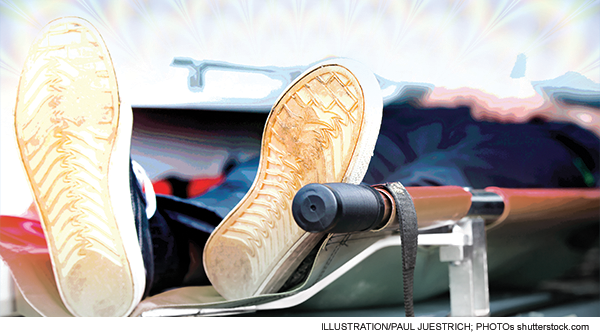
Patient 3 is a 19-year-old male. He was found supine on the floor of the residence, where he was noted to be occasionally screaming and thrashing. Upon arrival, his temperature is 37.2°C, heart rate 114, respirations 22, and blood pressure 126/67. He is confused and also has large 5 mm nonreactive pupils. Documentation from the examining physician includes: “He is lying on the gurney looking straight up in the ceiling. He has a smile on his face. He does not appear combative. He does not interact with me.” Significant laboratory studies include CO2 20 mmol/L and a WBC of 28,900. Urine drug screen is negative.

He is lying on the gurney looking straight up in the ceiling. He has a smile on his face. He does not appear combative. He does not interact with me. Significant laboratory studies included CO2 20 mmol/L and a WBC of 28,900.

He never looks uncomfortable. He does not communicate initially, but when he improves and is able to communicate, he reports euphoria and visual hallucinations. He is discharged three hours after admission following resolution of symptoms.

Pages: 1 2 3 4 | Single Page

Topics: AddictionCase PresentationCritical CareDrug OverdoseEmergency DepartmentEmergency PhysicianIllegal Drug Abuse

Related

  • Why the Nonrebreather Should be Abandoned

    December 3, 2025 - 0 Comment
  • Non-Invasive Positive Pressure Ventilation in the Emergency Department

    October 1, 2025 - 0 Comment
  • Emergency Department Management of Prehospital Tourniquets

    October 1, 2025 - 0 Comment

Current Issue

ACEP Now: November 2025

Download PDF

Read More

One Response to “Designer Drug 25B-NBOMe Use Likely to Land Overdose Cases in Your Emergency Department”

  1. September 3, 2015

    Boston Bans “Synthetic Marijuana” - ACEP Now Reply

    […] Centers for Disease Control in June warned that calls to poison control centers and deaths from overdoses of the drug were on the […]

Leave a Reply Cancel Reply

Your email address will not be published. Required fields are marked *


*
*


Wiley
  • Home
  • About Us
  • Contact Us
  • Privacy
  • Terms of Use
  • Advertise
  • Cookie Preferences
Copyright © 2025 by John Wiley & Sons, Inc. All rights reserved, including rights for text and data mining and training of artificial technologies or similar technologies. ISSN 2333-2603
