Logo

Log In Sign Up |  An official publication of: American College of Emergency Physicians
Navigation
  • Home
  • Multimedia
    • Podcasts
    • Videos
  • Clinical
    • Airway Managment
    • Case Reports
    • Critical Care
    • Guidelines
    • Imaging & Ultrasound
    • Pain & Palliative Care
    • Pediatrics
    • Resuscitation
    • Trauma & Injury
  • Resource Centers
    • mTBI Resource Center
  • Career
    • Practice Management
      • Benchmarking
      • Reimbursement & Coding
      • Care Team
      • Legal
      • Operations
      • Quality & Safety
    • Awards
    • Certification
    • Compensation
    • Early Career
    • Education
    • Leadership
    • Profiles
    • Retirement
    • Work-Life Balance
  • Columns
    • ACEP4U
    • Airway
    • Benchmarking
    • Brief19
    • By the Numbers
    • Coding Wizard
    • EM Cases
    • End of the Rainbow
    • Equity Equation
    • FACEPs in the Crowd
    • Forensic Facts
    • From the College
    • Images in EM
    • Kids Korner
    • Medicolegal Mind
    • Opinion
      • Break Room
      • New Spin
      • Pro-Con
    • Pearls From EM Literature
    • Policy Rx
    • Practice Changers
    • Problem Solvers
    • Residency Spotlight
    • Resident Voice
    • Skeptics’ Guide to Emergency Medicine
    • Sound Advice
    • Special OPs
    • Toxicology Q&A
    • WorldTravelERs
  • Resources
    • ACEP.org
    • ACEP Knowledge Quiz
    • Issue Archives
    • CME Now
    • Annual Scientific Assembly
      • ACEP14
      • ACEP15
      • ACEP16
      • ACEP17
      • ACEP18
      • ACEP19
    • Annals of Emergency Medicine
    • JACEP Open
    • Emergency Medicine Foundation
  • About
    • Our Mission
    • Medical Editor in Chief
    • Editorial Advisory Board
    • Awards
    • Authors
    • Article Submission
    • Contact Us
    • Advertise
    • Subscribe
    • Privacy Policy
    • Copyright Information

How to Conduct a Sexual Assault Examination and Collect Evidence

By Ralph J. Riviello, MD, MS, FACEP, and Heather V. Rozzi, MD, FACEP | on October 13, 2016 | 0 Comment
Forensic Facts
  • Tweet
  • Click to email a link to a friend (Opens in new window) Email
Print-Friendly Version
Sexual Assault Patient Care, Examination Tips for Emergency Physicians

Foreign material and clothing collection. Place a clean bed sheet on the floor; over that, place a clean paper sheet. Have the patient stand in the center of the sheet and disrobe. As each piece of clothing is removed, place it in a separate paper bag. If clothing is wet, it should ideally be air-dried before packaging. If the patient isn’t wearing the same clothing as at the time of assault, collect only the clothing in contact with the patient’s genital area. Once all clothing has been collected, fold the paper sheet to contain any foreign material and place that in a bag.

You Might Also Like
  • Know the Legal Requirements When Caring for Sexual Assault Victims
  • Wide Variation in the Emergency Department for Testing, Treatment After Teen Sexual Assault
  • Tips for Taking Forensic Photographic Evidence in the Emergency Department
Explore This Issue
ACEP Now: Vol 35 – No 10 – October 2016

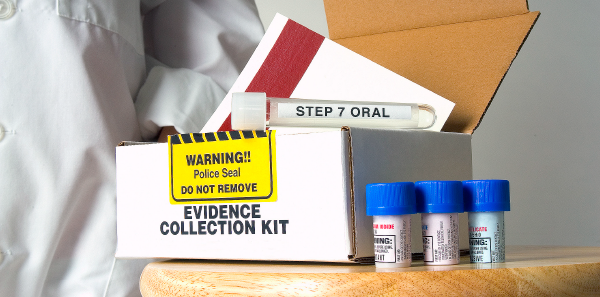
Oral assault evidence collection. If the patient reports oral assault, using one swab, swab the buccal area and gum line. Repeat with a second swab. With both swabs held together, prepare one smear on a slide. Allow swabs and smear to air-dry. Do not moisten swabs prior to sample collection.

External genitalia collection. There are similar protocols for female and male victims:

  • Female victim: Moisten swab with distilled water and swab the vulva. Repeat with a dry swab. Allow swabs to air-dry.
  • Male victim: Moisten swab with distilled water and swab the glans and shaft of the penis. Repeat with a dry swab. Using another moistened swab, swab the scrotum. Repeat with a dry swab. Allow swabs to air-dry.

Vaginal assault collection. Swab the vaginal vault with two separate swabs, then use both together to prepare a smear on one slide. Use warm water to lubricate a vaginal speculum. Swab the cervix with two separate swabs. Allow all swabs and the slide to air-dry.

Rectal assault collection. If the patient reports rectal assault, swab the rectal canal with two separate swabs. Allow to air dry. However, even if rectal assault is not reported, DNA evidence may be recovered due to fluid/evidence transfer to that area. In cases where the victim was incapacitated or unconscious, rectal swabs should be performed.

DNA analysis collection. Collection methods vary based on crime lab preferences. Many commercial kits include a collection pad meant to be used on the buccal mucosa. Some crime labs prefer a blood sample.

Miscellaneous collection. There are several areas that should be checked as part of the examination. Any evidence collected should be placed in separate envelopes:

  • Debris: Place any debris on a clean sheet of paper and fold the paper around debris.
  • Dried secretions: Lightly moisten a sterile swab with distilled water and swab the dried secretions. Repeat with a dry swab. Allow both swabs to air-dry and label them with the anatomical area that was swabbed.
  • Tampon/sanitary napkin: Allow to air-dry and place in a wax bag.
  • Fingernail clippings: Over a clean paper sheet, cut the patient’s fingernails using the clipper provided in the kit. Repeat using a new paper sheet for fingernails of other hand; be sure to label the hand from which the clippings were taken. Swab the fingertips/nails with swabs moistened with distilled water, then again with dry swabs.
  • Pubic hair combings: Place a paper sheet under the patient’s buttocks. Using the comb provided in the kit, comb the pubic hair so that loose hairs and debris fall onto the sheet. Fold the sheet to retain the debris.

Pages: 1 2 3 | Single Page

Topics: Critical CareEmergency DepartmentEmergency PhysicianEvidence CollectionExaminationPatient CarePractice ManagementSexual AssaultTrauma & Injury

Related

  • Why the Nonrebreather Should be Abandoned

    December 3, 2025 - 0 Comment
  • Florida Emergency Department Adds Medication-Dispensing Kiosk

    November 7, 2025 - 1 Comment
  • Q&A with ACEP President L. Anthony Cirillo

    November 5, 2025 - 0 Comment

Current Issue

ACEP Now: November 2025

Download PDF

Read More

No Responses to “How to Conduct a Sexual Assault Examination and Collect Evidence”

Leave a Reply Cancel Reply

Your email address will not be published. Required fields are marked *


*
*


Wiley
  • Home
  • About Us
  • Contact Us
  • Privacy
  • Terms of Use
  • Advertise
  • Cookie Preferences
Copyright © 2025 by John Wiley & Sons, Inc. All rights reserved, including rights for text and data mining and training of artificial technologies or similar technologies. ISSN 2333-2603
