
The Case: You’re working the overnight shift in a rural emergency department. The charge nurse says, “Tag, you’re it,” and hands you the chart of a 19-year-old female who reports that she has been sexually assaulted. There are no sexual assault nurse examiners at your hospital, but the department does have a stash of sexual assault evidence collection kits. Do you know how to proceed?
Explore This Issue
ACEP Now: Vol 35 – No 10 – October 2016Kit Contents
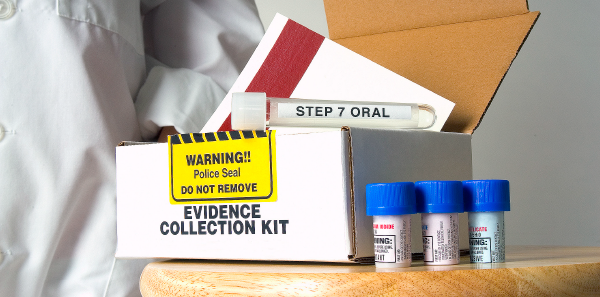
The type of sexual assault evidence kit (SAEK) your hospital uses may vary. The photos below are of the kit commonly used in Pennsylvania, but most commercially available kits contain similar contents. States or jurisdictions often mandate the contents of the SAEK to be used. Here’s what should be in a standard SAEK:
- Consent form
- Chain of Custody form
- Foreign material bags and envelopes
- Oral assault collection swabs/slide/envelopes
- Fingernail clipping envelopes
- Pubic hair combing envelopes
- Vaginal/penile assault collection swabs/envelopes
- Rectal assault collection envelopes
- Buccal swab collection envelopes
Examination
Always obtain consent prior to beginning a sexual assault examination. Depending upon where you practice, you may also be required to notify law enforcement as dictated by state and local laws. In addition, there are often jurisdictionally mandated chart forms that should be used. Some of the steps listed below may not be required depending on your practice location; it’s important to know the requirements in the jurisdictions where you practice.
Patients presenting after sexual assault, like all other patients, must have a medical screening exam upon presentation to the emergency department. Although serious physical injury following sexual assault is rare, if serious injury is present, medical care takes precedence over evidence collection.
Once you’ve begun collecting evidence, the kit must remain in your direct line of sight or securely stored until collected by law enforcement. Most kits include a Chain of Custody form, often on the outside of the box, to document transfer of evidence. Failure to maintain the chain of custody may result in collected evidence being inadmissible in court.
Although commercial swab driers are available, specimens can be air-dried by inverting swabs into a lump of clay, a rack of test tubes, or inverted Styrofoam cups. The cups and tubes are single use to prevent cross-contamination. The other surfaces should be thoroughly cleaned before and after use with a 10 percent bleach solution. Carefully label each swab immediately after collection.
Last but certainly not least, after placing the evidence in separate envelopes, seal the envelopes with tape or a label. Do not lick the envelopes!
Foreign material and clothing collection. Place a clean bed sheet on the floor; over that, place a clean paper sheet. Have the patient stand in the center of the sheet and disrobe. As each piece of clothing is removed, place it in a separate paper bag. If clothing is wet, it should ideally be air-dried before packaging. If the patient isn’t wearing the same clothing as at the time of assault, collect only the clothing in contact with the patient’s genital area. Once all clothing has been collected, fold the paper sheet to contain any foreign material and place that in a bag.
Oral assault evidence collection. If the patient reports oral assault, using one swab, swab the buccal area and gum line. Repeat with a second swab. With both swabs held together, prepare one smear on a slide. Allow swabs and smear to air-dry. Do not moisten swabs prior to sample collection.
External genitalia collection. There are similar protocols for female and male victims:
- Female victim: Moisten swab with distilled water and swab the vulva. Repeat with a dry swab. Allow swabs to air-dry.
- Male victim: Moisten swab with distilled water and swab the glans and shaft of the penis. Repeat with a dry swab. Using another moistened swab, swab the scrotum. Repeat with a dry swab. Allow swabs to air-dry.
Vaginal assault collection. Swab the vaginal vault with two separate swabs, then use both together to prepare a smear on one slide. Use warm water to lubricate a vaginal speculum. Swab the cervix with two separate swabs. Allow all swabs and the slide to air-dry.
Rectal assault collection. If the patient reports rectal assault, swab the rectal canal with two separate swabs. Allow to air dry. However, even if rectal assault is not reported, DNA evidence may be recovered due to fluid/evidence transfer to that area. In cases where the victim was incapacitated or unconscious, rectal swabs should be performed.
DNA analysis collection. Collection methods vary based on crime lab preferences. Many commercial kits include a collection pad meant to be used on the buccal mucosa. Some crime labs prefer a blood sample.
Miscellaneous collection. There are several areas that should be checked as part of the examination. Any evidence collected should be placed in separate envelopes:
- Debris: Place any debris on a clean sheet of paper and fold the paper around debris.
- Dried secretions: Lightly moisten a sterile swab with distilled water and swab the dried secretions. Repeat with a dry swab. Allow both swabs to air-dry and label them with the anatomical area that was swabbed.
- Tampon/sanitary napkin: Allow to air-dry and place in a wax bag.
- Fingernail clippings: Over a clean paper sheet, cut the patient’s fingernails using the clipper provided in the kit. Repeat using a new paper sheet for fingernails of other hand; be sure to label the hand from which the clippings were taken. Swab the fingertips/nails with swabs moistened with distilled water, then again with dry swabs.
- Pubic hair combings: Place a paper sheet under the patient’s buttocks. Using the comb provided in the kit, comb the pubic hair so that loose hairs and debris fall onto the sheet. Fold the sheet to retain the debris.
Dr. Riviello is professor of emergency medicine at Drexel Emergency Medicine in Philadelphia.
Dr. Rozzi is an emergency physician, director of the Forensic Examiner Team at WellSpan York Hospital in York, Pennsylvania, and chair of the Forensic Section of ACEP.
Pages: 1 2 3 | Multi-Page



No Responses to “How to Conduct a Sexual Assault Examination and Collect Evidence”