
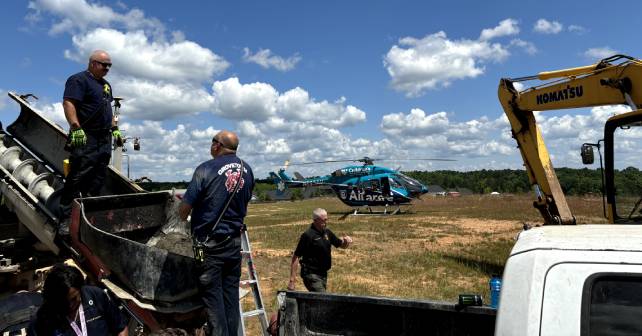
EMS and Fire are called to a new development construction site for a 22-year-old male who is possibly entrapped in a concrete machine. Prior to arrival, a bystander placed a belt on the patients legs, as a makeshift tourniquet. Upon arrival, they find a young male partially standing up inside the hopper of a concrete curb laying machine. Further investigation reveals his right leg was stuck in the auger of this machine with his mangled foot sticking out of the chute at the bottom. The fire crew requested a heavy rescue for additional resources. The EMS crew placed a second tourniquet, began two large bore IVs, and started intravenous fluids. Additionally, they called for an EMS helicopter for transport.
Explore This Issue
ACEP Now: Vol 43 – No 11 – November 2024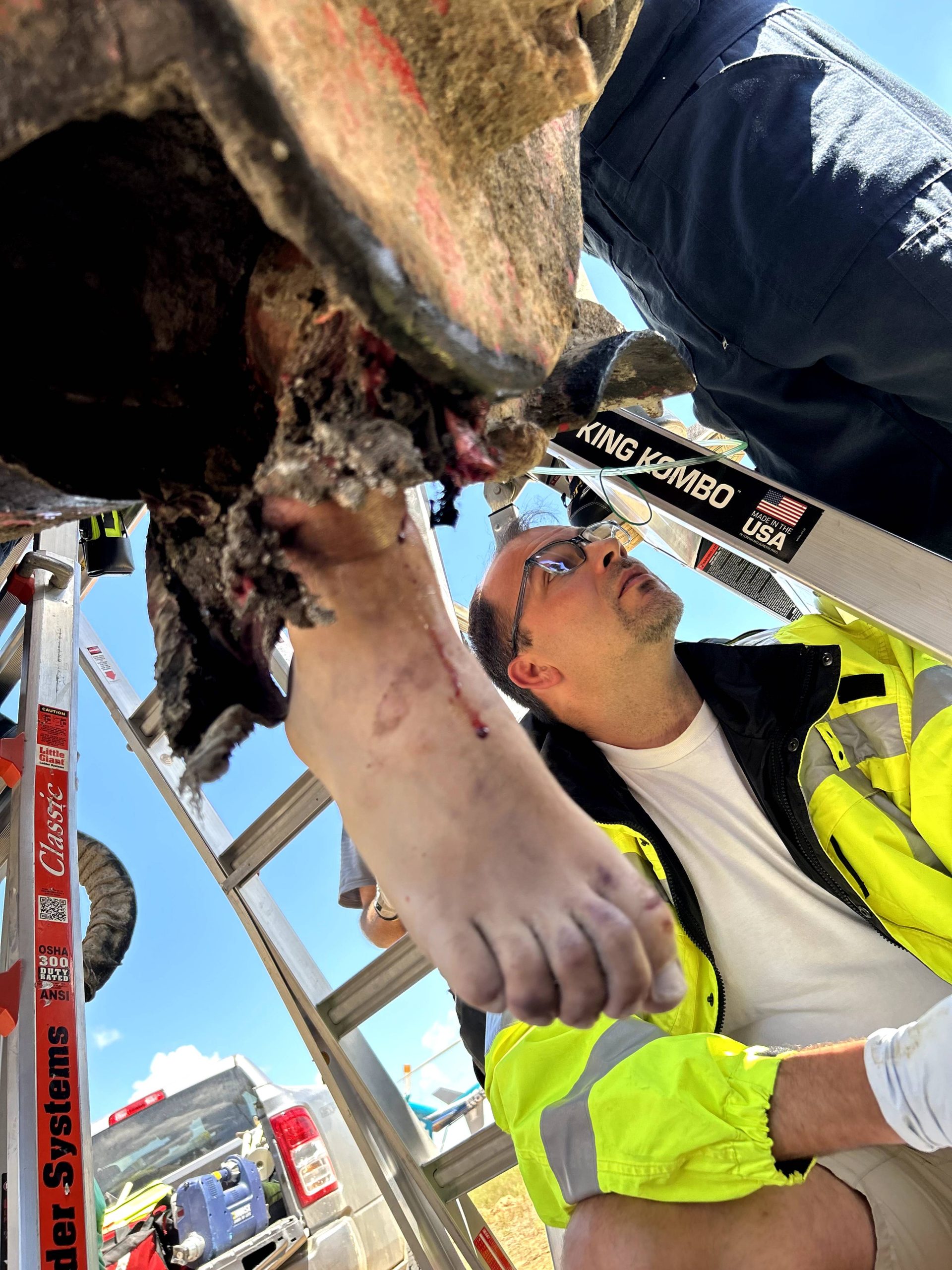
The patient’s foot dangles from the auger. (Click to enlarge.)
The Level 1 trauma center, Wellstar MCG Health, dispatched its EMS helicopter AirCare, but also made a request for their EMS physician response vehicle to respond. Three EMS physicians happened to be in a conference and available. Both AirCare and the EMS physician team arrived on scene within 30 minutes. Prior to their arrival, the fire department had commandeered a construction excavator and a heavy equipment operator to set up a lift to pull the patient out. The articulating arm was moved above the patient and a harness and rigging was attached to secure the patient in preparation to lift him out of the concrete machine.
Assessment
When the physician team arrived, AirCare had just landed and was performing their assessment. A quick scene size-up found the patient to be awake and alert, but tachycardic in 130s, respirations in 20s on RA, systolic blood pressure 90s, shock index of 1.4, and diaphoretic. The patient’s foot, noted to be a complete fracture dislocation of ankle joint and three-quarters amputated, was only being held by soft tissue. There was no palpable pulse and capillary refill time was greater than five 5 seconds; however, the patient had two tourniquets in place at this point.
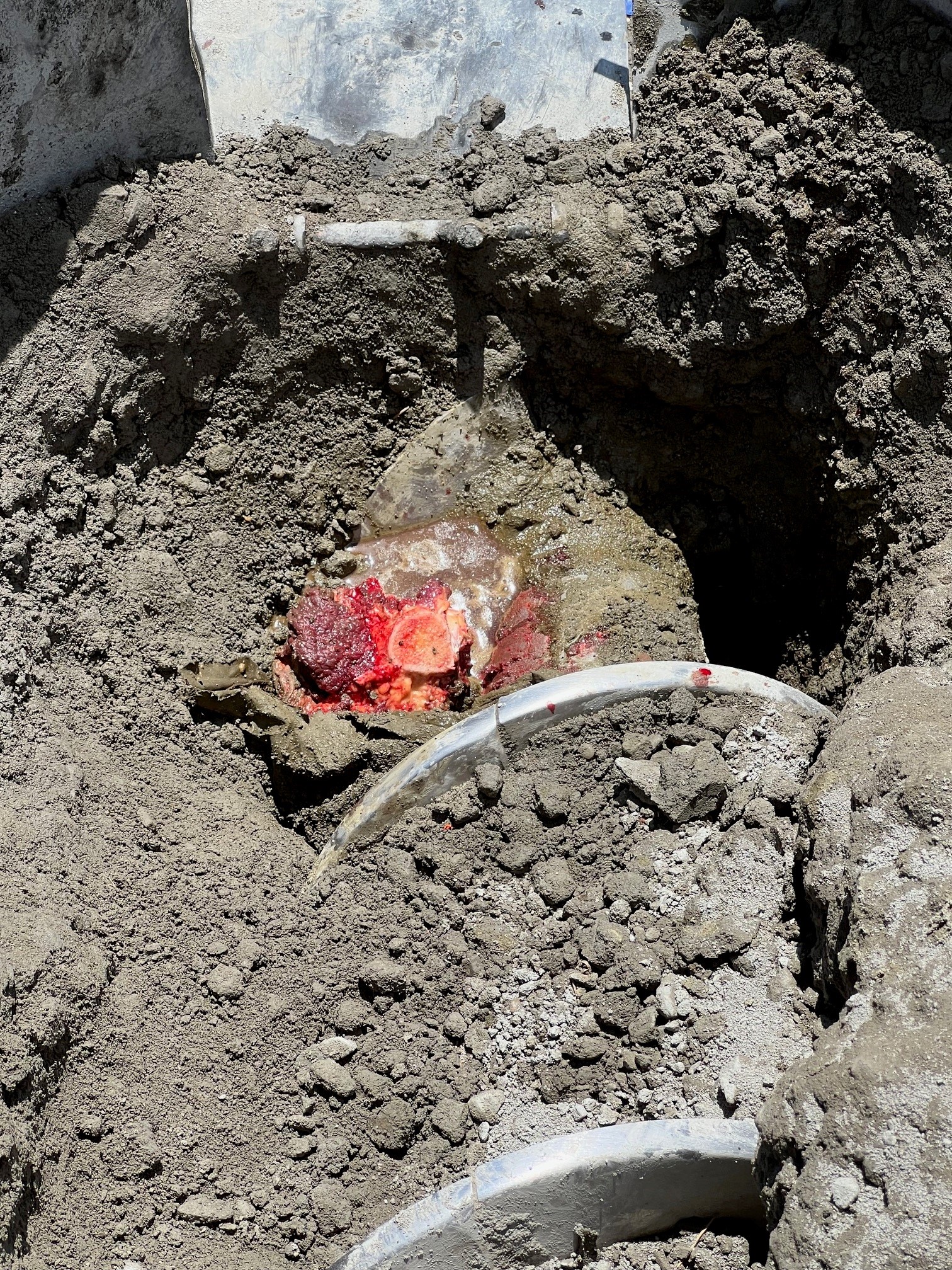
The second, higher, amputation site. (Click to enlarge.)
A quick discussion with rescue personnel revealed that the machine could not be put in reverse safely and that the machinery could not be taken apart in a timely fashion. The three physicians on scene concurred that the patient was not stable (initially given IV fluids with improvement in blood pressure, but now hypotensive), and his foot would need to be amputated. Simultaneously there was a request for the AirCare crew to give whole blood, tranexamic acid, and Ancef.
The physician team had a brief discussion with the patient regarding his condition and the need to amputate. The patient verbally agreed to amputation, however, the patient was noted to again be in considerable distress and had already received 200 mcg of. All the preparation done by fire rescue prior to EMS physician arrival helped minimize any delay to amputation and scene time.
Amputation
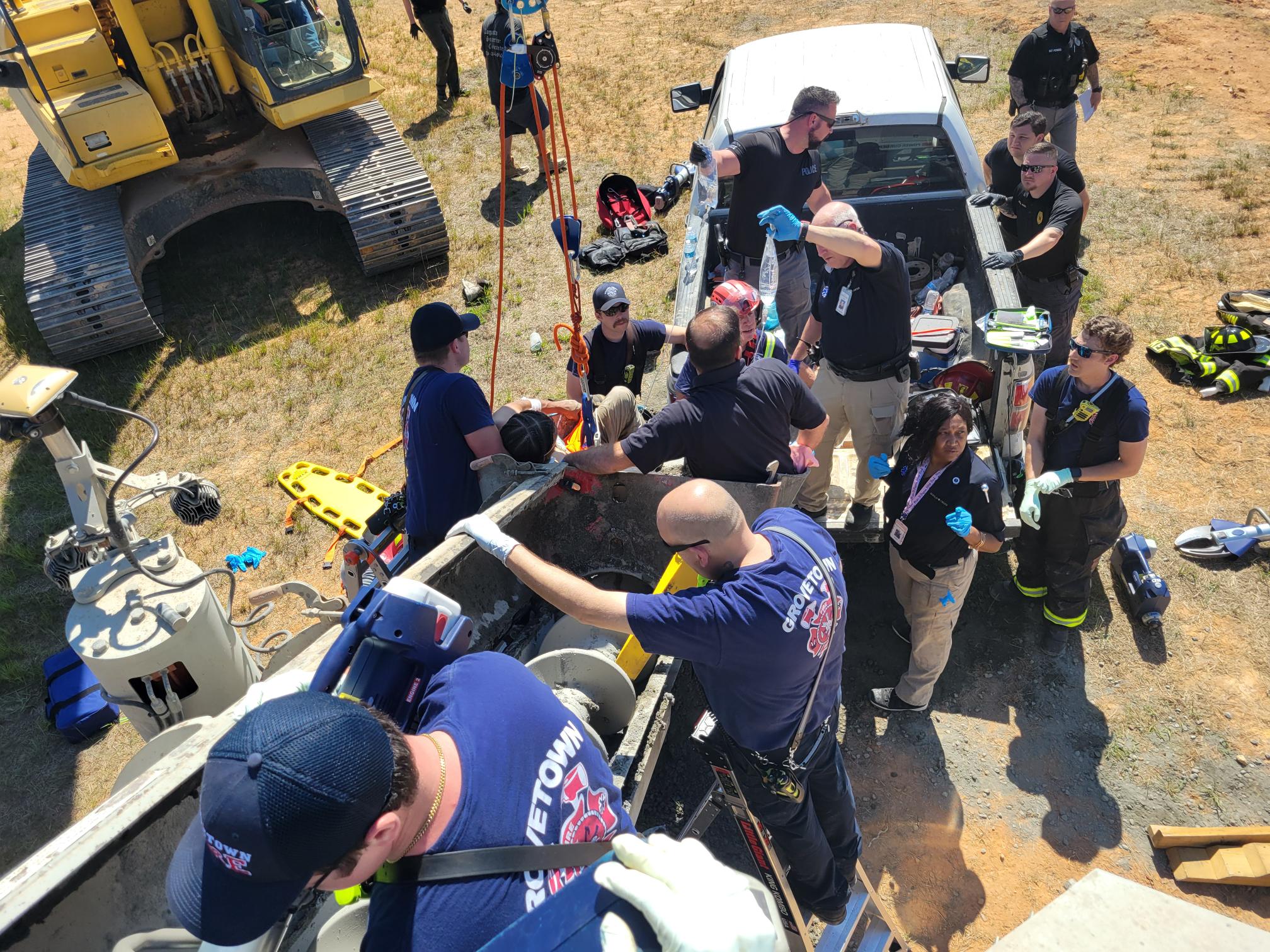
The patient is lowered from the auger. (Click to enlarge.)
The decision was made to intubate mainly for sedation. Ketamine was chosen because of the prior hypotension. In addition, this would provide both anesthesia and analgesia. The patient was given rocuronium for paralysis. The patient was found standing with most of his body in the concrete hopper and it was not possible to lay the patient down for intubation. One physician, Dr. Conner stood on a six-foot ladder above the patient to intubate using a portable glideslope kept on the EMS physician vehicle. Since the patient was already rigged in the position in which he was found, only head support was needed after paralysis. There was brief hypotension noted after intubation for which the patient was given a push dose of phenylephrine. The intubation was completed within 15 minutes of the EMS physician team arrival.
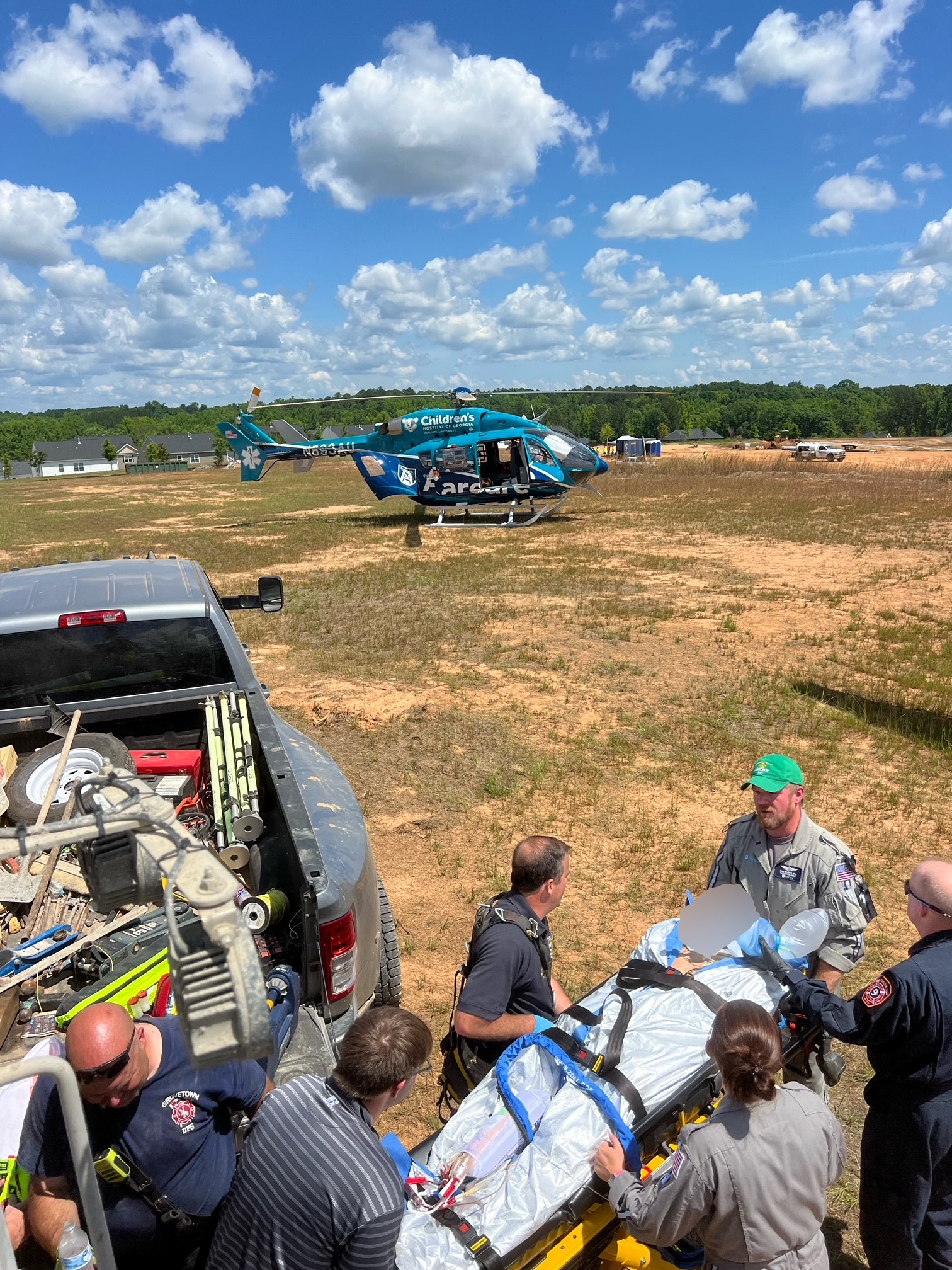
Post surgery, the patient was transported via helicopter to a trauma center. (Click to enlarge.)
After the airway was confirmed and secured, Dr. Burgbacher used a scalpel to cut through the remaining soft tissue. The patient’s foot was placed in a bag and in a cooler full of ice that was donated by the construction crew on scene. First amputation was completed within 20 minutes of EMS physician arrival.
At this point, the extrication team attempted to pull the patient out of concrete machine with the excavator and rigging, only to find that the patient’s leg was still entrapped. The patient’s lower leg was covered in soft concrete and once this was dug out, it was realized that the auger still had the patients right leg pinned at the upper calf.
After further discussion between the physician and rescue teams it was decided that a second amputation was required. Given the limited access inside the concrete hopper, the decision was made to attempt disarticulation at the knee. However, this proved to be too difficult to complete and was quickly abandoned in favor of an above the knee amputation. Using multiple scalpels to cut down any soft tissue to the bone, a commercial reciprocating saw borrowed by the fire department was used to cut through the distal femur. The second amputation was completed approximately 18 minutes after the first.
The patient was then able to be pulled from the machine and placed on stretcher. The patient was given additional ketamine for sedation during the second amputation. The wound was bandaged with compressive dressings.
The patient was then transported by AirCare to the Level 1 trauma center nine minutes away. A physician team member flew with AirCare to continue patient care. Upon arrival, the awaiting trauma team did an initial primary and secondary survey, and the patient was taken to the OR emergently for washout and ligation of vessels. It was noted by trauma surgery that the patient had several traumatic fasciotomies from the initial injury that required the amputation to be extended several inches higher. Postoperatively, the patient had a good recovery; however, needed several more surgeries for washout and reconstruction.
Discussion
Performing a field amputation is an extremely rare and heroic procedure, but one that emergency physicians should be familiar with. There are limited data published on field amputation and the majority is anecdotal. In 1996, a survey was sent to 200 U.S. metropolitan EMS agencies regarding field amputation. Out of the 143 agencies that responded, only 26 amputations had occurred during a five-year period. The procedure was performed by a trauma surgeon in 53 percent of cases, emergency medicine physician in 36 percent of cases, and paramedic in 14 percent of the cases. There was no formal training and only two of the systems had an existing protocol.
Generally accepted indications:
- Unstable patient
- Unstable environment
- Relatively stable patient (after resuscitation), stable environment
- Stable patient, stable environment (prolonged extrication)
The first two indications are more straightforward and would fall under emergent consent. The second two indications typically would require more discussion of risk/benefits/alternatives, and this may be more difficult, especially after giving analgesia. Discussion with another provider if possible is recommended. In our case all three physicians, as well as air crew and fire rescue on scene, agreed amputation was necessary.
Equipment Needed
- Monitor for sedation
- RSI/sedation/analgesic medications
- If possible, blood products for transfusion
- Saline or lactated ringers
- Tourniquets (x2)
- Sterile gloves, towels, drapes
- PPE: eye protection, mask, gowns, gloves
- ABD bandages, gauze, laparotomy pads, Ace wraps, and Kling
- Sterile scalpel, scissors, hemostats, Kelly clamp
- Betadine/chlorhexidine
- Gigli Saw or battery powered hand saw
Procedure
- Prepare monitor, dawn PPE, sedate patient
- Brief time out so team is ready
- Place tourniquets (if not already)
- Identify site as distal as possible
- Prep site with betadine or chlorhexidine
- Drape with sterile towels/sheets
- Using scalpel cut soft tissue circumferentially down to bone
- Use hemostats to ligate any bleeding vessels
- Use two sterile towels to wrap around bone and pull in opposite directions to create a soft tissue window to the bone
- Use saw to cut bone
- Irrigate wound and apply sterile dressing and compressive wrap
- If possible, obtain amputated limb, wrap in moist sterile dressing, place in bag, and place on ice
Todd Burgbacher, DO, FACEP, is an emergency medicine specialist practicing emergency medicine in Augusta.
Pages: 1 2 3 4 | Multi-Page


2 Responses to “Case Report: Foot Amputation in the Field”
December 2, 2024
Kyle JaschenGreat read Dr. Burgbacher! Any issues with the saw getting thru the femur? Was it battery powered or corded? How long and what type was the blade?
January 15, 2025
Joseph EndemanoNo problem getting through the femur. A reciprocating saw (sawzall) was used from one of the fire engines on scene.