
A 33-year-old male with a history of drug use presented to the emergency department (ED) for extreme agitation after receiving two doses of 2 mg naloxone by EMS for respiratory depression.
Explore This Issue
ACEP Now: Feb Digital 01-DUpon arrival, his vitals were as follows: heart rate of 132 bpm, respiratory rate of 27, blood pressure of 134/75 mm Hg, and a SpO2 of 100 percent. He was notably diaphoretic, tachycardic, and severely agitated, requiring physical restraint by multiple security and medical team members for patient and staff safety. He was initially treated with two doses of intramuscular (IM) haloperidol and escalating doses of IM and then intravenous midazolam over two hours. He remained agitated, with only minimal and brief periods of improvement.
Laboratory findings were significant for an acute kidney injury and elevated creatinine kinase. The family of the patient reported that he was a long-time user of significant amounts of kratom. A dexmedetomidine (Precedex) 400 mcg in 0.9 percent NaCl infusion was started, and the patient responded well, with significant decrease in his agitation. He began verbally responding, thus avoiding the need for intubation. He was admitted for a suspected kratom overdose and acute kratom withdrawal. He was discharged the next day.
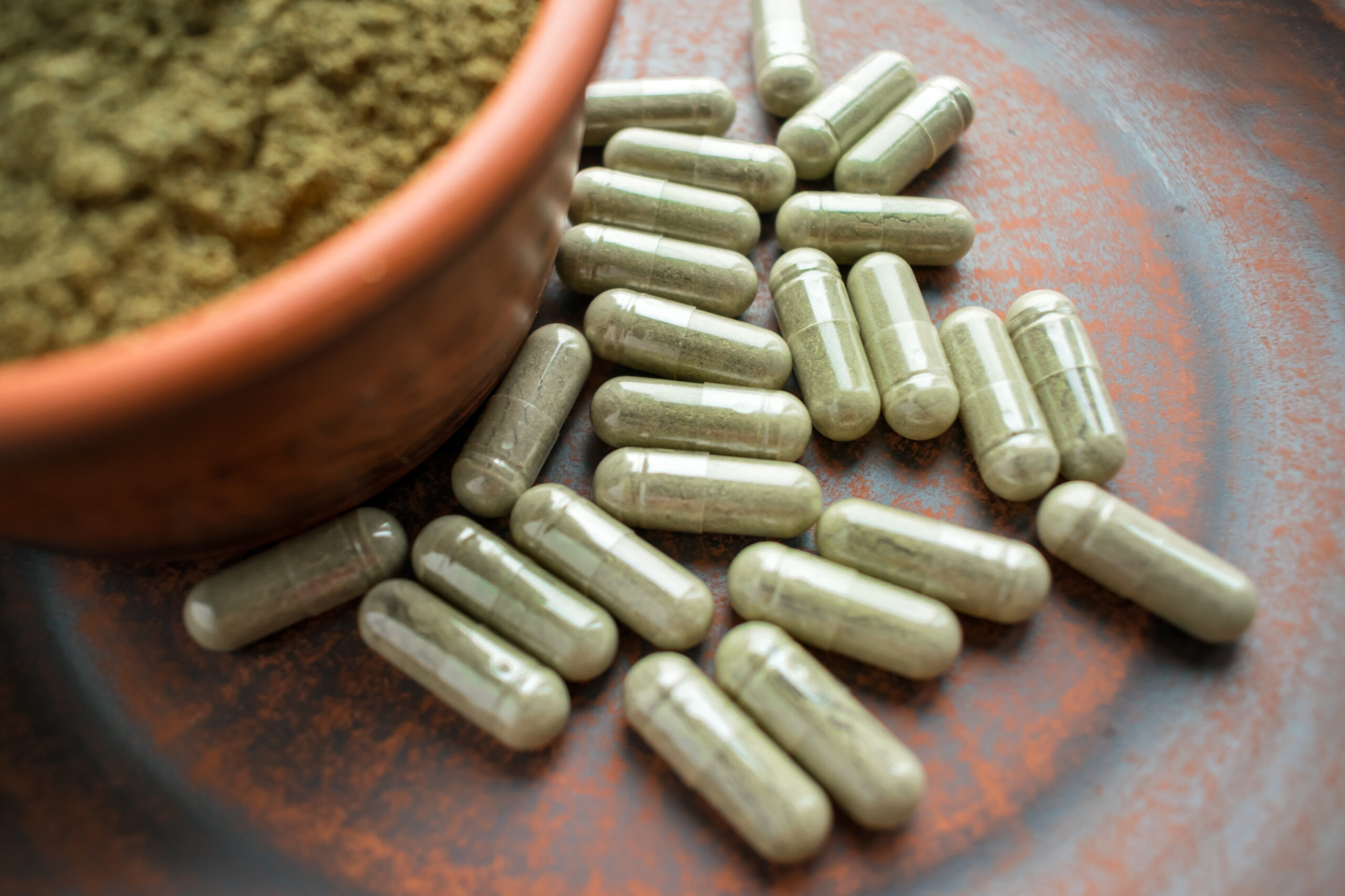
Kratom—a widely available herbal sold throughout the United States—is derived from the plant species known as Mitragyna speciosa.1 For centuries, this plant has been used for its analgesic and euphoric effects in its native environment, southeast Asia. Today, it can be found in powders, concentrated oils, and gels sold over the counter at tobacco shops. In the United States, kratom is mostly used for opiate withdrawal, pain, and anxiety. It is illegal in six states and not regulated in 33 states.2 In the states without regulation, there are no requirements for reporting potency, instructions for use of the drug, or warnings regarding potential issues with polypharmacy. In 2022, the National Poison Data system reported 1,278 cases involving kratom; about 45 percent of those cases required health care facility management.3
Chemical Makeup
Chemically, there are two major metabolites found within Mitragyna speciosa that have received most of the attention in scientific literature. Mitragynine (MG) and 7-hydroxymitragynine (7-HMG) are two alkaloid compounds that have been heavily studied, although data show there are as many as 50 additional substrates depending on the strain of the plant analyzed.4 Both MG and 7-HMG are µ-opioid agonists and show some antagonism at the delta opioid receptors, which has been postulated as a reason for the lower incidence of classic opioid side effects, such as constipation, with kratom use.4-6
When compared, 7-HMG is approximately 40 times more potent than MG and nearly 10 times as potent as conventional morphine.4 These two compounds are found in nearly all kratom products, but because of the lack of strict regulations, the quantity of each can vary in the products sold over the counter. Although the quantity of MG is usually close to 10 times higher in most products, it has been shown both in vitro and in vivo that MG can be converted to 7-HMG, which could theoretically lead to significant effects with heavy kratom use.7 Most of the difficulty in identifying patients who have overdosed or are in acute withdrawal from kratom comes from the inability to test for it in commercial assays of blood or urine.
The pathophysiology of withdrawal from kratom use is not well studied. As mentioned previously, both the major alkaloid compounds found within kratom have been shown to activate opioid receptors, but these compounds also have binding affinity for adrenergic, serotonergic, and dopaminergic receptors, leading to significant variations in presenting overdose and acute withdrawal symptoms.1,6-7
Withdrawal Syndrome
Most case reports describe an opiate withdrawal syndrome from chronic users of kratom. That is, they experienced nausea, vomiting, chills, myalgias, and diarrhea. In the acute setting, it is postulated that withdrawal may be brought on by the rapid reversal and displacement of opioid receptors from drugs such as naloxone (Narcan). Similarly, interruption of long-term use of alpha-2 adrenergic receptor agonists may lead to increased sympathetic activity and behavioral responses similar to alcohol or opioid withdrawal. Dexmedetomidine is an alpha-2 adrenergic receptor agonist, which may alleviate withdrawal symptoms through two pathways: 1) symptomatic management of acute agitation caused by opioid receptor displacement from Narcan administration and 2) treatment of alpha-2 adrenergic withdrawal from chronic kratom use through alpha-2 adrenergic agonism, thus inhibiting norepinephrine release. Through these mechanisms, it is postulated that dexmedetomidine manages noradrenergic hyperactivity seen in acute kratom withdrawal.6,8,9
 Dr. Davis is a PGY-1 Emergency Medicine resident at the Riverside Regional Medical Center in Newport News, VA
 Dr. Darling is a third-year emergency medicine resident at Riverside Regional Medical Center, who will continue her training at the University of Wisconsin with a fellowship in retrieval and critical care transport.

Dr. Scott is a Clinical Pharmacy Specialist in Emergency Medicine at VCU Health, Clinical Assistant Professor at VCU School of Pharmacy, and Clinical Assistant Professor at VCU School of Medicine.
 Dr. Polsinelli is program director of the emergency medicine residency at Riverside Regional Medical Center in Newport News, VA.
References
- White CM. Pharmacologic and clinical assessment of kratom: An update. Am J Health Syst Pharm. 2019;76(23):1915-1925.
- Substance Abuse and Mental Health Services Administration. National Survey on Drug Use and Health. https://www.samhsa.gov/data/release/2023-national-survey-drug-use-and-health-nsduh-releases. Accessed December 4, 2024.
- Gummin DD, Mowry JB, Beuhler MC, et al. 2022 Annual Report of the National Poison Data System® (NPDS) from America’s Poison Centers®: 40th Annual Report. Clin Toxicol (Phila). 2023;61(10):717-939.
- Todd DA, Kellogg JJ, Wallace ED, et al. Chemical composition and biological effects of kratom (Mitragyna speciosa): in vitro studies with implications for efficacy and drug interactions. Sci Rep. 2020;10(1):19158.
- Anand A, Hosanagar A. The addictive potential and challenges with use of the “herbal supplement” kratom: a case report and literature review. Pain Med. 2022;23(1):4-9.
- Obeng S, Kamble SH, Reeves ME, et al. Investigation of the adrenergic and opioid binding affinities, metabolic stability, plasma protein binding properties, and functional effects of selected indole-based kratom alkaloids. J Med Chem. 2020;63(1):433-439.
- Kruegel AC, Gassaway MM, Kapoor A, et al. Synthetic and receptor signaling explorations of the mitragyna alkaloids: mitragynine as an atypical molecular framework for opioid receptor modulators. J Am Chem Soc. 2016;138(21): 6754-6764.
- Gowing L, Ali R, White JM. Opioid antagonists with minimal sedation for opioid withdrawal. Cochrane Database Syst Rev. 2017;5(5):CD002021.
- Gold MS, Pottash AC. The neurobiological implication of clonidine HCl. Ann N Y Acad Sci. 1981;362:191-202.
Pages: 1 2 3 | Multi-Page



No Responses to “Case Report: Acute Kratom Withdrawal”