Logo

Log In Sign Up |  An official publication of: American College of Emergency Physicians
Navigation
  • Home
  • Multimedia
    • Podcasts
    • Videos
  • Clinical
    • Airway Managment
    • Case Reports
    • Critical Care
    • Guidelines
    • Imaging & Ultrasound
    • Pain & Palliative Care
    • Pediatrics
    • Resuscitation
    • Trauma & Injury
  • Resource Centers
    • mTBI Resource Center
  • Career
    • Practice Management
      • Benchmarking
      • Reimbursement & Coding
      • Care Team
      • Legal
      • Operations
      • Quality & Safety
    • Awards
    • Certification
    • Compensation
    • Early Career
    • Education
    • Leadership
    • Profiles
    • Retirement
    • Work-Life Balance
  • Columns
    • ACEP4U
    • Airway
    • Benchmarking
    • Brief19
    • By the Numbers
    • Coding Wizard
    • EM Cases
    • End of the Rainbow
    • Equity Equation
    • FACEPs in the Crowd
    • Forensic Facts
    • From the College
    • Images in EM
    • Kids Korner
    • Medicolegal Mind
    • Opinion
      • Break Room
      • New Spin
      • Pro-Con
    • Pearls From EM Literature
    • Policy Rx
    • Practice Changers
    • Problem Solvers
    • Residency Spotlight
    • Resident Voice
    • Skeptics’ Guide to Emergency Medicine
    • Sound Advice
    • Special OPs
    • Toxicology Q&A
    • WorldTravelERs
  • Resources
    • ACEP.org
    • ACEP Knowledge Quiz
    • Issue Archives
    • CME Now
    • Annual Scientific Assembly
      • ACEP14
      • ACEP15
      • ACEP16
      • ACEP17
      • ACEP18
      • ACEP19
    • Annals of Emergency Medicine
    • JACEP Open
    • Emergency Medicine Foundation
  • About
    • Our Mission
    • Medical Editor in Chief
    • Editorial Advisory Board
    • Awards
    • Authors
    • Article Submission
    • Contact Us
    • Advertise
    • Subscribe
    • Privacy Policy
    • Copyright Information

Case Report: Acute Kratom Withdrawal

By Marisela Davis, MS, DO; Dana Darling, DO; Savanna Scott PharmD, BCEMP; and Amanda Polsinelli, MD | on February 11, 2025 | 0 Comment
Case Report
  • Tweet
  • Click to email a link to a friend (Opens in new window) Email
Print-Friendly Version

A 33-year-old male with a history of drug use presented to the emergency department (ED) for extreme agitation after receiving two doses of 2 mg naloxone by EMS for respiratory depression.

You Might Also Like
  • 4-Step Approach to Treating Alcohol Withdrawal
  • Five Steps to Help You Manage Opioid Use Disorder Patients
  • Treatment Strategies for Precipitated Opioid Withdrawal after Naloxone Rescue
Explore This Issue
ACEP Now: Feb Digital 01-D

Upon arrival, his vitals were as follows: heart rate of 132 bpm, respiratory rate of 27, blood pressure of 134/75 mm Hg, and a SpO2 of 100 percent. He was notably diaphoretic, tachycardic, and severely agitated, requiring physical restraint by multiple security and medical team members for patient and staff safety. He was initially treated with two doses of intramuscular (IM) haloperidol and escalating doses of IM and then intravenous midazolam over two hours. He remained agitated, with only minimal and brief periods of improvement.

Laboratory findings were significant for an acute kidney injury and elevated creatinine kinase. The family of the patient reported that he was a long-time user of significant amounts of kratom. A dexmedetomidine (Precedex) 400 mcg in 0.9 percent NaCl infusion was started, and the patient responded well, with significant decrease in his agitation. He began verbally responding, thus avoiding the need for intubation. He was admitted for a suspected kratom overdose and acute kratom withdrawal. He was discharged the next day.

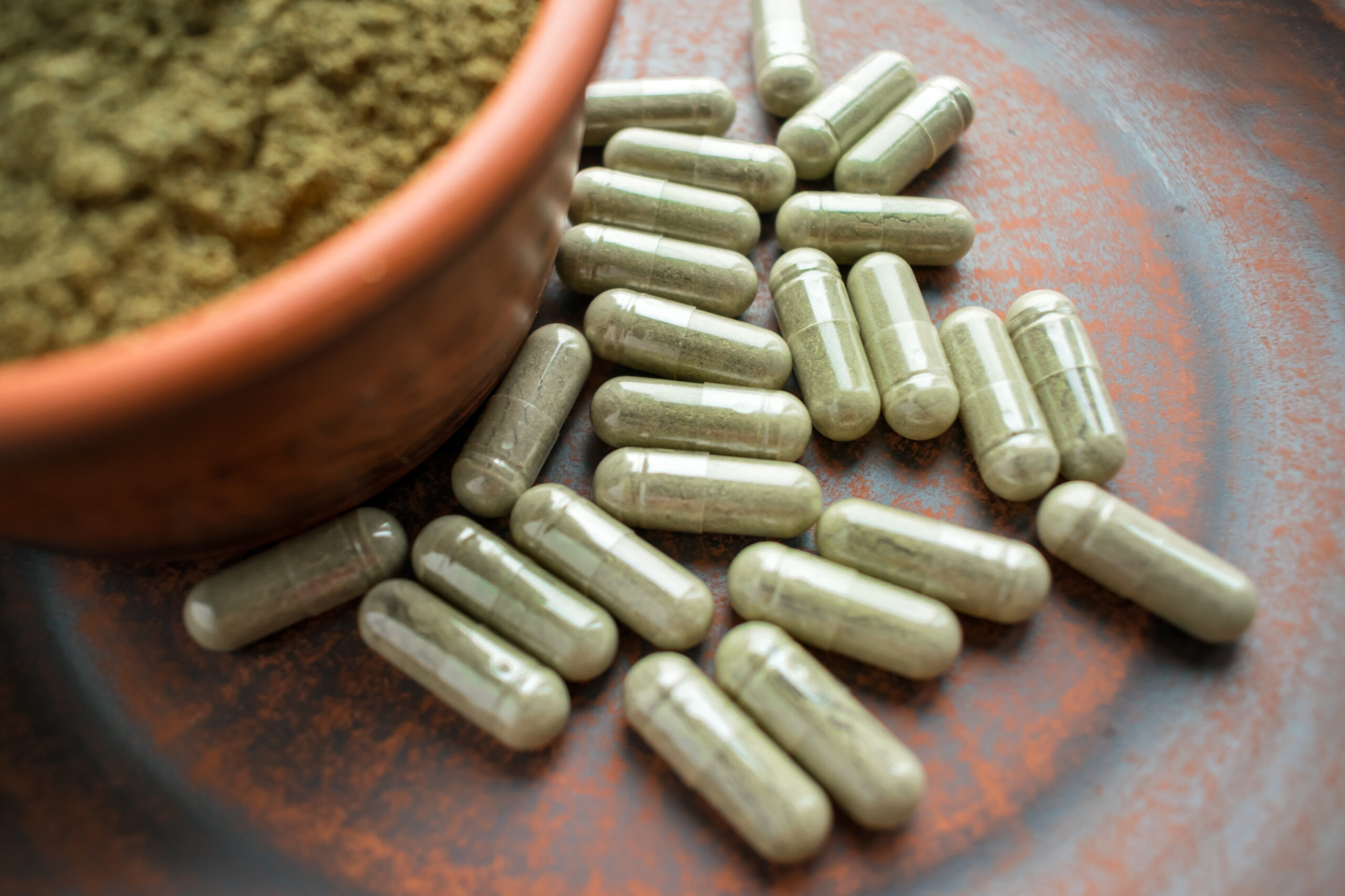
Kratom—a widely available herbal sold throughout the United States—is derived from the plant species known as Mitragyna speciosa.1 For centuries, this plant has been used for its analgesic and euphoric effects in its native environment, southeast Asia. Today, it can be found in powders, concentrated oils, and gels sold over the counter at tobacco shops. In the United States, kratom is mostly used for opiate withdrawal, pain, and anxiety. It is illegal in six states and not regulated in 33 states.2 In the states without regulation, there are no requirements for reporting potency, instructions for use of the drug, or warnings regarding potential issues with polypharmacy. In 2022, the National Poison Data system reported 1,278 cases involving kratom; about 45 percent of those cases required health care facility management.3

Chemical Makeup

Chemically, there are two major metabolites found within Mitragyna speciosa that have received most of the attention in scientific literature. Mitragynine (MG) and 7-hydroxymitragynine (7-HMG) are two alkaloid compounds that have been heavily studied, although data show there are as many as 50 additional substrates depending on the strain of the plant analyzed.4 Both MG and 7-HMG are µ-opioid agonists and show some antagonism at the delta opioid receptors, which has been postulated as a reason for the lower incidence of classic opioid side effects, such as constipation, with kratom use.4-6

Pages: 1 2 3 | Single Page

Topics: case reportCase ReportsClinicalkratom

Related

  • Non-Invasive Positive Pressure Ventilation in the Emergency Department

    October 1, 2025 - 0 Comment
  • Emergency Department Management of Prehospital Tourniquets

    October 1, 2025 - 0 Comment
  • ACEP’s October 2025 Poll: How Often Do You Read Your Own X-Rays?

    September 30, 2025 - 0 Comment

Current Issue

ACEP Now: November 2025

Download PDF

Read More

No Responses to “Case Report: Acute Kratom Withdrawal”

Leave a Reply Cancel Reply

Your email address will not be published. Required fields are marked *


*
*


Wiley
  • Home
  • About Us
  • Contact Us
  • Privacy
  • Terms of Use
  • Advertise
  • Cookie Preferences
Copyright © 2025 by John Wiley & Sons, Inc. All rights reserved, including rights for text and data mining and training of artificial technologies or similar technologies. ISSN 2333-2603
