Logo

Log In Sign Up |  An official publication of: American College of Emergency Physicians
Navigation
  • Home
  • Multimedia
    • Podcasts
    • Videos
  • Clinical
    • Airway Managment
    • Case Reports
    • Critical Care
    • Guidelines
    • Imaging & Ultrasound
    • Pain & Palliative Care
    • Pediatrics
    • Resuscitation
    • Trauma & Injury
  • Resource Centers
    • mTBI Resource Center
  • Career
    • Practice Management
      • Benchmarking
      • Reimbursement & Coding
      • Care Team
      • Legal
      • Operations
      • Quality & Safety
    • Awards
    • Certification
    • Compensation
    • Early Career
    • Education
    • Leadership
    • Profiles
    • Retirement
    • Work-Life Balance
  • Columns
    • ACEP4U
    • Airway
    • Benchmarking
    • Brief19
    • By the Numbers
    • Coding Wizard
    • EM Cases
    • End of the Rainbow
    • Equity Equation
    • FACEPs in the Crowd
    • Forensic Facts
    • From the College
    • Images in EM
    • Kids Korner
    • Medicolegal Mind
    • Opinion
      • Break Room
      • New Spin
      • Pro-Con
    • Pearls From EM Literature
    • Policy Rx
    • Practice Changers
    • Problem Solvers
    • Residency Spotlight
    • Resident Voice
    • Skeptics’ Guide to Emergency Medicine
    • Sound Advice
    • Special OPs
    • Toxicology Q&A
    • WorldTravelERs
  • Resources
    • ACEP.org
    • ACEP Knowledge Quiz
    • Issue Archives
    • CME Now
    • Annual Scientific Assembly
      • ACEP14
      • ACEP15
      • ACEP16
      • ACEP17
      • ACEP18
      • ACEP19
    • Annals of Emergency Medicine
    • JACEP Open
    • Emergency Medicine Foundation
  • About
    • Our Mission
    • Medical Editor in Chief
    • Editorial Advisory Board
    • Awards
    • Authors
    • Article Submission
    • Contact Us
    • Advertise
    • Subscribe
    • Privacy Policy
    • Copyright Information

Case Report: A Pediatric Amputated Juvenile Polyp

By Sean Eden, MD, PA-C; Alanna Cornder, MS4; and Jasmine Patterson, MD | on January 6, 2026 | 0 Comment
Case Report
  • Tweet
  • Click to email a link to a friend (Opens in new window) Email
Print-Friendly Version

Patient Presentation

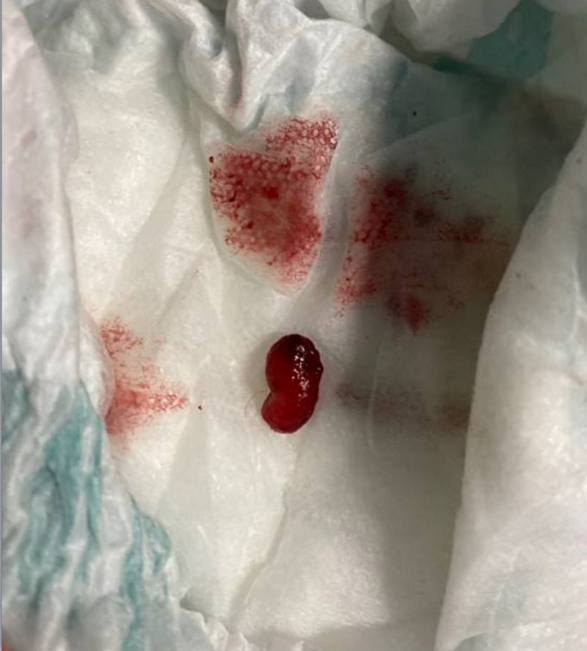
A 3-year-old female without past medical, surgical, or developmental history, and who is up to date on vaccines, presented with a chief complaint of “rectal prolapse” which occurred 20 minutes prior to arrival. She was in a normal state of health, eating and acting normally, until she attempted to have a bowel movement and developed abdominal and anal pain with a small amount of blood. The mother reported a protruding mass on wiping. The child was toilet training and had episodes of stool retention previously but had a formed bowel movement earlier in the day. There have been no recent illnesses or vaccinations, changes in diet, travel, sick contacts, fevers, upper respiratory symptoms, vomiting, diarrhea, or rashes. Her mother had a history of celiac disease, but denied family history of polyposis disorders, inflammatory bowel disease, or colon cancer. On arrival, the child’s vital signs were normal, weight was in the 21st percentile (higher than one year prior), she was nontoxic appearing, and in no acute distress. She was holding her knees to her chest and appeared uncomfortable. Her abdomen was soft, nontender, nondistended, with active bowel sounds. Her external anal exam appeared normal, without fissures or hemorrhoids, but her diaper had a bean-shaped mass of mucosal tissue with streaks of blood.

You Might Also Like
  • Is It Time to Sunset Rectal Examinations in the Trauma Bay?
  • Variceal Hemorrhage
  • Dialysis Access Emergencies
Explore This Issue
ACEP Now: January 2026

Diagnosis and Management

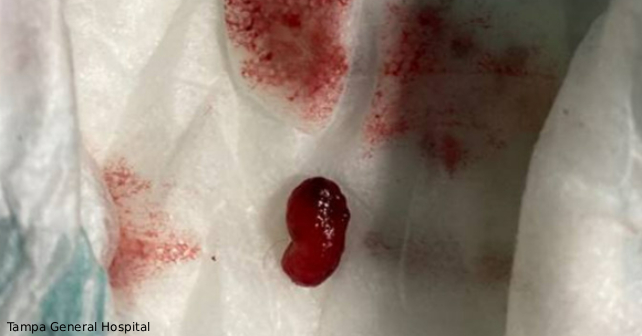
Self Amputated Juvenile Polyp / Credit: Tampa General Hospital

  • Juvenile polyps are a rare but important cause of rectal bleeding in children.
  • In rare cases such as this, the polyp may self-strangulate, causing passage of tissue and bleeding that may self-resolve or require intervention for hemorrhage.
  • Clinicians should maintain a high index of suspicion when patients present with persistent rectal prolapse, as timely recognition and polypectomy can both resolve symptoms and prevent recurrence

The initial differential diagnoses for the patient included thrombosed hemorrhoids, anal fissures, Meckel’s diverticulum, intussusception, infective enterocolitis, proctitis, inflammatory bowel disease, and proctitis. While the “mass in the diaper” seemed to have mucosal tissue qualities, it was unclear whether the source was from the patient or partially undigested food product. Shortly after initial evaluation, the patient had a bowel movement in the department with frank blood; her pain subsequently resolved afterwards without further intervention.

Evaluation included an ultrasound for intussusception that showed no abnormal findings. KUB X-ray showed an abnormal appearance of the distal descending colon, raising the possibility of bowel wall thickening, possibly infectious or inflammatory in etiology, and moderate stool in the ascending colon. Pediatric gastroenterology (GI) was consulted and recommended obtaining labs including CBC, CMP, coagulation studies, and tissue transglutaminase IgA – all of which were within normal range. She was monitored in the department and repeat bowel movement was without any bleeding or pain. She tolerated oral intake, her vitals remained normal, and she was ultimately discharged home to follow up with her primary care and pediatric GI. The tissue sample was sent for pathology which resulted two days later as a polypoid fragment of granulation tissue with dilated colonic glands and inflammation, consistent with inflammatory/juvenile polyp, negative for dysplasia. She followed up with her pediatrician two days later without recurrence of symptoms and a normal exam. She was seen by pediatric GI 19 days after her emergency department visit without any recurrence of symptoms, abnormal findings on exam, and no additional imaging or colonoscopy was recommended. The exact cause of this patient’s symptoms is still unclear, but it is likely that the polyp and possibly some portion of the rectum prolapsed, strangulated and amputated, leaving a bleeding stump that spontaneously achieved hemostasis.

Rectal prolapse in children involves protrusion of rectal mucosa through the anal sphincter and is most often seen in those under 4 years of age. While constipation and straining are typical causes, less common etiologies include anatomic variants (i.e., cystic fibrosis or Hirschsprung’s) and rare pathologies such as polyps. Juvenile polyps are the most frequent colonic polyps in children. They occur in one to two percent of the population, usually under age 10, and most commonly in the 2 to –6-year-old age range. They are benign hamartomas usually located in the rectosigmoid colon.

Histologically, juvenile polyps exhibit dilated mucus-filled glands within an inflamed stroma, distinguishing them from adenomatous polyps or syndromic polyposis conditions. Although usually sporadic, multiple lesions or a positive family history should raise suspicion for juvenile polyposis syndrome, which carries a risk of gastrointestinal malignancy and warrants surveillance. They commonly present with painless rectal bleeding, which is often minimal, but there have been case reports detailing hemorrhagic shock requiring surgical or endovascular management. Additionally, polyps may prolapse, most of which self-reduce or can be manually reduced, but the literature does detail cases requiring hot snare polypectomy for unreducible polyps with rectal prolapse. Recurrent polyp prolapse should undergo surgical removal.

Lastly, they may self-amputate and be expelled, causing self-limiting pain and bleeding. A literature search resulted in only one other case report of self-amputated polyp but was complicated by intestinal parasitic infection. This case underscores the value of including juvenile polyps in the diagnostic consideration of pediatric rectal bleeds. Since this is usually a painless, self-limiting disorder, the frequency may be higher and go under-reported.


Dr. Sean Eden graduated Drexel University’s Physician Assistant program in 2016 followed by Rutgers University’s New Jersey Medical School in 2025. He is currently a PGY1 in the Emergency Medicine Residency of the University of South Florida, Tampa General Hospital and serves as a medical officer for the United States Air Force National Guard.

Alanna Cordner is a proud Florida native who graduated from the University of Florida in 2021. She is currently a fourth-year medical student at the University of South Florida Morsani College of Medicine in Tampa, pursuing a career in Emergency Medicine.

Dr. Jasmine Patterson trained at Wake Forest in N.C. and is an EM/PEM doctor at Tampa General hospital since 2016. She has been a core faculty member for the Department of Emergency Medicine at the University of South Florida and medical director of the pediatric emergency department at Tampa General Hospital since 2020.  


References

  1. Almas T, Hussain S, Alsufyani R, et al. Non-familial Juvenile Polyposis Syndrome Presenting as Rectal Prolapse: An Unusual Presentation of a Rare Disease. Cureus. 2020;12(10): e11222. doi:10.7759/cureus.11222.
  2. Arredondo-Montero, J, Carracedo-Vega, E, Razquin-Lizarraga, S, et al. Pediatric rectosigmoid atypical juvenile polyps presenting with rectal prolapse and acute bleeding: A case report and a comprehensive literature review.
  3. Asmare WM, and Lashitie Z M  A prolapsing juvenile rectal polyp in a 9-year-old female patient, successfully managed by colonoscopic hot snare polypectomy.
  4. Boland CR, Idos GE, DurnoC, et al. Diagnosis and management of cancer risk in the gastrointestinal hamartomatous polyposis syndromes: Recommendations from the US Multi-Society Task Force on Colorectal Cancer.
  5. Cares K, Klein M, Thomas R, and El-Baba M. Rectal prolapse in children: An update to causes, clinical presentation, and management.
  6. Kakiuchi T, Yoshiura M. Juvenile polyp presenting as prolapsed mass per rectum in a 5-year-old child.
  7. Kim DY, Bae JY, Ko KO, et al. Juvenile Polyp Associated with Hypovolemic Shock Due to Massive Lower Gastrointestinal Bleeding.
  8. Larsen-Haidle J, MacFarland SP, and Howe JR. Juvenile polyposis syndrome. In Adam MP, (Eds.).
  9. Moon JK, Stratigis JD, and Lipskar AM. Rectal prolapse in the pediatric population.
  10. Rowe DA, Bharrat K, Scott K, Asore B, Middlesworth W. A Rare Case of Pedunculated, Prolapsed Juvenile Rectal Polyp in a Pediatric Patient.

Topics: AbdominalBleedingcase reportCase ReportsGastrointestinaljuvenile polypPediatricsrectal prolapse

Related

  • Pediatric Torticollis: A Simple Emergency Department Approach

    January 7, 2026 - 0 Comment
  • Case Report: Five Days of Fever

    December 16, 2025 - 3 Comments
  • FACEPs in the Crowd: Dr. John Ludlow

    November 5, 2025 - 0 Comment

Current Issue

ACEP Now: December 2025 (Digital)

Read More

No Responses to “Case Report: A Pediatric Amputated Juvenile Polyp”

Leave a Reply Cancel Reply

Your email address will not be published. Required fields are marked *


*
*


Wiley
  • Home
  • About Us
  • Contact Us
  • Privacy
  • Terms of Use
  • Advertise
  • Cookie Preferences
Copyright © 2026 by John Wiley & Sons, Inc. All rights reserved, including rights for text and data mining and training of artificial technologies or similar technologies. ISSN 2333-2603