Logo

Log In Sign Up |  An official publication of: American College of Emergency Physicians
Navigation
  • Home
  • Multimedia
    • Podcasts
    • Videos
  • Clinical
    • Airway Managment
    • Case Reports
    • Critical Care
    • Guidelines
    • Imaging & Ultrasound
    • Pain & Palliative Care
    • Pediatrics
    • Resuscitation
    • Trauma & Injury
  • Resource Centers
    • mTBI Resource Center
  • Career
    • Practice Management
      • Benchmarking
      • Reimbursement & Coding
      • Care Team
      • Legal
      • Operations
      • Quality & Safety
    • Awards
    • Certification
    • Compensation
    • Early Career
    • Education
    • Leadership
    • Profiles
    • Retirement
    • Work-Life Balance
  • Columns
    • ACEP4U
    • Airway
    • Benchmarking
    • Brief19
    • By the Numbers
    • Coding Wizard
    • EM Cases
    • End of the Rainbow
    • Equity Equation
    • FACEPs in the Crowd
    • Forensic Facts
    • From the College
    • Images in EM
    • Kids Korner
    • Medicolegal Mind
    • Opinion
      • Break Room
      • New Spin
      • Pro-Con
    • Pearls From EM Literature
    • Policy Rx
    • Practice Changers
    • Problem Solvers
    • Residency Spotlight
    • Resident Voice
    • Skeptics’ Guide to Emergency Medicine
    • Sound Advice
    • Special OPs
    • Toxicology Q&A
    • WorldTravelERs
  • Resources
    • ACEP.org
    • ACEP Knowledge Quiz
    • Issue Archives
    • CME Now
    • Annual Scientific Assembly
      • ACEP14
      • ACEP15
      • ACEP16
      • ACEP17
      • ACEP18
      • ACEP19
    • Annals of Emergency Medicine
    • JACEP Open
    • Emergency Medicine Foundation
  • About
    • Our Mission
    • Medical Editor in Chief
    • Editorial Advisory Board
    • Awards
    • Authors
    • Article Submission
    • Contact Us
    • Advertise
    • Subscribe
    • Privacy Policy
    • Copyright Information

Button Batteries a Swallowing Hazard for Children

By Sean M. Fox, MD | on September 12, 2014 | 0 Comment
Features
  • Tweet
  • Click to email a link to a friend (Opens in new window) Email
Print-Friendly Version
Button Batteries a Swallowing Hazard for Children

Co-ingestion of a magnet with a button battery necessitates removal. After removal, some advocate for a delayed second-look endoscopy to ensure no damage has occurred. It is important to note that perforations and fistulas may develop up to 18 days after removal. Strictures can develop weeks and months after removal.

You Might Also Like
  • Treating Ingested Button Batteries in Kids
  • Bougienage Good Alternative for Treating Retained Esophageal Coins
  • Guidance on Cerebrospinal Fluid Sterilization in Pediatric Meningitis, Carotid Injury Risk after Palatal Wound in Children
Explore This Issue
ACEP Now: Vol 33 – No 09 – September 2014

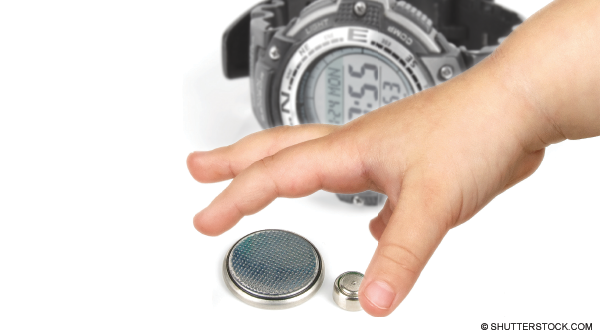
Even though button batteries represent a genuine hazard, emergency physicians alert to the signs and symptoms of button battery ingestion can effectively manage them and help their patients achieve good outcomes.

Case 1

Photos courtesy of Roger Mitchell, MD, New Jersey Office of the State Medical Examiner.

Photos courtesy of Roger Mitchell, MD, New Jersey Office of the State Medical Examiner.

A 3-year-old male was well until he vomited bright-red blood and became unresponsive; EMS transported the patient to the hospital. He arrived in asystole cardiac arrest, with blood around his nose and mouth, and received continuous pediatric advanced life support. Despite this, he expired.

At postmortem, a button battery was found impacted in the esophagus at the level of the transverse aorta. There was a fistula connecting the esophagus and aorta, with the esophagus packed with bright-red blood and with gastric content of large dark-colored blood clots. The small and large bowels were also found to be packed with dark-colored stool.

Case submitted by Eugene Varghese, MD, Rutgers New Jersey Medical School in Newark, and David Woodkotch, MD, chief resident of emergency medicine at Rutgers.

Case 2

Photos courtesy of Peter Chase, MD, PhD

Photos courtesy of Peter Chase, MD, PhD

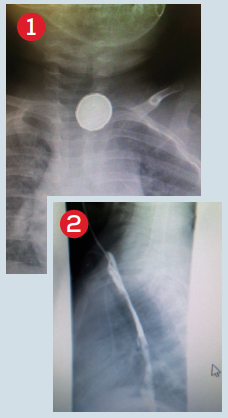
A 5-year-old female who was “playing around” with her grandma’s battery while hanging out in her grandma’s car ingested a button battery. She waited a few hours before telling anyone and was seen about six hours after ingestion. She complained of a sore throat and had no difficulty with secretions or breathing. Lateral and anteroposterior chest X-rays showed a battery lodged in her upper esophagus (see Figure 1).

We used propofol for endoscopy done by a pediatric gastroenterologist while in the ED. She was admitted by pediatrics after retrieval of the battery for concern of necrotic tissue in the upper esophagus noted by the gastroenterologist (see Figure 2). She was initially placed on antibiotics by us and steroids by the gastroenterologist out of concern for possible perforation and/or mediastinitis (which did not occur). Figure 3 shows the button battery after retrieval.

Case and photos submitted by Peter Chase, MD, PhD, assistant professor of pharmacy practice and science at The University of Arizona in Tucson.

Case 3
Photos courtesy of Cindy Nielsen, MD

Photos courtesy of Cindy Nielsen, MD

Pages: 1 2 3 | Single Page

Topics: Airway ManagementButton BatteriesCritical CareEmergency MedicineEmergency PhysicianPediatrics

Related

  • Why the Nonrebreather Should be Abandoned

    December 3, 2025 - 0 Comment
  • FACEPs in the Crowd: Dr. John Ludlow

    November 5, 2025 - 0 Comment
  • Non-Invasive Positive Pressure Ventilation in the Emergency Department

    October 1, 2025 - 0 Comment

Current Issue

ACEP Now: November 2025

Download PDF

Read More

No Responses to “Button Batteries a Swallowing Hazard for Children”

Leave a Reply Cancel Reply

Your email address will not be published. Required fields are marked *


*
*


Wiley
  • Home
  • About Us
  • Contact Us
  • Privacy
  • Terms of Use
  • Advertise
  • Cookie Preferences
Copyright © 2025 by John Wiley & Sons, Inc. All rights reserved, including rights for text and data mining and training of artificial technologies or similar technologies. ISSN 2333-2603
