
Explore This Issue
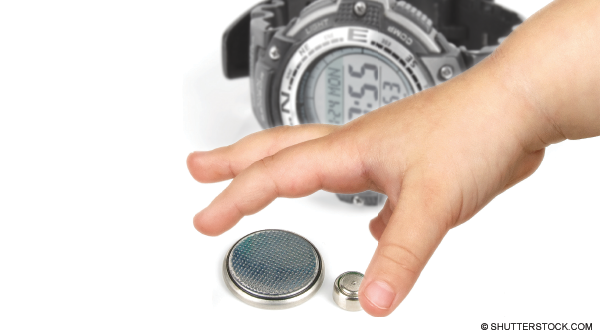
ACEP Now: Vol 33 – No 09 – September 2014Kids love to put odd objects in their mouths (and ears and nostrils and other interesting places), which can cause significant problems and lead to emergencies. Object location (eg, airway) and the object itself may also cause problems and severe tissue destruction. Button batteries are unique objects that warrant special concern and respect. While a button battery in the nostril can cause problems, button battery ingestion can be a more devastating problem.
Small Batteries, Big Problem
With the proliferation of small electronic devices, button batteries have become more prevalent, and the number of battery-related ED visits has increased significantly over the past 20 years. In 2009, about 6,000 children were seen in U.S. emergency departments for battery-related complaints; that’s more than 16 visits per day.1 Not surprisingly, cases involving children under four years of age, lithium batteries, and batteries more than 20 mm in diameter are more likely to result in poor outcomes.
Presentation, Imaging, and Diagnosis Button battery ingestion often presents similar to ingestion of other foreign bodies, with such symptoms as cough and gagging, drooling, dysphagia, labored breathing, or stridor. Patients may exhibit symptoms that are related to tissue damage, including vomiting, fever, irritability, or listlessness. In addition to obstruction/compression, batteries can cause chemical (especially alkaline) and electrical tissue damage; liquefaction necrosis and other damage can occur in a little as two hours.2
Vigilance and care are needed in diagnosing button battery ingestion. Fully 54 percent of fatalities due to button battery ingestion were misdiagnosed; many had nonspecific presentations, or the batteries were diagnosed as a swallowed coin.3 Fortunately, button batteries are radiopaque, coin-like objects that are evident on most plan films. Viewed en face, a button battery will have a halo rim (a ring of radiolucency just inside the outer edge of the object). Viewed on edge, a button battery may have a central bulge or step off (this can be difficult to appreciate if seen obliquely or with the newer, thinner lithium batteries).
Management
Treat any button battery ingestion as an emergency—time is of the essence to minimize local tissue damage. Removal can be difficult, especially because local tissue damage can lead to friable structures that can be further damaged by instrumentation. A battery should be removed under direct visualization. A surgical team often needs to be called. A helpful algorithm is found on the National Capital Poison Center website, http://www.poison.org/battery/guideline.asp.
In an asymptomatic patient, a battery in the stomach or beyond can be monitored and allowed to pass. Repeat radiographs are reasonable: repeat in four days for patients less than 6 years of age or for larger button batteries (more than 15 mm in diameter), and repeat in 10–14 days for older children or for a smaller battery. After that time, if the battery is still in the stomach, endoscopic removal is recommended. Note that strict anticipatory guidance and return precautions should be given, emphasizing the need for patients to be evaluated for any abdominal pain, fever, or vomiting.
Pages: 1 2 3 | Single Page



No Responses to “Button Batteries a Swallowing Hazard for Children”