
Explore This Issue
ACEP Now: Vol 33 – No 09 – September 2014Your last patient on a shift is a 55-year-old well-appearing woman with fever and cough in whom you suspect community-acquired pneumonia. As she steps in to draw labs, your nurse asks you, “Doc, two sets of cultures, right?”
In 2010, 4.1 percent of emergency department patients received blood culture testing.1 Each set of blood cultures costs $28 to process, with additional costs for microscopy and pathogen identification if there is growth, amounting to more than $151 million in annual medical costs based on Medicare reimbursement rates (a low estimate as many insurers and the uninsured are charged more than Medicare reimbursement rates).2

Blood culture bottles. Bacteriology laboratory.
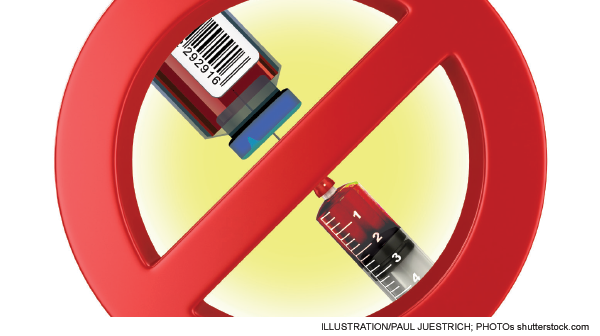
Blood cultures test for bacteremia, a condition associated with high mortality. However, they are frequently ordered on patients with clinical diagnoses for which they add little value. The true-positive rate of blood cultures based on prospective studies is as low as 4.1 percent to 7 percent.3 Up to 40 percent of positive blood cultures are false-positive from contaminants, resulting in prolonged hospital stays, avoidable testing (such as repeat cultures and echocardiograms), and antibiotic use. False-positive blood cultures are associated with three to five day increases in hospital length of stay and $4,400 to $8,800 in additional costs compared with true negatives.4,5 without culture data.
The true-positive rate of blood cultures based on prospective studies is as low as 4.1 percent to 7 percent. Up to 40 percent of positive blood cultures are
false positive.
Common Clinical Scenarios in Which Blood Cultures Are Unnecessary
Patients with community-acquired pneumonia. These patients should not routinely receive blood culture testing. Per the 2009 ACEP Clinical Policy, “Critical Issues in the Management of Adult Patients with Community-Acquired Pneumonia,” patients who do not require admission to the ICU and are not immunocompromised (eg, leukopenia, chronic alcohol abuse, liver disease, or steroids) are at low risk for bacteremia.6 Positive blood cultures rarely change management in pneumonia; retrospective studies document that only 0.4 percent to 3.4 percent of patients had antibiotic coverage changed.7 While the Centers for Medicare & Medicare Services (CMS) and The Joint Commission previously required blood cultures be drawn in the ED prior to administration of antibiotics as a pneumonia quality measure, this has been retired as of Jan. 1, 2014. The same is true for children. The Pediatric Infectious Diseases Society and the Infectious Diseases Society of America discourage routine blood cultures in their clinical practice guidelines.8

Table 1. How to Reduce False-Positive Blood Cultures
Patients with cellulitis. These patients have a pretest probability for bacteremia of 2 percent, so blood cultures in this population are very low yield.9 Numerous studies have documented the predominance of strep and staph species in skin and soft tissues infections; thus when antibiotics are indicated, they may be initiated empirically
Patients with uncomplicated pyelonephritis. Urine cultures are higher yield than blood cultures. In the rare cases where blood cultures identify organisms, they rarely differ from those identified in urine and very rarely alter clinical management.10
Patients being discharged from the ED. Blood cultures are a test for bacteremia, and bacteremia is a serious condition requiring close monitoring—ergo, you should not send blood cultures on patients being discharged from the ED. Outpatient blood cultures expose you to significant medical legal risk as positive results require contacting the patient and determining if further ED or inpatient care is needed. Like any general rule, there are exceptions: nonacute diseases for which blood cultures are the diagnostic test of choice, such as subacute bacterial endocarditis. If you will be sending blood cultures on an outpatient, be clear who will follow up on the results and make sure you have correct contact information.
Patients with normal vital signs or those with isolated fever and otherwise normal vital signs. The presence of systemic inflammatory response syndrome (SIRS) was found to be 96 percent sensitive for bacteremia among patients who had blood cultures drawn on a general medical service, meaning that the absence of SIRS greatly reduces the likelihood of bacteremia.11
What about patients with sepsis? The Surviving Sepsis Campaign recommends blood cultures as part of the three-hour bundle for patients with severe sepsis or septic shock (based on low-strength evidence).12 This accounts for a small proportion of the patients with the above-mentioned infections.
What Can You Do to Improve the Cost-Effectiveness of Blood Culture Testing?
Do not send blood cultures on patients for whom you have a low clinical suspicion of bacteremia. Talk to your clinical director about removing blood cultures from routine order sets for patients with community-acquired pneumonia, cellulitis, and urine infections including pyelonephritis. Have an educated discussion with the next admitting physician who asks if you sent cultures on the pneumonia patient you are admitting to the floor; the references for this article should be the evidence they need!
When cultures are sent, be sure they are collected appropriately to minimize contamination (see Table 1). Consider a protocol to have cultures drawn by staff trained in blood culture collection technique, and reinforce best practices with your staff.
 Dr. Lin is an attending emergency physician and a fellow in the Division of Health Policy Research and Translation in the Department of Emergency Medicine, Brigham and Women’s Hospital in Boston. She also serves as an instructor at Harvard Medical School.
 Dr. Schuur is vice chair of quality and safety and chief of the Division of Health Policy Research and Translation in the Department of Emergency Medicine, Brigham & Women’s Hospital in Boston. He also serves as assistant professor at Harvard Medical School.
References
- Centers for Disease Control and Prevention. National Hospital Ambulatory Medical Care Survey: 2010 Emergency Department Summary Tables. Centers for Disease Control and Prevention Web site. Available at: www.cdc.gov/nchs/data/ahcd/nhamcs_emergency/2010_ed_web_tables.pdf. Accessed July 30, 2014.
- Centers for Medicare & Medicaid Services. 2014 Clinical Laboratory Fee Schedule. Centers for Medicare & Medicaid Services Web site. Available at: http://www.cms.gov/Medicare/Medicare-Fee-for-Service-Payment/ClinicalLabFeeSched/clinlab.html. Accessed July 30, 2014.
- Bates DW, Cook EF, Goldman L, et al. Predicting bacteremia in hospitalized patients: a prospectively validated model.Ann Intern Med. 1990;113:495-500.
- Alahmadi YM, Aldeyab MA, McElnay JC, et al. Clinical and economic impact of contaminated blood cultures within the hospital setting. J Hosp Infect. 2011;77:233-6.
- Bates DW, Goldman L, Lee TH. Contaminant blood cultures and resource utilization: the true consequences of false-positive results. JAMA. 1991;265:365-369.
- Mandell LA, Wunderink RG, Anzueto A, et al. Infectious Diseases Society of America/American Thoracic Society consensus guidelines on the management of community-acquired pneumonia in adults. Clin Infect Dis. 2007;44(Suppl. 2):S27-S72.
- Benenson RS, Kepner AM, Pyle DN 2nd, et al. Selective use of blood cultures in emergency department pneumonia patients. J Emerg Med. 2007;33:1-8.
- Bradley JS, Byington CL, Shah SS, et al. Executive summary: the management of community-acquired pneumonia in infants and children older than 3 months of age: clinical practice guidelines by the Pediatric Infectious Diseases Society and the Infectious Diseases Society of America. Clin Infect Dis. 2011;53:617.
- Perl B, Gottehrer NP, Raveh D, et al. Cost-effectiveness of blood cultures for adult patients with cellulitis.Clin Infect Dis. 1999;29:1483-1488.
- Pasternak EL, Topinka MA. Blood cultures in pyelonephritis: do results change therapy? Acad Emerg Med. 2000;7:1170.
- Jones GR, Lowes JA. The systemic inflammatory response syndrome as a predictor of bacteraemia and outcome from sepsis. QJM. 1996;89:515-522.
- International Guidelines for Management of Severe Sepsis and Septic Shock: 2012. Surviving Sepsis Campaign. Society of Critical Care Medicine Web site. Available at: http://www.sccm.org/Documents/SSC-Guidelines.pdf. Accessed August 11, 2014.
- Baron EJ, Miller JM, Weinstein MP, et al. A guide to utilization of the microbiology laboratory for diagnosis of infectious diseases: 2013 recommendations by the Infectious Diseases Society of America (IDSA) and the American Society for Microbiology (ASM). Clin Infect Dis. 2013;57:e22–e121.
Pages: 1 2 3 4 | Multi-Page





2 Responses to “Blood Culture Testing: Send Samples Selectively to Lower Costs, Medico-Legal Risk”
October 4, 2014
CuloochGreat article!
In future versions would be useful to discuss the cost of false positive cultures (usually $4000-7000 per false positive in a hospitalized patient)
Also it is not so important whether or not a culture is positive but rather how often does it change management. While 4% of ED drawn blood cultures may be positive (and half of those being false positives) a positive culture almost never prompts a change in abx. When it does, it is almost always in a immunosuppressed patient orthose with severe sepsis/septic shock
June 10, 2015
Delores LyonWow, I had no idea that blood cultures could be so inaccurate. With a false positive testing rate of 40%, that is a lot of unnecessary follow up. In my opinion, if I was sick for some reason, I would probably want my doctor to forego something like this. The last thing I want is unnecessary medical bills.