
Explore This Issue
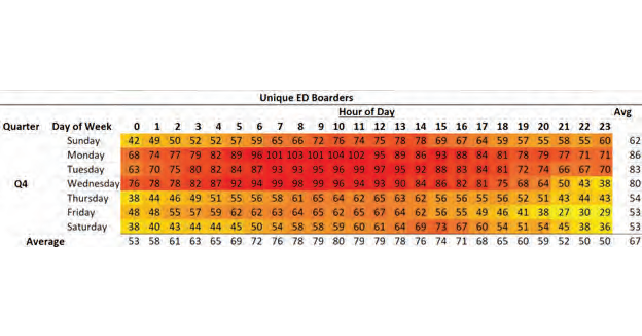
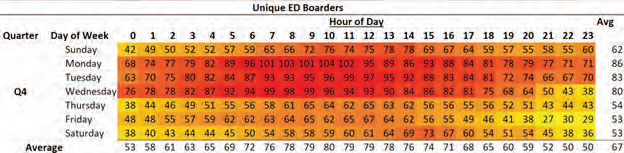
ACEP Now: Vol 42 – No 12 – December 2023FIGURE 2: Mock-up of internal dashboard collapsed to average boarding by day and hour. (Click to enlarge.)
From October 1, 2022 to March 16, 2023, the dashboard had 963 views, with 13 high-volume users accounting for 374 views. The heatmap allows any end-user, including clinicians and staff, to quickly assess key features of boarding at our institution, including predictability, temporality, and cyclicality. In our department, boarding reliably peaks during the middle of the day and during midweek (Tues-Thurs). We also find that our levels of emergency department boarding are correlated strongly with inpatient census. Making these trends more accessible for all users helped lead to several multidisciplinary interventions, including: staffing the ED with medical-surgical nurses during predicted boarding peaks, facilitating inpatient hallway boarding, and supplementing inpatient capacity and discharge planning. The success of these interventions has relied on collaboration with our inpatient colleagues, and making these trends broadly accessible to stakeholders outside the emergency department was critical to generating institutional support.
Sharing Our Approach
Boarding is a national problem, but trends and drivers may be institution specific. Though our emergency department, an urban Level I trauma center and safety net hospital, may be different than others facing similar throughput issues, our approach is dynamic and applicable in a variety of settings. Even with variability across institutions, efficiently visualizing institution specific trends can help direct root cause analyses.9 Our boarding heatmap allows any emergency department stakeholder to quickly identify trends in and the severity of boarding to inform interventions. The heatmap enables frontline clinicians to better predict boarding and shift practice patterns appropriately, while also engaging a broader audience to understand the problem and generate ideas for institution-wide responses. While there is lack of consensus in the literature on how to best define and visualize boarding, we propose the heatmap as an effective, accessible method for informing local intervention that is both standardized and flexible to institutional trends and variability. Solving the boarding crisis will require multidisciplinary collaboration between departments and across stakeholder groups—democratizing boarding data is an important first step.
 Ms. Schwartz (@HOPESCHWARTZY) is a 4th year medical student at UCSF and health policy fellow at the Kaiser Family Foundation, where she conducts research on cost, quality, and value of emergency department care.
 Dr. Peabody (@TOFFPEABODY) is an associate clinical professor of emergency medicine and director of the UCSF Acute Care Innovation Center.
Pages: 1 2 3 | Single Page



No Responses to “An Actionable, Visual Dashboard Approach to Boarding”