Logo

Log In Sign Up |  An official publication of: American College of Emergency Physicians
Navigation
  • Home
  • Multimedia
    • Podcasts
    • Videos
  • Clinical
    • Airway Managment
    • Case Reports
    • Critical Care
    • Guidelines
    • Imaging & Ultrasound
    • Pain & Palliative Care
    • Pediatrics
    • Resuscitation
    • Trauma & Injury
  • Career
    • Practice Management
      • Reimbursement & Coding
      • Legal
      • Operations
    • Awards
    • Certification
    • Early Career
    • Education
    • Leadership
    • Profiles
    • Retirement
    • Work-Life Balance
  • Compensation Reports
  • Columns
    • ACEP4U
    • Airway
    • Benchmarking
    • By the Numbers
    • EM Cases
    • End of the Rainbow
    • Equity Equation
    • FACEPs in the Crowd
    • Forensic Facts
    • From the College
    • Kids Korner
    • Medicolegal Mind
    • Opinion
      • Break Room
      • New Spin
      • Pro-Con
    • Pearls From EM Literature
    • Policy Rx
    • Practice Changers
    • Problem Solvers
    • Residency Spotlight
    • Resident Voice
    • Skeptics’ Guide to Emergency Medicine
    • Sound Advice
    • Special OPs
    • Toxicology Q&A
    • WorldTravelERs
  • Resources
    • mTBI Resource Center
    • ACEP.org
    • ACEP Knowledge Quiz
    • CME Now
    • Annual Scientific Assembly
      • ACEP14
      • ACEP15
      • ACEP16
      • ACEP17
      • ACEP18
      • ACEP19
    • Annals of Emergency Medicine
    • JACEP Open
    • Emergency Medicine Foundation
  • Issue Archives
  • Archives
    • Brief19
    • Coding Wizard
    • Images in EM
    • Care Team
    • Quality & Safety
  • About
    • Our Mission
    • Medical Editor in Chief
    • Editorial Advisory Board
    • Awards
    • Authors
    • Article Submission
    • Contact Us
    • Advertise
    • Subscribe
    • Privacy Policy
    • Copyright Information

Alcohol Use Disorder: Screening Tools and Medications in the ED

By Nicholas S. Imperato, DO, MPH; Christopher W. Meaden, MD, MS; and Howard A. Greller, MD | on February 10, 2026 | 0 Comment
Features
Share:  Print-Friendly Version

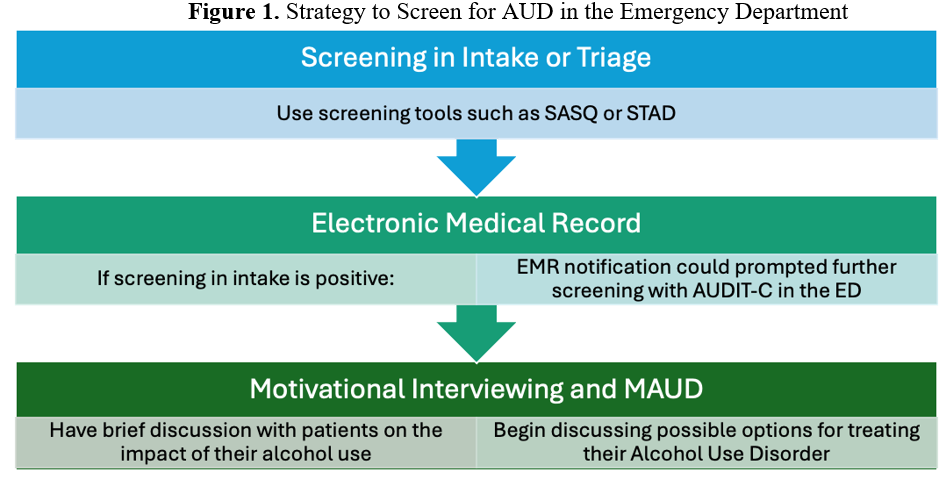
The Single Alcohol Screening Question (SASQ) has been found to have both a sensitivity and specificity over 80 percent when applied in the primary care setting.8 While this tool was not  intended for the emergency department, its ease of use makes it a suitable option for screening programs. Another screening tool that could be beneficial in the ED is the Screening Test for At-Risk Drinking (STAD), developed from the AUDIT, with reported sensitivities >80 percent and specificities >95 percent in ED settings.9 Either of these tools are short enough to be efficiently implemented in triage or intake, as part of a universal screening program, and are effective at rapidly identifying patients with AUD. The third screening modality we recommend for use in the ED is the Alcohol Use Disorders Identification Test–Consumption (AUDIT-C), which consists of three questions drawn from the full AUDIT. It has been shown to have a sensitivity of 100 percent and a specificity above 85 percent.10 This tool is more reliable but not as brief as the SASQ or STAD. It would be a beneficial tool to use when speaking to patients who have previously screened positive with either of those tests. Any universal screening program will likely use these screening tools in some capacity, but identifying the tools best suited to your institution is most important.

You Might Also Like
  • Shift from Metabolize-to-Freedom to Medication-Assisted Treatment
  • Problem Drinking Remains a Big Problem
  • 4-Step Approach to Treating Alcohol Withdrawal
Explore This Issue
ACEP Now: February 2026 (Digital)

Integrating Screening in the ED

Click to enlarge.

We recommend implementing universal screening in the ED. A short-form screening tool (e.g., SASQ, STAD) should be integrated into the intake or triage process and administered to all patients. Nursing should be involved in facilitating seamless integration. Positive screens should prompt physicians to conduct further screening with the AUDIT-C. For a positive AUDIT-C, physicians can then begin addressing the patient’s AUD and, if interested, can discuss available treatment options with them.

Medications for Alcohol Use Disorder

Medications for alcohol use disorder don’t cure the condition.  Numerous studies have demonstrated reduced alcohol consumption, cravings, and the risk of relapsing into heavy drinking. Programs designed to prescribe MAUD in the ED have been shown to be both feasible and effective.11 The Society for Academic Emergency Medicine (SAEM) recently published the Guidelines for Reasonable and Appropriate Care in the Emergency Department (GRACE-4), focusing on the management of AUD.12 In these guidelines, they recommend that anti-craving medication, such as naltrexone or acamprosate, should be prescribed to patients with AUD.12

Pages: 1 2 3 4 5 6 7 | Single Page

Topics: acamprosateAddictionalcohol use disorderalcohol withdrawalClinicalMedicationNaloxonenaltrexonepsychobehavioralScreening

Related

  • Extensor Tendon Repair by Emergency Physicians

    March 10, 2026 - 1 Comment
  • Screening Tool Helps Docs Evaluate Patients at High Risk of Suicide

    February 10, 2026 - 0 Comment
  • Emergency Medicine as Leaders in Care Provision for Patients with Opioid Use Disorder

    January 27, 2026 - 0 Comment

Current Issue

ACEP Now: March 2026

Download PDF

Read More

No Responses to “Alcohol Use Disorder: Screening Tools and Medications in the ED”

Leave a Reply Cancel Reply

Your email address will not be published. Required fields are marked *


*
*


Wiley
  • Home
  • About Us
  • Contact Us
  • Privacy
  • Terms of Use
  • Advertise
  • Cookie Preferences
Copyright © 2026 by John Wiley & Sons, Inc. All rights reserved, including rights for text and data mining and training of artificial technologies or similar technologies. ISSN 2333-2603