
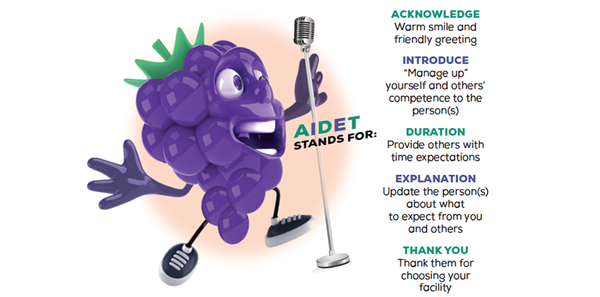
A number of communication strategies have evolved over the past decade to improve the patient encounter and experience of care. One model that is promoted by the Studer Group, and employed by many health systems, is called the AIDET system.1 What is AIDET? It is a composite of five behaviors to use in every patient/staff interaction to anticipate, meet, and exceed expectations of patients, coworkers, and visitors. AIDET is used to decrease the anxiety of patients and their families and to improve patient satisfaction.
Explore This Issue
ACEP Now: Vol 34 – No 12 – December 2015Baylor Regional Medical Center in Grapevine, Texas, is a 269-bed hospital that sees almost 50,000 emergency department visits. Already performing well in patient satisfaction measures (according to U.S. News & World Report, 80 percent of patients would recommend the facility to others), the emergency physician group committed to the AIDET system to take these measures to the next level.2 Gordon Aalund, MD, and Dahlia Hassani, MD, presented their novel approach in a poster at the 2015 Innovations in Emergency Department Management conference in Orlando, Florida, February 24–26.3
Staff members trained in AIDET are encouraged to use the words “excellent” and “thank you” liberally. Some of the particular habits or behaviors that can promote the AIDET philosophy include:
✔ ACKNOWLEDGE—Show a positive attitude and put others at ease.
- Anticipate needs.
- Greet the person, provide eye contact, and smile.
- Follow the 10 and 5 Rule: at 10 feet, look up and acknowledge, make eye contact, and smile; at five feet, verbally greet and offer assistance if necessary.
✔ INTRODUCE—Give your name and role.
- Name: self, skill set, experience
- Department: coworkers, other departments, physicians
✔ DURATION—“How long will this take?”
- Under-promise and over-deliver.
- Give a time expectation that will surely be met and follow up if unable to meet expectations.
- There are two types of time: real and perceived. Understand both.
✔ EXPLANATION—“What will you be doing and why?”
- Explain step-by-step what will happen.
- Give explanation of purpose, the “why.”
- Ask the person if they have any questions or tell them to feel free to ask later.
✔ THANK YOU—Let them know you have enjoyed helping or working with them.
- Thank the person for communication and cooperation or assistance and support.
- Thank the person for giving you an opportunity to help.
The group of emergency physicians in Grapevine has found another way to utilize scribes: as observers of physicians’ practices. While there is a growing body of literature demonstrating that scribes in the emergency department can improve efficiency, patient satisfaction, and staff satisfaction, scribes were used in Grapevine to facilitate their AIDET model. The department providers utilized the AIDET tool but struggled with a process to validate each individual provider’s performance for feedback purposes. In an early trial, they used another provider to validate the use of AIDET, but that proved costly and required providers to be available on a shift for which they weren’t previously scheduled (not a popular proposition!).
Each provider is audited on two to five patients by scribes during an assigned shift … the [AIDET] tool is used to give performance feedback to the provider.
The need to identify another method for monitoring AIDET in practice led to utilization of departmental scribes for the auditing project. All providers receive AIDET training. Scribes are also trained on AIDET and the use of the AIDET validation tool. Each provider is audited on two to five patients by scribes during an assigned shift. The tool is easily completed by the scribes in the course of the workflow, and the tool is used to give performance feedback to the provider. The feedback is unique in that it is nearly done in real time, which allows physicians to improve in real time. The results are provided routinely with no increased departmental costs. Providers discuss results at departmental meetings. Coaching is tailored for individual providers.
Pages: 1 2 | Single Page




No Responses to “AIDET: A Popular Way of Improving Patients’ Care Experience”