Logo

Log In Sign Up |  An official publication of: American College of Emergency Physicians
Navigation
  • Home
  • Multimedia
    • Podcasts
    • Videos
  • Clinical
    • Airway Managment
    • Case Reports
    • Critical Care
    • Guidelines
    • Imaging & Ultrasound
    • Pain & Palliative Care
    • Pediatrics
    • Resuscitation
    • Trauma & Injury
  • Resource Centers
    • mTBI Resource Center
  • Career
    • Practice Management
      • Benchmarking
      • Reimbursement & Coding
      • Care Team
      • Legal
      • Operations
      • Quality & Safety
    • Awards
    • Certification
    • Compensation
    • Early Career
    • Education
    • Leadership
    • Profiles
    • Retirement
    • Work-Life Balance
  • Columns
    • ACEP4U
    • Airway
    • Benchmarking
    • Brief19
    • By the Numbers
    • Coding Wizard
    • EM Cases
    • End of the Rainbow
    • Equity Equation
    • FACEPs in the Crowd
    • Forensic Facts
    • From the College
    • Images in EM
    • Kids Korner
    • Medicolegal Mind
    • Opinion
      • Break Room
      • New Spin
      • Pro-Con
    • Pearls From EM Literature
    • Policy Rx
    • Practice Changers
    • Problem Solvers
    • Residency Spotlight
    • Resident Voice
    • Skeptics’ Guide to Emergency Medicine
    • Sound Advice
    • Special OPs
    • Toxicology Q&A
    • WorldTravelERs
  • Resources
    • ACEP.org
    • ACEP Knowledge Quiz
    • Issue Archives
    • CME Now
    • Annual Scientific Assembly
      • ACEP14
      • ACEP15
      • ACEP16
      • ACEP17
      • ACEP18
      • ACEP19
    • Annals of Emergency Medicine
    • JACEP Open
    • Emergency Medicine Foundation
  • About
    • Our Mission
    • Medical Editor in Chief
    • Editorial Advisory Board
    • Awards
    • Authors
    • Article Submission
    • Contact Us
    • Advertise
    • Subscribe
    • Privacy Policy
    • Copyright Information

Agitation Treatment in the Emergency Department

By Gregg Miller, MD, FACEP, Enrique Enguidanos, MD, FACEP and Michael Wilson, MD, PhD, FACEP | on July 7, 2023 | 1 Comment
Features
  • Tweet
  • Click to email a link to a friend (Opens in new window) Email
Print-Friendly Version

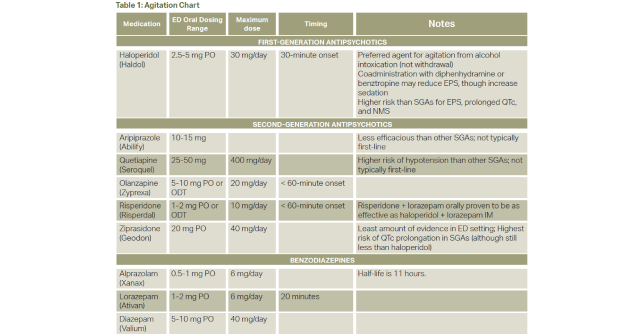
This is the second in a multi-part ACEP Now series focused on mental health emergencies. Last month’s article focused on ACEP’s efforts and resources to support EDs and patients with psychiatric emergencies. Future articles will highlight solutions and success stories. This month, we are discussing the medical management of patients with mild to moderate agitation.

You Might Also Like
  • How to Approach Psych Patients Who Refuse Treatment in the Emergency Department
  • How to Manage Acute Agitation in Children
  • Tips for Managing Acute Agitation in the Elderly
Explore This Issue
ACEP Now: Vol 42 – No 07 – July 2023

Emergency departments (EDs) focus on rapid initiation of medical treatment. Patients with sepsis get antibiotics. Patients with opiate overdose get naloxone. Patients in DKA get insulin. And yet, when many patients arrive with a mental health crisis, they get nothing—until they escalate, at which point they often get too much and remain over-sedated for hours. Just as for patients experiencing other emergencies, ED physicians should rapidly initiate appropriate medical treatment for patients experiencing mental health crises, before they decompensate.

Calming Measures

Sometimes ED physicians are reluctant to initiate calming treatment in lower acuity patients, preferring to wait until more aggressive sedation is absolutely necessary. They might have been instructed that early calming measures lead to an inaccurate evaluation of the patient by a mental health professional or worry about over-sedating the patient. However, rapid initiation of treatment is actually patient-centered care that can both lead to better outcomes and limit ED boarding. Mental health evaluation teams can rely on documentation and interviews to understand a patient’s initial agitation level. It is also equally important for mental health evaluators to understand how patients respond to calming medication, as that can help guide inpatient versus outpatient treatment decisions.

This article focuses on calming medication in patients with mild to moderate agitation. The article also will not address severe agitation, which is already well covered elsewhere and is the topic of an ACEP clinical policy currently in development.1–3

When to Consider Calming Treatments

Calming treatment should be considered immediately upon arrival for patients who are experiencing agitation or anxiety, even if the symptoms are not severe.4 The first step is to establish a therapeutic alliance and engage in verbal de-escalation.5 ED physicians should use a calm, non-confrontational tone, respect the patient’s personal space, set polite but firm boundaries for behavior, and offer choices where appropriate. Sometimes investing an extra two to five minutes—certainly a significant time commitment on a busy shift—to establish trust can limit the need to spend even more time later in the shift managing escalating behavior (or permit a much earlier disposition).

Pages: 1 2 3 4 | Single Page

Topics: agitationMental Health

Related

  • Pediatric Patients in Acute Mental Health Crisis Face Long Waits

    August 29, 2025 - 0 Comment
  • Opinion: The Hidden Power of Doing Less—A New Perspective on Clinician Wellness

    June 24, 2025 - 0 Comment
  • March 2025 News from the College

    March 8, 2025 - 0 Comment

Current Issue

ACEP Now: November 2025

Download PDF

Read More

One Response to “Agitation Treatment in the Emergency Department”

  1. July 12, 2023

    John Smith Reply

    I appreciate the article’s emphasis on the importance of early intervention in the treatment of agitation. Agitation can quickly escalate, so it is important to intervene early to prevent a patient from becoming more aggressive or violent.

Leave a Reply Cancel Reply

Your email address will not be published. Required fields are marked *


*
*


Wiley
  • Home
  • About Us
  • Contact Us
  • Privacy
  • Terms of Use
  • Advertise
  • Cookie Preferences
Copyright © 2025 by John Wiley & Sons, Inc. All rights reserved, including rights for text and data mining and training of artificial technologies or similar technologies. ISSN 2333-2603
