
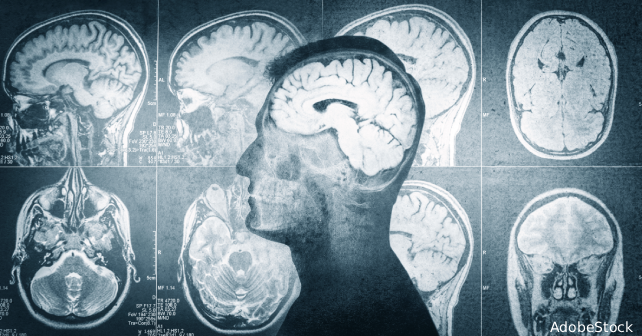
Patients presenting with a primary or secondary complaint of acute headache represent a persistent source of malpractice claims and lawsuits.¹ They are especially costly, because they can result in death and lifelong disability.² Although the value of noncontrast computed tomography (NCCT) brain imaging for evaluating headache is undisputable, over-reliance on a negative NCCT can lead to a serious miss and a lawsuit.3,⁴ Consider adding more historical detail, a National Institutes of Health Stroke Scale (NIHSS), meningeal signs, and funduscopic examination to the physical exam in selected patients with acute headache.
Explore This Issue
ACEP Now: March 2026Legal Background
In studies of misdiagnosis and closed lawsuits, over-reliance on a negative CT and missing history and physical exam elements are cited as causes.1 The most common claims are for subarachnoid hemorrhage, stroke, cerebral venous sinus thrombosis (CVST), and meningitis/encephalitis.4 The most common theory advanced by the plaintiff is that, had the defendant done a more thorough history and physical (H&P) exam, it would have triggered further testing and the condition would have been caught. It can be a challenge to convince a jury that additional physical examination should not have been done when a catastrophic result occurs.
Medical Background
Given the unmodifiable constraints of time and resources in the emergency department, it is not possible to perform every element of the H&P.5 However, there are selected features clinicians may choose to add to better cover subtle or atypical presentations.
Historical Features
Delineating the exact time of onset and rapidity of onset are particularly valuable with regard to subarachnoid hemorrhage. If the timing can be accurately established at less than six hours, a negative CT comes very close to ruling out subarachnoid hemorrhage (SAH).3 Detailing that the time to maximal onset exceeds one hour is also helpful.6 The presence or absence of neurological symptoms, including posterior circulation features such as dizziness, imbalance, and new visual disturbances can help point to stroke as a potential cause, because approximately 40 percent of posterior circulation strokes present with headache as a primary or secondary complaint.7 Fourteen percent of anterior circulation strokes do so as well.8
NIHSS
The NIHSS can be a valuable tool, because a significant percentage of these conditions can present with subtle neurological deficits, particularly stroke. Approximately 10 percent of SAH, a significant percentage of strokes, and roughly 17 to 43 percent of CVST can present with both acute headache and subtle neurological deficits.9,10 In the first four to six hours, the NIHSS may be more sensitive than MRI for stroke, because an NIHSS score of zero does not exclude stroke and early diffusion-weighted MRI may be falsely negative.11,12 I don’t recommend NIHSS for every patient with acute headache, but in selected cases it’s of high value and can be performed quickly.
Meningeal Signs
Although meningeal signs are often taught to be insensitive, consider adding them anyway. If positive, they may trigger further workup. If negative, they contribute to a defensible record in the event of a catastrophic outcome. Approximately 60 percent of subarachnoid hemorrhage and about 50 percent of meningitis cases present with positive meningeal signs.13,14
Fundoscopy
Checking for the presence or absence of papilledema may seem daunting, but with practice fundoscopy can be done quickly. Twenty to 30 percent of CVST cases present with papilledema.15
Summary
The NCCT brain is a valuable tool for evaluating patients with acute headache, and this is one reason its use has increased significantly over the past two decades.16 But the H&P remains essential. Adding targeted elements to the history and physical exam can improve diagnostic sensitivity for subtle but catastrophic disease and make your care more defensible. Studies show that patients value thoroughness and often rate clinicians higher when they perceive a more complete examination.17,18
 Dr. Bedolla is the national director of risk science at US Acute Care Solutions, and an assistant professor at the University of Texas Dell Medical School.
References
- A Dose of Insight: Emergency Department. Coverys Web site. https://www.coverys.com/. Accessed February 6, 2026.
- Brown TW, McCarthy ML, Kelen GD, Levy F. An epidemiologic study of closed emergency department malpractice claims in a national database of physician malpractice insurers.
- Perry JJ, Stiell IG, Sivilotti ML, et al. Sensitivity of computed tomography performed within six hours of onset of headache for diagnosis of subarachnoid hemorrhage: prospective cohort study.BMJ. 2011;343:d4277. Published 2011 July 18. doi:10.1136/bmj.d4277
- Newman-Toker DE, Nassery N, Schaffer AC, et al. Burden of serious harms from diagnostic error in the USA.BMJ Qual Saf. 2024;33(2):109-120. Published 2024 January 19. doi:10.1136/bmjqs-2021-014130
- Morley C, Unwin M, Peterson GM, Stankovich J, Kinsman L. Emergency department crowding: A systematic review of causes, consequences and solutions.PLoS One. 2018;13(8):e0203316. Published 2018 August 30. doi:10.1371/journal.pone.0203316
- Perry JJ, Sivilotti MLA, Émond M, et al. Prospective Implementation of the Ottawa Subarachnoid Hemorrhage Rule and 6-Hour Computed Tomography Rule.Stroke. 2020;51(2):424-430. doi:10.1161/STROKEAHA.119.026969
- Nouh A, Remke J, Ruland S. Ischemic posterior circulation stroke: a review of anatomy, clinical presentations, diagnosis, and current management.Front Neurol. 2014;5:30. Published 2014 April 7. doi:10.3389/fneur.2014.00030
- Kumral E, Bogousslavsky J, Van Melle G, Regli F, Pierre P. Headache at stroke onset: the Lausanne Stroke Registry.J Neurol Neurosurg Psychiatry. 1995;58(4):490-492. doi:10.1136/jnnp.58.4.490
- Behrouz R, Birnbaum LA, Jones PM, Topel CH, Misra V, Rabinstein AA. Focal Neurological Deficit at Onset of Aneurysmal Subarachnoid Hemorrhage: Frequency and Causes.J Stroke Cerebrovasc Dis. 2016;25(11):2644-2647. doi:10.1016/j.jstrokecerebrovasdis.2016.07.009
- Saposnik G, Barinagarrementeria F, Brown RD Jr, et al. Diagnosis and management of cerebral venous thrombosis: a statement for healthcare professionals from the American Heart Association/American Stroke Association.Stroke. 2011;42(4):1158-1192. doi:10.1161/STR.0b013e31820a8364
- Martin-Schild S, Albright KC, Tanksley J, et al. Zero on the NIHSS does not equal the absence of stroke.Ann Emerg Med. 2011;57(1):42-45. doi:10.1016/j.annemergmed.2010.06.564
- Edlow BL, Hurwitz S, Edlow JA. Diagnosis of DWI-negative acute ischemic stroke: A meta-analysis.Neurology. 2017;89(3):256-262. doi:10.1212/WNL.0000000000004120
- Cohen-Gadol AA, Bohnstedt BN. Recognition and evaluation of nontraumatic subarachnoid hemorrhage and ruptured cerebral aneurysm.Am Fam Physician. 2013;88(7):451-456.
- Niemelä S, Lempinen L, Löyttyniemi E, Oksi J, Jero J. Bacterial meningitis in adults: a retrospective study among 148 patients in an 8-year period in a university hospital, Finland.BMC Infect Dis. 2023;23(1):45. Published January 23, 2023. doi:10.1186/s12879-023-07999-2
- Tanislav C, Siekmann R, Sieweke N, et al. Cerebral vein thrombosis: clinical manifestation and diagnosis. BMC Neurol. 2011;11:69. Published June 10, 2011. doi:10.1186/1471-2377-11-69
- Centers for Disease Control and Prevention. Morbidity and Mortality Weekly Report. QuickStats: Annual Percentage of Emergency Department Visits with Selected Imaging Tests Ordered or Provided — National Hospital Ambulatory Medical Care Survey, United States, 2001–2010. https://www.cdc.gov/mmwr/preview/mmwrhtml/mm6222a6.htm. Accessed February 6, 2026.
- Duan L, Mukherjee EM, Federman DG. The physical examination: a survey of patient preferences and expectations during primary care visits. Postgrad Med. 2020;132(1):102-108. doi:10.1080/00325481.2020.1713618
- 18. Boudreaux ED, O’Hea EL. Patient satisfaction in the Emergency Department: a review of the literature and implications for practice.



No Responses to “Acute Headache: Don’t Forget the Physical Exam”