Logo

Log In Sign Up |  An official publication of: American College of Emergency Physicians
Navigation
  • Home
  • Multimedia
    • Podcasts
    • Videos
  • Clinical
    • Airway Managment
    • Case Reports
    • Critical Care
    • Guidelines
    • Imaging & Ultrasound
    • Pain & Palliative Care
    • Pediatrics
    • Resuscitation
    • Trauma & Injury
  • Resource Centers
    • mTBI Resource Center
  • Career
    • Practice Management
      • Benchmarking
      • Reimbursement & Coding
      • Care Team
      • Legal
      • Operations
      • Quality & Safety
    • Awards
    • Certification
    • Compensation
    • Early Career
    • Education
    • Leadership
    • Profiles
    • Retirement
    • Work-Life Balance
  • Columns
    • ACEP4U
    • Airway
    • Benchmarking
    • Brief19
    • By the Numbers
    • Coding Wizard
    • EM Cases
    • End of the Rainbow
    • Equity Equation
    • FACEPs in the Crowd
    • Forensic Facts
    • From the College
    • Images in EM
    • Kids Korner
    • Medicolegal Mind
    • Opinion
      • Break Room
      • New Spin
      • Pro-Con
    • Pearls From EM Literature
    • Policy Rx
    • Practice Changers
    • Problem Solvers
    • Residency Spotlight
    • Resident Voice
    • Skeptics’ Guide to Emergency Medicine
    • Sound Advice
    • Special OPs
    • Toxicology Q&A
    • WorldTravelERs
  • Resources
    • ACEP.org
    • ACEP Knowledge Quiz
    • Issue Archives
    • CME Now
    • Annual Scientific Assembly
      • ACEP14
      • ACEP15
      • ACEP16
      • ACEP17
      • ACEP18
      • ACEP19
    • Annals of Emergency Medicine
    • JACEP Open
    • Emergency Medicine Foundation
  • About
    • Our Mission
    • Medical Editor in Chief
    • Editorial Advisory Board
    • Awards
    • Authors
    • Article Submission
    • Contact Us
    • Advertise
    • Subscribe
    • Privacy Policy
    • Copyright Information

ACEP’s 2014 Report Card on Emergency Medicine Reveals Major Access-to-Care Deficit

By ACEP Now | on February 6, 2014 | 0 Comment
Features
  • Tweet
  • Click to email a link to a friend (Opens in new window) Email
Print-Friendly Version

A near-failing grade for most states points to subpar conditions and policies for delivery of EM care, lack of support for hospitals, say ACEP leaders

Last month’s release of ACEP’s 2014 Report Card on Emergency Medicine was considered a wake-up call to the health-care system, revealing a lack of support for emergency patients and a deserving D+ overall grade. One category set off the fire alarm.

You Might Also Like
  • Rural Hospital Closures Leave Whole Communities Without Access to Emergency Care
  • ACEP’s Clinical Emergency Data Registry to Measure, Report Health Care Quality, Outcomes
  • ACEP-Supported Issues, Bills at the 2014 Leadership and Advocacy Conference
Explore This Issue
ACEP Now: Vol 33 – No 02 – February 2014

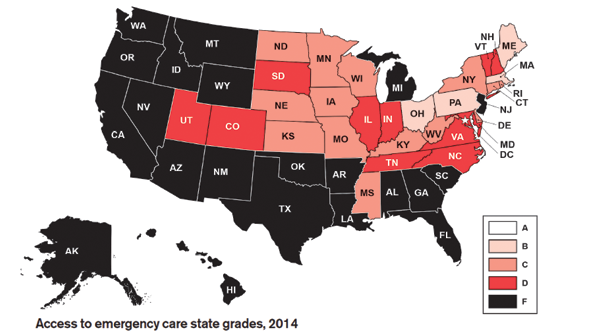
Access to Emergency Care, which accounted for 30 percent of the overall grade and was weighted more heavily than the other four (Quality and Patient Safety, Medical Liability Environment, Public Health and Injury Prevention, and Disaster Preparedness) and showed that very few states get the support they need in terms of conditions and policies under which emergency care is being delivered. It received a grade nationwide of D-, and 22 states received an F.

Overall, this category hasn’t improved since the last time ACEP released the Report Card in 2009.

The Report Card measures conditions and policies under which emergency care is being delivered, not the quality of care provided by hospitals and emergency providers. Emergency physicians across the country, including ACEP President Alex M. Rosenau, DO, FACEP, say this category is crucial when it comes to improving the support for emergency department patients. ACEP is encouraging its members to talk with legislators and make them aware of deficiencies.

“Access is one of the most important parts of providing care to any type of patient,” Dr. Rosenau said. “If a patient can’t get in to see a physician and can’t get care, the best medicine in the world won’t mean anything.”

ACEP points out in the report that access to emergency care is both fundamental and complex. The College is urging news outlets to recognize that emergency departments are a vital part of the health care system in each community and region. They deliver emergency care day in and day out, and they serve as the health care safety net for anyone, insured or not, who cannot otherwise obtain timely health care services when needed. Access to emergency care is complex because the demand for emergency services often is related to the capacity of the broader health care system to deliver services.

Thus, measures of Access to Emergency Care must include elements that comprise that broader system. This category measures the availability of emergency care resources, such as numbers of emergency physicians, emergency departments, registered nurses, and trauma centers per person, along with proximity to Level I or II trauma centers, and the median time from arrival to departure from the emergency department. Because emergency department capacity is also a function of the broader health care system, the access category includes key measures of that system’s capacity, such as the availability of primary care, mental health care, and substance abuse treatment.

Pages: 1 2 3 | Single Page

Topics: ACEPAmerican College of Emergency PhysiciansEmergency MedicineEmergency PhysicianPublic HealthPublic PolicyQualityWorkforce

Related

  • Opinion: Physicians Must Reduce Plastic Waste

    December 4, 2025 - 0 Comment
  • The Emergency Physician Job Market 2025-26

    October 15, 2025 - 2 Comments
  • October 2025 News from the College

    September 23, 2025 - 0 Comment

Current Issue

ACEP Now: November 2025

Download PDF

Read More

No Responses to “ACEP’s 2014 Report Card on Emergency Medicine Reveals Major Access-to-Care Deficit”

Leave a Reply Cancel Reply

Your email address will not be published. Required fields are marked *


*
*


Wiley
  • Home
  • About Us
  • Contact Us
  • Privacy
  • Terms of Use
  • Advertise
  • Cookie Preferences
Copyright © 2025 by John Wiley & Sons, Inc. All rights reserved, including rights for text and data mining and training of artificial technologies or similar technologies. ISSN 2333-2603