Logo

Log In Sign Up |  An official publication of: American College of Emergency Physicians
Navigation
  • Home
  • Multimedia
    • Podcasts
    • Videos
  • Clinical
    • Airway Managment
    • Case Reports
    • Critical Care
    • Guidelines
    • Imaging & Ultrasound
    • Pain & Palliative Care
    • Pediatrics
    • Resuscitation
    • Trauma & Injury
  • Resource Centers
    • mTBI Resource Center
  • Career
    • Practice Management
      • Benchmarking
      • Reimbursement & Coding
      • Care Team
      • Legal
      • Operations
      • Quality & Safety
    • Awards
    • Certification
    • Compensation
    • Early Career
    • Education
    • Leadership
    • Profiles
    • Retirement
    • Work-Life Balance
  • Columns
    • ACEP4U
    • Airway
    • Benchmarking
    • Brief19
    • By the Numbers
    • Coding Wizard
    • EM Cases
    • End of the Rainbow
    • Equity Equation
    • FACEPs in the Crowd
    • Forensic Facts
    • From the College
    • Images in EM
    • Kids Korner
    • Medicolegal Mind
    • Opinion
      • Break Room
      • New Spin
      • Pro-Con
    • Pearls From EM Literature
    • Policy Rx
    • Practice Changers
    • Problem Solvers
    • Residency Spotlight
    • Resident Voice
    • Skeptics’ Guide to Emergency Medicine
    • Sound Advice
    • Special OPs
    • Toxicology Q&A
    • WorldTravelERs
  • Resources
    • ACEP.org
    • ACEP Knowledge Quiz
    • Issue Archives
    • CME Now
    • Annual Scientific Assembly
      • ACEP14
      • ACEP15
      • ACEP16
      • ACEP17
      • ACEP18
      • ACEP19
    • Annals of Emergency Medicine
    • JACEP Open
    • Emergency Medicine Foundation
  • About
    • Our Mission
    • Medical Editor in Chief
    • Editorial Advisory Board
    • Awards
    • Authors
    • Article Submission
    • Contact Us
    • Advertise
    • Subscribe
    • Privacy Policy
    • Copyright Information

ACEP4U: the ACEP/CORD Teaching Fellowship

By Christina Shenvi, MD, PhD, MBA, FACEP | on November 4, 2025 | 0 Comment
ACEP4U
  • Tweet
  • Click to email a link to a friend (Opens in new window) Email
Print-Friendly Version

The TF’s format has evolved over the years to meet the changing needs of academic medicine and learners. The program continues to be highly interactive and high yield. Participants attend two five-day in-person phases and complete a year-long education-focused project in between. They engage in small group learning, give presentations to each other, and practice giving and receiving feedback, under the guidance of seasoned faculty educators. It is the training program where many prominent educators got their start in education.

You Might Also Like
  • 2020 ACEP Leadership Award Winners
  • 2018 ACEP Elections Preview: Meet the Board of Directors Candidates
  • Congratulations to the 2019 ACEP Leadership Award Winners
Explore This Issue
ACEP Now: November 2025
“The most valuable thing from the TF was building a network of passionate educators from across the nation that I have continued to work with and regularly see at national meetings. This network was … key to my own development and often helps to remind me that I am not alone when fighting to improve the educational experience for trainees. The TF helped me launch my career in education. I completed the program as a chief resident, and it confirmed to me that there was legitimacy in pursuing education as an outlet and would also help sustain me throughout my career. The network it helped me build was invaluable for the support, for those challenging moments as an educational leader, while also reinforcing key skills to be the best educator I could be for my trainees.”

————————————-

Matthew Stull, MD, FACEP

Director of Emergency Critical Care,

University of South Carolina,

TF Class of 2015

Two-Phase Program

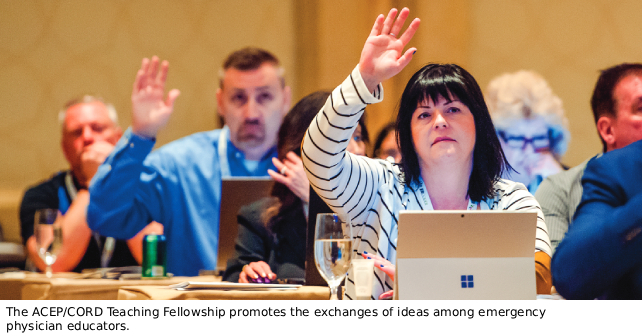
The two in-person phases are now integrated into ACEP’s Accelerate conference, providing participants with even more opportunities for networking, mentorship, and professional development. This integration allows TF participants to engage with a broader community of educators and leaders and gives them more time between the phases to complete their projects.

“The most valuable part of the TF was the community. I left with a national network of educators, collaborators, and — most meaningfully — lifelong friends,” said Shayne Gue, program director, BayCare Health System in Tampa, Fla., TF class of 2022.

During the TF, the first phase focuses on foundational skills critical for every educator, such as curriculum design, effective speaking, slide design, bedside teaching, and feedback. During Phase 1, each participant delivers a “microteaching” presentation within a small group led by a faculty member and receives feedback. During Phase 2, the focus is on leadership and more advanced topics, such as communication, keys to career success, negotiations, mentorship, and program leadership. In Phase 2, each participant presents their projects. Participants also leave with a strong professional identity as educators. The emphasis on interactive learning, reflection, and feedback equips fellows with knowledge, but it also helps spark the curiosity that supports lifelong development as academic physicians.

Pages: 1 2 3 4 | Single Page

Topics: ACEP AccelerateACEP Teaching FellowshipCareer DevelopmentCORDEducationFacultyLeadershipMedical EducationMentorshipTeaching

Related

  • FACEPs in the Crowd: Dr. John Ludlow

    November 5, 2025 - 0 Comment
  • ACEP Announces Michael Fraser, PhD, MS, CAE, as Executive Director

    October 28, 2025 - 0 Comment
  • Get to Know ACEP’s Leadership

    October 21, 2025 - 0 Comment

Current Issue

ACEP Now: November 2025

Download PDF

Read More

No Responses to “ACEP4U: the ACEP/CORD Teaching Fellowship”

Leave a Reply Cancel Reply

Your email address will not be published. Required fields are marked *


*
*


Wiley
  • Home
  • About Us
  • Contact Us
  • Privacy
  • Terms of Use
  • Advertise
  • Cookie Preferences
Copyright © 2025 by John Wiley & Sons, Inc. All rights reserved, including rights for text and data mining and training of artificial technologies or similar technologies. ISSN 2333-2603