

ACEP leaders and emergency medicine researchers knew in the late 1990s that the specialty lacked the respect and recognition afforded to other specialties in peer-reviewed medical education and research.
Explore This Issue
ACEP Now: June 2025 (Digital)Emergency physician, researcher, and instructor Edward Panacek, MD, FACEP, decided to do something about it with help from the College and his research colleagues. Together, they decided to build a rigorous body of peer-reviewed research, but they knew it would take a growing number of skilled researchers and academicians to get that done. More researchers would lead to more research. In 1997, Dr. Panacek led the charge to introduce the Emergency Medicine Basic Research Skills course (EMBRS). The 11-day course at ACEP’s headquarters was designed to provide attendees with a strong foundation in research methodology.
“The idea was to create ‘a mini-research fellowship’ modeled after the successful EMF Teaching Fellowship,” Dr. Panacek said.
Fast forward to 2025, and the EMBRS course Dr. Panacek and his team created has been an unqualified success. Since the first course in 1997, hundreds of learners from around the world have completed EMBRS. Alumni now are global leaders in emergency medicine, serving as department chairs, vice chairs of research, residency program directors, and clinician researchers in both academic medical centers and community emergency departments. At least 10 former chairs of ACEP committees and sections, and nearly 30 vice chairs, are graduates of EMBRS.
The EMBRS Who’s Who includes:
- Christopher Kang, MD, FACEP, ACEP Past President
- Gillian Schmitz, MD, FACEP, ACEP Past President
- Andra Leah Blomkalns, MD, FACEP, professor and chair of emergency medicine at Stanford
- Benjamin P. Donham, MD, Commander, U.S. Army Medical Department, Alaska
- Marie-Carmelle Eli, MD, FACEP, Endowed Professor at the University of Alabama at Birmingham and the first Black woman to be named Chair of an academic emergency-medicine department at a major medical school
- Bryan G. Kane, MD, FACEP, Past President of the Lehigh Valley Health Network
- Angela M. Mills, MD, inaugural chair, department of emergency medicine, Columbia University
- Andre M. Pennardt, MD, FACEP, chief medical officer of FEMA
Today, Dr. Panacek’s idea has entered a new era. EMBRS has been restructured and rebranded as ACEP Research Academy.
Research Academy
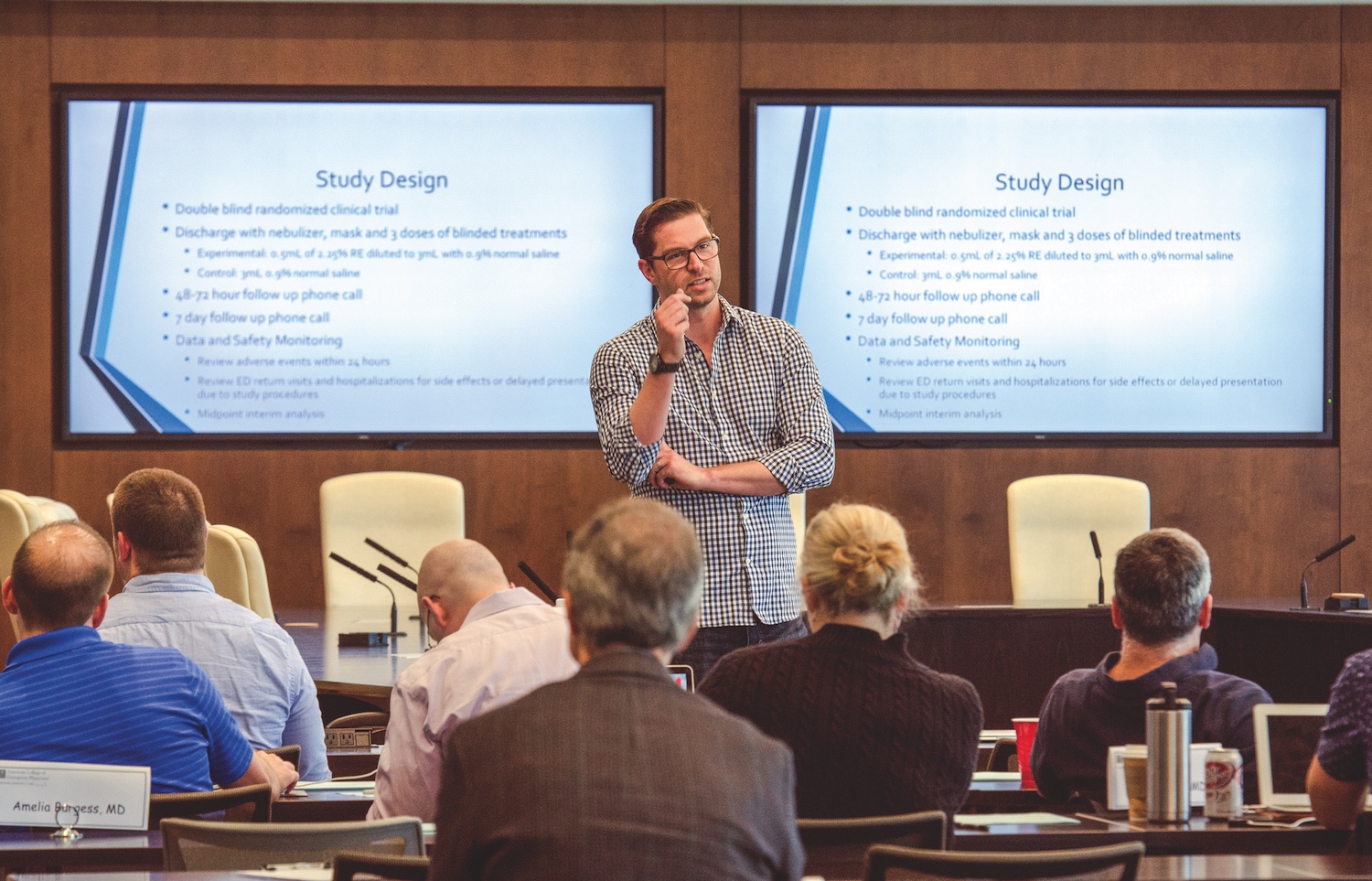
As part of ACEP’s Research Academy, students are asked to present their research to the class and instructors for feedback. Research Academy, formerly known as the Emergency Medicine Basic Research Skills (EMBRS) Course, kicks off this fall with Session I from Sept. 5-6 in Salt Lake City. Session II will take place next Spring at ACEP’s headquarters in Irving, Texas. (Click to enlarge.)
Under the directorship of Gary Gaddis, MD, PhD, FACEP, the course has evolved by incorporating a flipped-classroom format designed to optimize in-person time and better suit today’s learners. Reduced from the original 11 days to three, the fall session places increased emphasis on interactive discussions and practical exercises. Attendees review a repository of online content before the in-person sessions, allowing more time to workshop their research ideas with faculty and peers.
This year, Research Academy Session I is set for Sept. 5-6 to coincide with ACEP25 in Salt Lake City. Session II will be April 23-26 at ACEP’s headquarters in Irving, Texas.
“With feedback and reflection on our previous format, we redeveloped the course to incorporate leading educational strategies, emphasize the most critical content for early career and research project success, and reduce the cost and time needed away from home,” said Martin Wegman, MD, PhD, FACEP. Mr. Wegman is ACEP’s Senior Research Fellow and staff leader for the course.
The ACEP Research Academy is also entering a new era of leadership. Dr. Gaddis, who succeeded Dr. Panacek as Course Director in 2017, will soon pass the torch to its third course director, Alexander Limkakeng, MD, MHSc, FACEP. As an alumnus of the course, Dr. Limkakeng brings first-hand knowledge of the student experience and a passion for teaching.
“When I got the call from ACEP to be an instructor for Research Academy, I felt like I was entering ‘Top Gun,’” Dr. Limkakeng said. “These faculty are world-class academicians, and I am honored to be included among them. As course director, my goal is to not only continue teaching research fundamentals, but to also continuously improve and adapt the curriculum to the diverse interests of our students.”
In balancing continuity and change, Dr. Panacek and Dr. Gaddis will continue as faculty for the course.
Dr. Gaddis will remain as the primary statistics instructor, while Dr. Panacek continues to give an interactive introduction to developing research questions and hypotheses.
Broad Appeal
Dr. Limkakeng emphasized the course’s broad appeal.
“Whether you aspire to become an NIH-funded researcher or you just want to better understand the latest medical literature to improve your clinical practice, Research Academy is for you,” Dr. Limkakeng said. “Past attendees range from clinicians focused on bettering their patient care to department leaders seeking to integrate research into their work. Others are residency program leaders seeking to better mentor their students and residents.
“Several come from programs that are still developing their research infrastructure, or which don’t have an extensive pool of mentors at their institutions. Lastly, increasing numbers of attendees have been looking to supplement their sub-specialty fellowship experiences in ultrasound, toxicology, emergency medical systems, sports medicine, palliative care, education, or addiction medicine.”
Other popular features of the course that have been retained include:
- The introduction to grant writing by the founder of the Foundation for the Education and Research in Neurologic Emergencies (FERNE), Ed Sloan, MD, MPH, FACEP.
- Hands-on experience in creating and using data forms by Daniel Nishijima, MD, MAS, from the University of California-Davis.
- Sessions on building a research career and research program by Deborah Diercks, MD, MSc, MBA, FACEP, department chair at University of Texas Southwestern Medical Center.
- Attendee presentations of grant proposals, competing for $10,000 in dedicated funding for Research Academy participants from the Emergency Medicine Foundation.
Learn more about the Research Academy.
Dr. Limkakeng is a professor of emergency medicine, vice chair of clinical research, and director of the Acute Care Research Team at the Duke University School of Medicine in Durham, N.C. He is director of ACEP’s Research Academy course.
Dr. Gaddis is a “lifetime academic” who currently serves as a teaching professor of biomedical and health informatics at the University of Missouri-Kansas City School of Medicine (UMKC SoM), and as a volunteer clinical professor of emergency medicine at the University of California-Irvine School of Medicine.
Pages: 1 2 3 | Multi-Page



No Responses to “ACEP4U: Reinventing Research Education”