Logo

Log In Sign Up |  An official publication of: American College of Emergency Physicians
Navigation
  • Home
  • Multimedia
    • Podcasts
    • Videos
  • Clinical
    • Airway Managment
    • Case Reports
    • Critical Care
    • Guidelines
    • Imaging & Ultrasound
    • Pain & Palliative Care
    • Pediatrics
    • Resuscitation
    • Trauma & Injury
  • Resource Centers
    • mTBI Resource Center
  • Career
    • Practice Management
      • Benchmarking
      • Reimbursement & Coding
      • Care Team
      • Legal
      • Operations
      • Quality & Safety
    • Awards
    • Certification
    • Compensation
    • Early Career
    • Education
    • Leadership
    • Profiles
    • Retirement
    • Work-Life Balance
  • Columns
    • ACEP4U
    • Airway
    • Benchmarking
    • Brief19
    • By the Numbers
    • Coding Wizard
    • EM Cases
    • End of the Rainbow
    • Equity Equation
    • FACEPs in the Crowd
    • Forensic Facts
    • From the College
    • Images in EM
    • Kids Korner
    • Medicolegal Mind
    • Opinion
      • Break Room
      • New Spin
      • Pro-Con
    • Pearls From EM Literature
    • Policy Rx
    • Practice Changers
    • Problem Solvers
    • Residency Spotlight
    • Resident Voice
    • Skeptics’ Guide to Emergency Medicine
    • Sound Advice
    • Special OPs
    • Toxicology Q&A
    • WorldTravelERs
  • Resources
    • ACEP.org
    • ACEP Knowledge Quiz
    • Issue Archives
    • CME Now
    • Annual Scientific Assembly
      • ACEP14
      • ACEP15
      • ACEP16
      • ACEP17
      • ACEP18
      • ACEP19
    • Annals of Emergency Medicine
    • JACEP Open
    • Emergency Medicine Foundation
  • About
    • Our Mission
    • Medical Editor in Chief
    • Editorial Advisory Board
    • Awards
    • Authors
    • Article Submission
    • Contact Us
    • Advertise
    • Subscribe
    • Privacy Policy
    • Copyright Information

A Patient Transfer Leads to a Lawsuit

By Eric Funk, MD | on September 25, 2020 | 0 Comment
Medicolegal Mind
  • Tweet
  • Click to email a link to a friend (Opens in new window) Email
Print-Friendly Version

A difficult airway is every emergency physician’s worst nightmare. The decision to intubate a patient needs to be coupled with adequate preparation, good communication with nurses and other team members, and a backup plan for possible complications. These situations require rapid decision making under stress. The case below depicts a real-life situation that resulted in a medical malpractice lawsuit. The descriptions and figures shown are the actual evidence used in the lawsuit.

You Might Also Like
  • When Delayed Diagnosis Leads to a Malpractice Lawsuit
  • Elderly Patient Dies after Emergency Dept. Bounceback, Lawsuit Results
  • A Lack of Communication Let a Cancer Grow, Which Led to a Lawsuit
Explore This Issue
ACEP Now: Vol 39 – No 09 – September 2020

The Case

A 52-year-old woman presented to the emergency department with shortness of breath. She was brought to the emergency department in a wheelchair by her husband. The triage nurse immediately recognized that she was in severe respiratory distress. Her respirations were noted to be rapid and labored, and she had an audible gurgle. She was assigned a triage Level 1.

There were no available rooms, so she was put in a hallway bed. The physician was immediately at the bedside. He noted that she was cool, clammy, and grossly cyanotic. The patient was able to state that she did not have asthma or chronic obstructive pulmonary disease but did note a history of congestive heart failure. After a very limited history, the patient’s respiratory status declined into complete apnea. The physician made an initial attempt at blind nasal intubation while the nurses started an IV, but he was unsuccessful. A second attempt was made, also with no success. By that time, the nurses had cleared a room and she was brought into the resuscitation bay. The patient’s heart rate declined to 40 bpm on the monitor, a pulse could not be palpated, and chest compressions were started. One milligram of epinephrine was given.

By then, the nurses had established an IV, and 5 mg midazolam (Versed) was given. An oral intubation was attempted without any success. The doctor then elected to place a King Airway device. The patient was ventilated through the King Airway, return of spontaneous circulation was obtained, and her oxygen saturation increased to 97 percent.

A portion of the doctor’s note describing the events is shown in Figure 1.
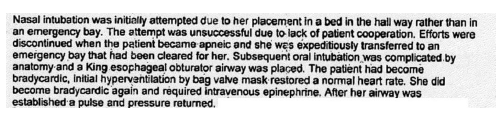
Figure 1

Figure 1

Over the next 10 minutes, the patient’s oxygen saturation declined to the mid-80s. She was given lorazepam (Ativan) for sedation and furosemide (Lasix), as the physician suspected fluid overload. The physician also prescribed dexamethasone (Decadron) and diphenhydramine (Benadryl) to reduce airway swelling as well as metoprolol due to the fact that she was hypertensive. Outside medical records were obtained showing that she had a coronary artery bypass graft approximately 18 months earlier.

Pages: 1 2 3 4 | Single Page

Topics: Case ReportsEMTALAMalpracticePracticee Managementtransfer

Related

  • Q&A with ACEP President L. Anthony Cirillo

    November 5, 2025 - 0 Comment
  • How Evidence-Based Medicine Strengthens Your Malpractice Defense

    October 28, 2025 - 0 Comment
  • The Business of Emergency Medicine: Insurance Essentials

    October 9, 2025 - 0 Comment

Current Issue

ACEP Now: November 2025

Download PDF

Read More

No Responses to “A Patient Transfer Leads to a Lawsuit”

Leave a Reply Cancel Reply

Your email address will not be published. Required fields are marked *


*
*


Wiley
  • Home
  • About Us
  • Contact Us
  • Privacy
  • Terms of Use
  • Advertise
  • Cookie Preferences
Copyright © 2025 by John Wiley & Sons, Inc. All rights reserved, including rights for text and data mining and training of artificial technologies or similar technologies. ISSN 2333-2603
