Logo

Log In Sign Up |  An official publication of: American College of Emergency Physicians
Navigation
  • Home
  • Multimedia
    • Podcasts
    • Videos
  • Clinical
    • Airway Managment
    • Case Reports
    • Critical Care
    • Guidelines
    • Imaging & Ultrasound
    • Pain & Palliative Care
    • Pediatrics
    • Resuscitation
    • Trauma & Injury
  • Resource Centers
    • mTBI Resource Center
  • Career
    • Practice Management
      • Benchmarking
      • Reimbursement & Coding
      • Care Team
      • Legal
      • Operations
      • Quality & Safety
    • Awards
    • Certification
    • Compensation
    • Early Career
    • Education
    • Leadership
    • Profiles
    • Retirement
    • Work-Life Balance
  • Columns
    • ACEP4U
    • Airway
    • Benchmarking
    • Brief19
    • By the Numbers
    • Coding Wizard
    • EM Cases
    • End of the Rainbow
    • Equity Equation
    • FACEPs in the Crowd
    • Forensic Facts
    • From the College
    • Images in EM
    • Kids Korner
    • Medicolegal Mind
    • Opinion
      • Break Room
      • New Spin
      • Pro-Con
    • Pearls From EM Literature
    • Policy Rx
    • Practice Changers
    • Problem Solvers
    • Residency Spotlight
    • Resident Voice
    • Skeptics’ Guide to Emergency Medicine
    • Sound Advice
    • Special OPs
    • Toxicology Q&A
    • WorldTravelERs
  • Resources
    • ACEP.org
    • ACEP Knowledge Quiz
    • Issue Archives
    • CME Now
    • Annual Scientific Assembly
      • ACEP14
      • ACEP15
      • ACEP16
      • ACEP17
      • ACEP18
      • ACEP19
    • Annals of Emergency Medicine
    • JACEP Open
    • Emergency Medicine Foundation
  • About
    • Our Mission
    • Medical Editor in Chief
    • Editorial Advisory Board
    • Awards
    • Authors
    • Article Submission
    • Contact Us
    • Advertise
    • Subscribe
    • Privacy Policy
    • Copyright Information

A Behavioral Health Intake-Process Model

By Shari Welch, MD, FACEP | on May 2, 2023 | 0 Comment
Special OPs
  • Tweet
  • Click to email a link to a friend (Opens in new window) Email
Print-Friendly Version

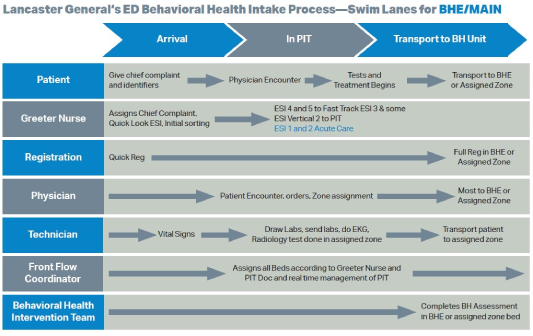
The swim lane diagram (see Figure 1) shows the process they developed.

You Might Also Like
  • Physician Staffing Model at Texas Health ED Helps Maintain Top Clinical, Operational Metrics
  • Intermountain Medical Center in Utah Improves Efficiency, Performance with Vertical Flow Model
  • Virginia Commonwealth University Improves Patient Flow Through “Vision in Action” Model
Explore This Issue
ACEP Now: Vol 42 – No 05 – May 2023

Meanwhile, the LGH Hospital leadership team re-conceptualized the BH space altogether. Rather than serving as a holding area for acutely psychotic or suicidal patients waiting for placement, they created a small unit that follows the psychiatric assessment, treatment and healing (PATH) model. Figure 2 shows the newly conceptualized PATH model.

FIGURE 2. Click to enlarge.

Some of the features of this unit include:

  • Ligature-free rooms and common hallway spaces
  • Lockers to store patient belongings safely and privately
  • Medication-reconciliation specialist in ED
  • Security stationed in unit
  • Duress buttons provided for every staff member
  • Care team: ED registered nurse, BH intervention team (BHIT) member, psychiatry consults when applicable
  • Laundry area in unit, overflow rooms with garage doors

The LGH ED overall and within the PATH unit has another innovative process to mitigate elopements. The Rauland call-bell system in the unit is enabled when the yellow E button is depressed.

When activated the PATH area becomes a locked unit. Patients who pose suicide or elopement risk wear bright yellow gowns for easy identification. The yellow E technology has proven to reduce and prevent patient elopements.

PIT has improved overall median length of stay (LOS) and earlier BH assessment. The data show that BH patients managed through the BHIT process in triage consistently have shorter LOS than BH patients managed using a traditional flow model.

The LGH leadership team invented a model for BH patients using available resources that could be replicated elsewhere. The Lancaster General Hospital ED is proud of its success in managing their BH burden; Bit by BHIT they know they have found the right PATH to do so!


Dr. Welch was a practicing emergency physician for more than 30 years and a research fellow at the Intermountain Institute for Health Care Delivery Research in Murray, Utah. She has written numerous articles and three books on ED quality, safety, and efficiency. She is a consultant with Quality Matters Consulting, and her expertise is in ED operations.

Pages: 1 2 | Single Page

Topics: behavioral healthBoardingMental HealthOperationsPatient FlowPatient VolumePractice ManagementPsychiatric Care

Related

  • Florida Emergency Department Adds Medication-Dispensing Kiosk

    November 7, 2025 - 1 Comment
  • Q&A with ACEP President L. Anthony Cirillo

    November 5, 2025 - 0 Comment
  • November 2025 News from the College

    November 4, 2025 - 0 Comment

Current Issue

ACEP Now: November 2025

Download PDF

Read More

No Responses to “A Behavioral Health Intake-Process Model”

Leave a Reply Cancel Reply

Your email address will not be published. Required fields are marked *


*
*


Wiley
  • Home
  • About Us
  • Contact Us
  • Privacy
  • Terms of Use
  • Advertise
  • Cookie Preferences
Copyright © 2025 by John Wiley & Sons, Inc. All rights reserved, including rights for text and data mining and training of artificial technologies or similar technologies. ISSN 2333-2603
