Logo

Log In Sign Up |  An official publication of: American College of Emergency Physicians
Navigation
  • Home
  • Multimedia
    • Podcasts
    • Videos
  • Clinical
    • Airway Managment
    • Case Reports
    • Critical Care
    • Guidelines
    • Imaging & Ultrasound
    • Pain & Palliative Care
    • Pediatrics
    • Resuscitation
    • Trauma & Injury
  • Career
    • Practice Management
      • Reimbursement & Coding
      • Legal
      • Operations
    • Awards
    • Certification
    • Early Career
    • Education
    • Leadership
    • Profiles
    • Retirement
    • Work-Life Balance
  • Compensation Reports
  • Columns
    • ACEP4U
    • Airway
    • Benchmarking
    • By the Numbers
    • EM Cases
    • End of the Rainbow
    • Equity Equation
    • FACEPs in the Crowd
    • Forensic Facts
    • From the College
    • Kids Korner
    • Medicolegal Mind
    • Opinion
      • Break Room
      • New Spin
      • Pro-Con
    • Pearls From EM Literature
    • Policy Rx
    • Practice Changers
    • Problem Solvers
    • Residency Spotlight
    • Resident Voice
    • Skeptics’ Guide to Emergency Medicine
    • Sound Advice
    • Special OPs
    • Toxicology Q&A
    • WorldTravelERs
  • Resources
    • mTBI Resource Center
    • ACEP.org
    • ACEP Knowledge Quiz
    • CME Now
    • Annual Scientific Assembly
      • ACEP14
      • ACEP15
      • ACEP16
      • ACEP17
      • ACEP18
      • ACEP19
    • Annals of Emergency Medicine
    • JACEP Open
    • Emergency Medicine Foundation
  • Issue Archives
  • Archives
    • Brief19
    • Coding Wizard
    • Images in EM
    • Care Team
    • Quality & Safety
  • About
    • Our Mission
    • Medical Editor in Chief
    • Editorial Advisory Board
    • Awards
    • Authors
    • Article Submission
    • Contact Us
    • Advertise
    • Subscribe
    • Privacy Policy
    • Copyright Information

5 Tips to Build Good Working Relationships with Medical Consultants

By Wolfram Schynoll, MD, FACEP | on April 14, 2015 | 0 Comment
What I Wish I Knew
  • Tweet
  • Click to email a link to a friend (Opens in new window) Email
Print-Friendly Version

5 Tips to Build Good Working Relationships with Medical Consultants

You Might Also Like
  • Tips for Working with Consultants
  • Tips for Collaborating with Advanced Practice Providers
  • How to Build a Community of Mentors to Support Your Career
Explore This Issue
ACEP Now: Vol 34 – No 04 – April 2015

In the course of every provider’s medical career, there is a certainty that we all have to face: the challenge of managing a relationship with a difficult consultant. This also begs a broader question: how do you forge a good working relationship with consultants in general? There are several proven methods to successfully accomplish this.

1. You need to better understand their world. Take every opportunity to learn and appreciate their workload, schedule, and career demands. The easiest way to do that is to simply round on them from time to time. Spending a few informal minutes “off the clock” talking with consultants about their lives, careers, or interests can facilitate the start of great professional relationships. Ask them how their day or week is going. Ask them what makes their work challenging or difficult, and apply their answers to internally asking yourself what you can do to minimize these stated challenges. Ideally, do this when you aren’t asking anything from them.

2. Once you have a better understanding of them, use this knowledge to ask what mutual expectations both of you may have that will result in a good working relationship. Inquire what you can do to optimize the collaboration, efficiency, and transfer of care to them. It is as simple as inquiring, “As I consult you from time to time, what can I do optimize our working relationship and to make it easier and more efficient for you to complete your consult? My goal is to always provide you with a high-quality handoff, and I would like to know, from your perspective, how I can consistently achieve that.” This type of conversation inevitably promotes great mutual respect.
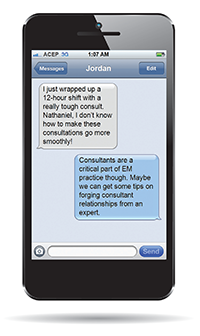
Nathaniel Mann, MD, is a resident in the department of emergency medicine at the University of Cincinnati in Ohio. Jordan Celeste, MD, is president of the Emergency Medicine Residents’ Association and an emergency physician in Florida.

Nathaniel Mann, MD, is a resident in the department of emergency medicine at the University of Cincinnati in Ohio. Jordan Celeste, MD, is president of the Emergency Medicine Residents’ Association and an emergency physician in Florida.

3. Take the time to thank consultants on a regular basis. By making them feel appreciated for their time, efforts, and contributions, you openly acknowledge their value and expertise. An example might be, “I want to take a moment to thank you for being a valued resource and colleague to me. I appreciate your expertise, passion for great patient care, and commitment to quality. I acknowledge how stressful and difficult your day can be, and I want to express my appreciation for the support and expertise that you provide to me.” Even the most cantankerous consultants will warm their demeanor when faced with persistent praise and appreciation.

Pages: 1 2 | Single Page

Topics: Career DevelopmentEmergency PhysicianMedical ConsultantOperationsPractice Trends

Related

  • February 2026 News from the College

    January 27, 2026 - 0 Comment
  • Despite Drawbacks, Emergency Medicine Remains a Great Specialty

    January 9, 2026 - 1 Comment
  • ACEP Now’s Top Five Articles of 2025

    December 22, 2025 - 0 Comment

Current Issue

ACEP Now: January 2026

Download PDF

Read More

No Responses to “5 Tips to Build Good Working Relationships with Medical Consultants”

Leave a Reply Cancel Reply

Your email address will not be published. Required fields are marked *


*
*


Wiley
  • Home
  • About Us
  • Contact Us
  • Privacy
  • Terms of Use
  • Advertise
  • Cookie Preferences
Copyright © 2026 by John Wiley & Sons, Inc. All rights reserved, including rights for text and data mining and training of artificial technologies or similar technologies. ISSN 2333-2603