
In response to an EM resident’s question about moonlighting, we present the following “Top Five” things we wish we had known about moonlighting.
Explore This Issue
ACEP Now: Vol 34 – No 06 – June 2015
1 Know the Rules of the Road
The Accreditation Council for Graduate Medical Education explicitly allows moonlighting in its program requirements for EM as long as the resident is able to achieve the goals and objectives of the residency program, does not violate duty hours, and is not a first-year resident. In addition, most institutions have their own graduate medical education moonlighting policy. Almost all residency programs require that residents meet specific criteria or be in good standing before they are allowed to moonlight externally. Dig into your residency program’s policy and discuss your plans with your program director before you start because you will need the director’s final blessing on any credentialing paperwork for the hospital.
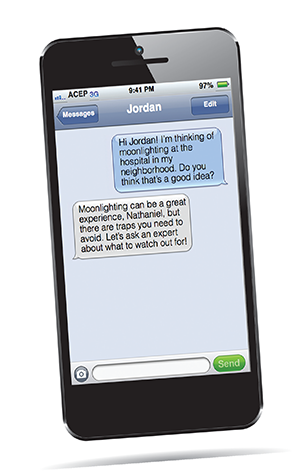
Nathaniel Mann, MD, is a resident in the department of emergency medicine at the University of Cincinnati in Ohio. Jordan Celeste, MD, is president of the Emergency Medicine Residents’ Association and an emergency physician in Florida.

2 Start Smart
Why do you want to moonlight? The two most common motivators are financial and educational. Many residents carry a high debt burden and make modest salaries. Moreover, working in practice settings that are different from the training hospital is a powerful educational experience that not only enables residents to see different types of cases but also to make decisions independently. You need to first develop your personal objectives for moonlighting so that you can ask the right questions and decide which practice setting is right for you. For example, do you want to see a high volume of low-acuity patients? Do you want more experience with pediatric patients or trauma patients? Do you prefer to work in a place with few consultants? Senior residents, recent graduates, or attendings who work in other institutions are great resources here. Finally, before you sign up, analyze the contract very carefully and review it with your program director. Most important, ask about the amount and type of professional liability (malpractice) coverage offered by the group or hospital and who is responsible for obtaining it and paying premiums. Pay special attention to whether “tail coverage” is needed and who will pay the extra premium for this. The Emergency Medicine Residents’ Association offers more information about moonlighting, professional liability, and contractual issues on its website, as does the American Academy of Emergency Medicine Resident and Student Association in the Resources section of its website.
While many residents feel that this unsupervised practice facilitates their growth as an EM physician, it is also a risky undertaking.

3 Be a Paperwork Pro
Once you’ve decided on the practice setting, it’s time to begin the application and credentialing process, which can take months. Here are some general tips:
- Maintain an updated CV and make sure it includes your current residency program information and any pertinent credentials such as advanced trauma life support (ATLS), advanced cardiovascular life support (ACLS), basic life support (BLS), and pediatric advanced life support (PALS).
- Ask two to three faculty members in your home institution if you can list them as your references for your moonlighting position.
- Draft a cover letter that highlights your patient care, professionalism, and interpersonal/communication skills.
- Scan or make several copies of your state medical license, Drug Enforcement Administration (DEA) certificate, driver’s license, immunization records, and other pertinent documents.
- Ask whether your current license and DEA certificate are appropriate for the institution. For example, DEA certificates for county hospitals may not be used for private institutions.

4 The Buck Stops With You
Practicing outside of your training institution means that you are practicing under your own medical license with minimal to no attending supervision. You have the sole responsibility for all aspects of patient care, including accurate and appropriate documentation both for medical care and billing. Do not sacrifice high-quality, thoughtful patient care and education at the expense of efficiency and throughput. Your attending won’t be there to fill in the holes in your documentation or make sure that patients understand their discharge planning. While many residents feel that this unsupervised practice facilitates their growth as an EM physician, it is also a risky undertaking. A single-coverage practice setting is probably not the best place for a first-time moonlighter. Always remember that the faculty in your home institution is available for you to ask questions, so it’s OK to call and discuss cases with the attending on shift if you are ever unsure.

5 Get the Most Bang for Your Buck
All moonlighting residents should take an active role in maximizing the educational benefit of the moonlighting experience. Here are some suggestions:
- Actively seek feedback from patients, nurses, colleagues, and physician leadership. Your colleagues can provide valuable suggestions for improvement. Use this opportunity to identify your weaknesses and focus on improving those areas.
- Many groups provide patient care information, such as productivity, patient satisfaction, and compliance with guidelines and benchmarks, to providers. If you don’t receive this information, ask for it.
- Perform frequent patient follow-ups, via chart review or phone, to “calibrate” your clinical judgment (eg, how many of your admitted chest pain patients rule in for acute coronary syndrome or if the patient you sent home with vague abdominal pain returns with acute appendicitis).
- Ask for help if you’re unsure. Remember that patient care should always come first, and asking for help is not an admission of weakness or ignorance.
- Log all major procedures (eg, intubations, chest tubes, central lines, procedural sedation). Although they do not count toward residency requirements, they can be used for future credentialing.
- Do not forget to maintain a healthy work-life balance. Your primary job is to finish residency, not to moonlight.
 Dr. Silman is assistant clinical professor of emergency medicine, assistant residency director, and director of medical student education in the department of emergency medicine at the University of California, San Francisco.
 Dr. Chen is associate program director and associate professor of clinical emergency medicine in the department of emergency medicine at the University of California, San Francisco.
Pages: 1 2 | Multi-Page


2 Responses to “5 Things Emergency Physicians Should Consider Before Moonlighting”
June 28, 2015
Jon K. Jones MD FACEPGreat article on moonlighting and some potential pitfalls. Moonlighting can build confidence as an attending. The suggestion to “calibrate clinical judgment” is excellent and useful also for attending physicians as well. And patient care (and your own work-life balance) should come first.
September 1, 2022
Andrea SnyderIt appears that most health plans do not allow billing for MDs that have not completed a residency, so we will need to provide supervision for a long term urgent care moonlighter from a local ED residency program (outside the 60 day window). Would appreciate connecting with anyone that has experience with establishing supervision for an EM moonlighter in a non-academic urgent care setting. Thanks!