
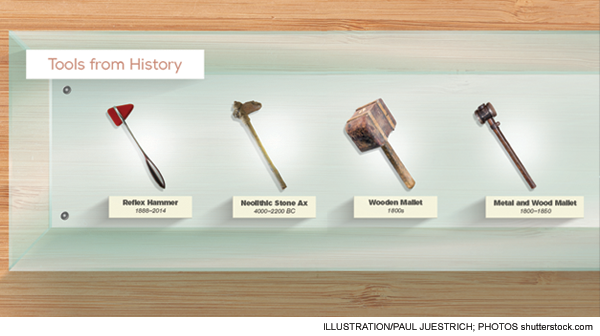
A body of research on the emergency-department evaluation of chest pain (accelerated diagnostic protocol, or the ADP and ADAPT studies) has resulted in a number of protocols that do not include physical findings as part of the decision tree.4,5 In 2013, a study in Emergency Medicine Australasia suggested that the vaginal exam added very little to aid in the diagnosis of first-trimester vaginal bleeding.6 In 2005, a paper in the Journal of Trauma found that the digital rectal exam (DRE) adds nothing to the evaluation of trauma patients, a deviation from more than 20 years of ATLS-mandated fingers in rectums.7 It concluded that the DRE be omitted in virtually all trauma patients. In July 2013, an article in Academic Emergency Medicine found that the history and physical examination could not accurately rule out UTI in symptomatic women.8 A simple U/A did, but the physical examination did not.
Explore This Issue
ACEP Now: Vol 33 – No 02 – February 2014Experienced clinicians know sick when they see it. Physicians, in particular emergency physicians, get very good at the “blink response” regarding patients’ severity of illness.9,10
Patients have expectations. They are seeking an intimate relationship with their health care providers and crave the “magical hands” that will find health care problems and restore health, which is in direct conflict with the value of the exam they expect. Patients’ expectations often remain unmet.11,12 One of their more common complaints is, “The doctor barely examined me.”
The following is a proposal for a five-step exam that may fulfill the expectations of patients while not wasting physician time on activities that add no value to the diagnostic picture. Remember that 85 percent of communication is nonverbal, and this is never truer than in the examination room. Assuming a more detailed problem-focused physical exam based on the patient’s chief complaint, these five elements may be quickly performed on all patients:
- Tactile temperature check. Place the back of the hand on the patient’s forehead. It is a very intimate and caring gesture that actually has some clinical value. If the patient is diaphoretic, the physician is alerted, and this should change the expectation on the part of the physician in terms of acuity. There is a vital piece of information to be obtained through this maneuver.
- Manual pulse check. Though vital signs are almost uniformly on the patient’s chart, feeling the pulse is another gesture familiar to patients for decades. The nonverbal communication can be married to holding the patient’s hand, conveying care. The quality of the pulse may also provide useful information.
- The “No Listen” lung exam in a patient without pulmonary complaints. The stethoscope often adds little diagnostic value, but it meets an expectation of the patient.
- Belly mash. While the abdominal exam may be much more detailed for a patient with a real abdominal diagnosis, this meets the patient’s expectation and need not slow down the encounter for the physician.
- Quick neuro. Pick any three favorite neurological maneuvers (“follow my finger,” “touch your finger to your nose,” “squeeze my hands” …). The patient attributes all kinds of diagnostic cunning to these maneuvers and expects that you will perform them.
This abbreviated general physical exam ought not take more than two minutes. The take-home message is this: there are increasing data that the traditional physical exam adds little value to the health-care encounter and may need an ideological overhaul. Besides the value of the “blink response” and physicians’ unique gestalt to know sick when they see it, other general examination components are likely irrelevant and obsolete. We must not forget that healing may require that patients’ expectations be met during their encounter with their physician. As a specialty, we must begin to educate patients and payers about what really matters in the emergency physician/patient encounter and work to uncouple the valuable lifesaving work we do from the unnecessary activities now embedded and demanded in our reimbursement model.
Pages: 1 2 3 | Single Page




One Response to “Does a 10-Item Physical Exam Add Value to Patient Care?”
November 25, 2014
The Land of Protocols - LITFL[…] A recent article in ACEP Now provides a particularly pernicious set of recommendations that explicitly and implicitly would lead to avoidance of much of the physical exam (only 10% yield in diagnoses – ignoring the much lower yields in ACS rule-outs and CT PE studies in low yield patients), deceiving our patients as we knowingly performing useless bedside maneuvers for show, and fabricating medical records for billing purposes. It’s one of the most disturbing articles I’ve read recently. […]