
Standing on the sidelines, I hear the sounds of Lady Gaga’s version of the national anthem end and the Blue Angels fly overhead as the teams move onto the field. Outside, the stadium footprint has been expanded to include on-site sponsor, corporate, and fan events with temporary structures and fan plazas; large broadcast and entertainment compounds for national and international media, pregame shows, and halftime shows; and compounds for security, medical, and public safety resources. This footprint is surrounded by a 300-foot buffer zone and enclosed with a hardened secure perimeter with access through high-security entrances with bag checks, security wands, metal detectors, X-ray machines, and sniffing dog teams. Well-armed security teams rove both inside and outside the perimeter. Vehicles that need to enter the perimeter must be sanitized and go through the Vehicle and Cargo Inspection System, which applies imaging and radiation scanning to a vehicle prior to entry. Air is constantly sampled for nuclear, chemical, biological, and radiation levels. One can’t help but think of the long process of planning, implementation, and problem-solving that brought us to this point, and the game hasn’t even started.
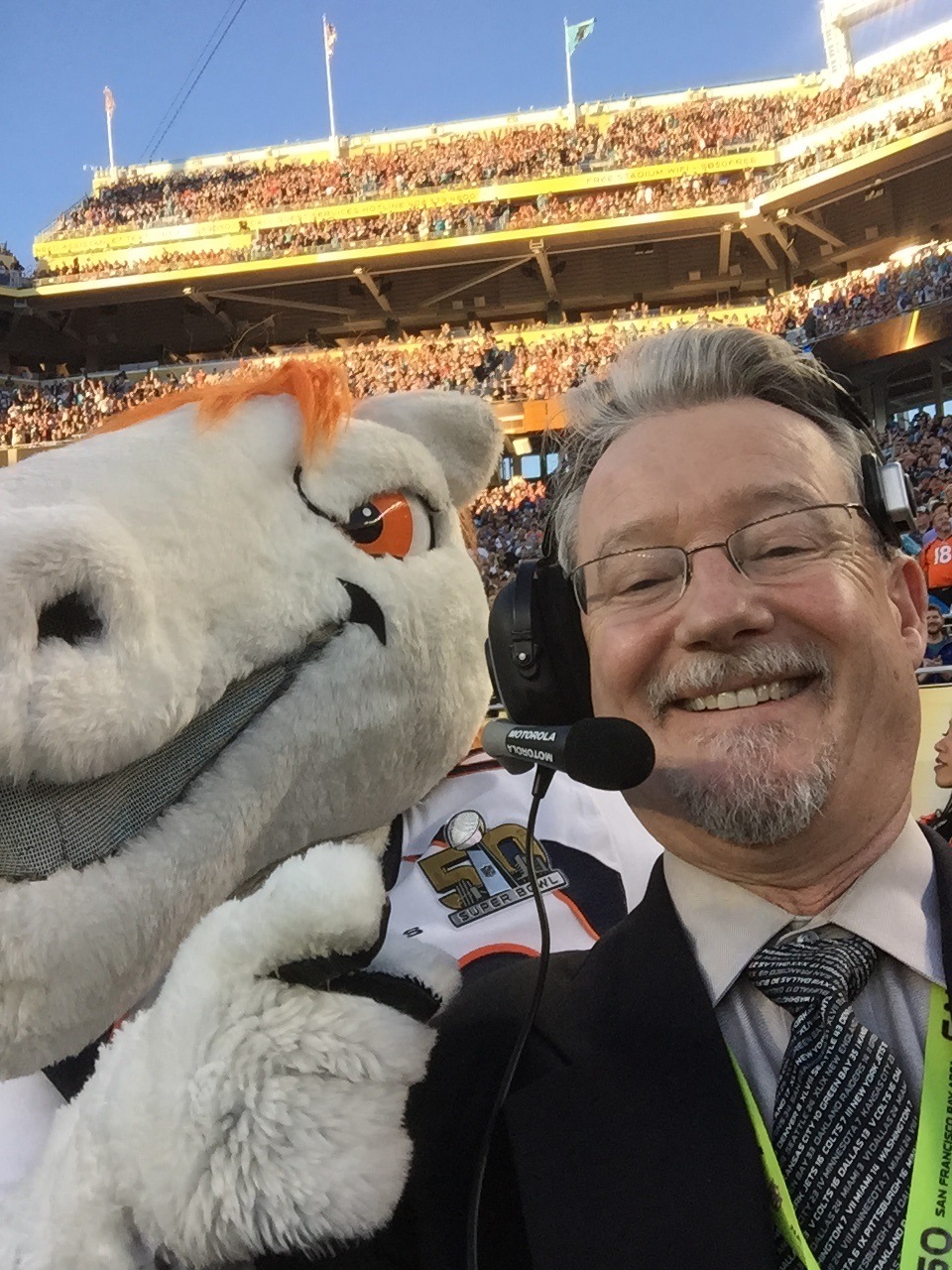
Dr. Martinez with the Denver Broncos’ mascot at Super Bowl 50.
This is a sporting event like no other. The Super Bowl is a National Special Security Event and a national icon for the United States. That also makes it a terrorist target. A multidisciplinary group of experts in events production and management, sports architecture, security, public safety, emergency medical services (EMS), transportation, medical, information technology, marketing, social media, public health, and construction, to name a few, work on the multiple and complex issues required to produce the game for more than a year. This planning occurs in conjunction with more than 30 federal agencies, multiple local jurisdictions, and state and local agencies. Collaboration and coordination are everything.
The game itself was just one part of a larger set of Super Bowl 50–related events. Super Bowl City fan fest, the long “50th Mile” interactive display, the multiday NFL Experience with active fan participation in games and drills, large media and sponsor events, team practices and movements, nightly festivals, and local festivities all impacted the region for more than a week. For Super Bowl 50, the geographic footprint in California was expansive, from north of San Francisco to San Jose in the south, with the stadium in Santa Clara. Travel time alone was more than an hour on a good day. To stay coordinated, daily video meetings occurred between key sites, communications centers gathered and shared information among key contacts (and set up issue-resolution calls on the fly), and evening debriefings transpired.
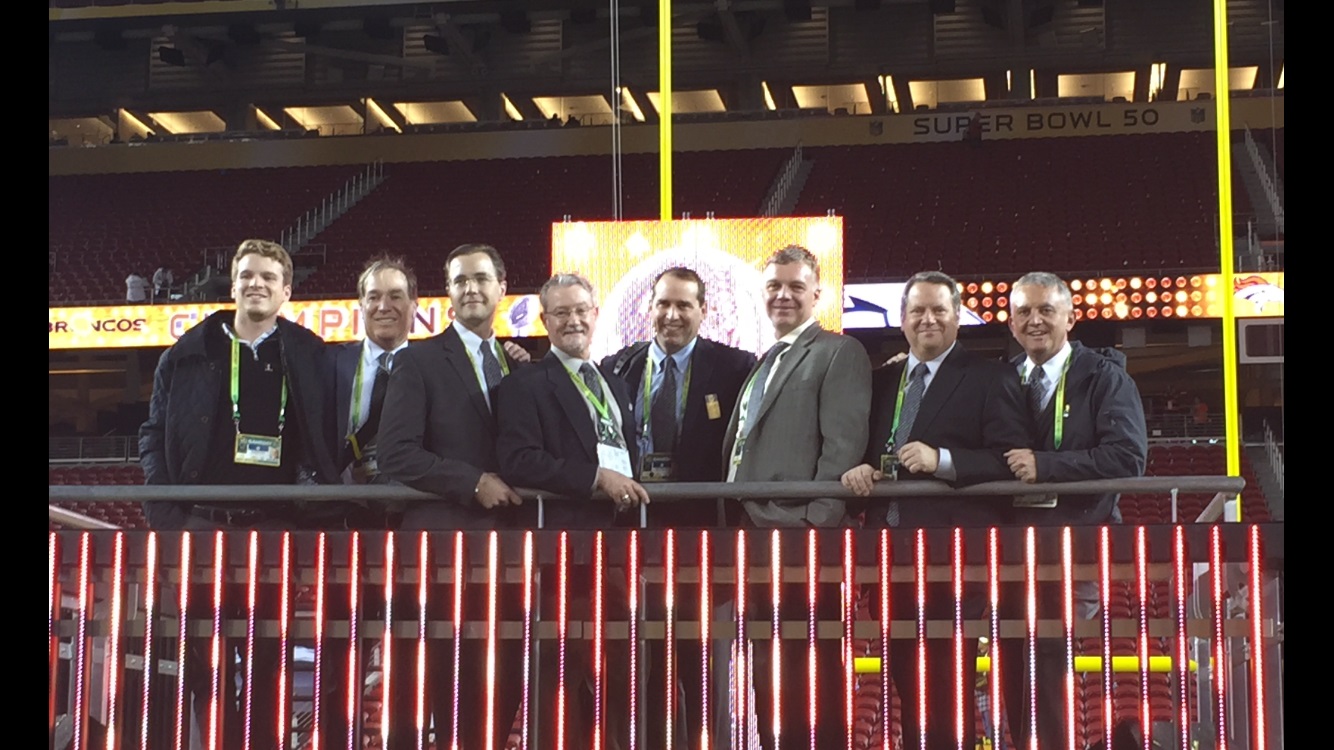
The SuperBowl 50 medical team. From left to right: Brad Ellis, Dr. Jim Ellis, Dr. Matt Bitner, Dr. Ricardo Martinez, Dr. Eric Ossmann, Mr. Ed Klima, Mr. John Ritter, and Dr. Alex Isakov.
Emergency medicine experts play a large role in working across the spectrum of issues to be addressed and building effective partnerships. I’ve been the senior medical advisor for the Super Bowl since 1988. Our current medical team includes five emergency physicians, each of whom have deep expertise and are nationally known: Jim Ellis, MD, FACEP, Alex Isakov, MD, MPH, Eric Ossmann, MD, Matt Bitner, MD, and myself. Our two other colleagues, John Ritter, NREMT-P, an EMT, and Ed Klima, a firefighter and emergency manager, also have deep expertise in the public safety, emergency management, and EMS environments. At a high level, our scope of activities include coordination of overall health and safety, with particular focus on:
Disaster Preparedness and Planning
As noted, with multiple jurisdictions impacted, it is imperative to facilitate a joint and integrated approach to multiple contingencies. This year, while security became heightened in the wake of the Paris and San Bernardino terrorist actions, planning had to also include environmental issues such as El Niño and earthquakes, technological/infrastructure issues such as power failure or structural collapse, and biologic issues such as outbreaks or food contamination. Our team facilitates communications, problem-solving, development of all hazard-response plans, staging and predeployment of required assets, and training across various stakeholders. A joint command post operates 24-7 for more than a week.
Team Care
For regular season games, teams normally come in the day before a game and leave after. For the Super Bowl, the teams arrive a week before the game. We set up systems of care for teams, including at their hotels, at practice facilities, and on game day. We meet with the team medical staff and trainers upon arrival to review these plans with them. In addition to key contact information, each team is given multiple GPS units with preloaded destinations to facilitate travel to offices, clinics, hospitals, and imaging centers. Each stadium has an Emergency Action Plan (EAP) that is shared with team medical staff and reviewed again with both teams on the field on game day. Team medical staff have a separate radio channel to communicate among themselves, with the ability to switch to the NFL medical channel if needed. On the field, there are medical teams on each side that consist of multiple specialties and EMS as well as X-ray and oxygen techs. Separate ambulances are dedicated to the field. Thom Mayer, MD, another well-respected emergency physician and the medical director for the NFL Players Association, meets with our group to review plans in detail and participates in on-field review of resources and the EAP meeting. Over the years, the planning and availability of resources for players have improved dramatically.
“NFL Family” Care
Putting on a weeklong event like this literally takes a cast of thousands. When adding associated broadcast, logistics and media partners, and executives and staff from various teams and NFL operational personnel who arrive during the run-up to the game, the overall group may be as large as 3,500. We term that the “NFL Family.” We work with local health systems to facilitate access and care as well as collaboration. Convenience care clinics are placed at the stadium and in the headquarters hotel, and additional contact numbers are added to health system call centers so that staff who become ill or injured can more easily navigate the local system. Of course, our emergency physicians are on call and responsive 24-7 for both the staff and the health systems. Over the years, we have had to deal with the same issues emergency physicians have to routinely handle (eg, strokes, infections, viral outbreaks, trauma, allergic reactions, and myocardial infarctions), albeit sometimes in a more challenging environment. Our team focuses on rapid communications both within our group and with the health systems to ensure critical handoffs and follow-through for patients. These same systems are available to the medical team physicians for managing the team executives, staff, and family.
Stadium Care
The focus on health and safety for the stadium area starts long before game day. The load-in and build-out of the stadium and surrounding area start as much as a month before the game and convert the area into an industrial zone. Multidisciplinary tabletop exercises are reviewed to identify issues and address potential gaps in response. During the week of the game, our group is on-site for halftime and pregame rehearsals and works with risk managers to identify and address any concerns, such as stage movement, staff routes, and angled ramps. For the game, additional medical/EMS staff resources and staff are added within the secured perimeter; temporary first-aid stations are added if needed, especially if security requirements impede normal response routes; and the level of care is raised to include on-site physicians in order to decrease the need for transports and spare ambulances. To improve response to a blast event, tourniquet training and supplies are integrated into the medical plans. Rest areas are added so that people who are dehydrated, fatigued, or feeling ill can be cared for in a comfortable setting and return to the event if they improve. Over the years, great strides have been made to accommodate those needing self-care (eg, injections, stoma care), privacy for breastfeeding, and disability-related services. Communications and coordination are key, so radios, ring-down phones, and command centers are integrated to minimize notification and response time.
Events
Each large-scale event, like Game Day or the NFL Experience, has a health and safety plan crafted among security, medical, public safety, operations, and others. We have found this to be key as different disciplines often have different perspectives. For example, while security focuses on restricted access, medical looks for unfettered access for rapid response. By working together and building a solid plan to train all staff, one can maximize the effectiveness of both individuals and systems. Each frontline staff member should be able to recognize a security, operations, or medical problem and then know who to call, what to report, and what to do until help arrives. On-site command posts facilitate this mindset and approach. From the health and safety perspective, injuries and illnesses are reported and monitored, problem-solving is performed within the multidisciplinary group, and changes are made to the events on the fly. For smaller events, site surveys, review of existing plans for any gaps and recommendations, and facilitated planning occur.
On top of all of this, several all-day planning sessions take place in the host city during the year, starting just weeks after the last whistle blows and we march forward anew, building upon the lessons learned and sharing this knowledge with a new city and colleagues. These planning meetings ramp up as the game approaches. Daily Super Bowl leadership team meetings start about three weeks prior to the game, and our group moves into the host city about two weeks out. All of this planning and preparation undergirds the ability to manage the complexity of the Super Bowl and problem-solve as issues arise or situations change.
Emergency medicine expertise plays a strong role that crosses numerous significant aspects of planning and producing a successful event. In my experience, it is the local emergency physicians who have always been reliable go-to people and the ones with the broadest connections. Both of these are reflective of the important roles that emergency physicians often play in their communities and of the key skills that make emergency medicine a unique specialty that enables Super Bowl planning to become reality.
Dr. Martinez is assistant professor of emergency medicine at Emory School of Medicine in Atlanta.
Pages: 1 2 3 | Multi-Page

One Response to “ACEP Members Provide Emergency Care at the Super Bowl”
May 30, 2016
James M LarsonThere were 3 other ACEP members actually doing the work of caring for the patients and staffing multiple clinics. I know because I was one of them.
James M Larson, MD FACEP